Common sense and peasant common sense: a common wisdom?
Can common sense be taught? Among the variations of meaning, literature declines the literal sense, the figurative sense, the manifest sense or the common sense...
Publish at November 17 2025 Updated November 17 2025


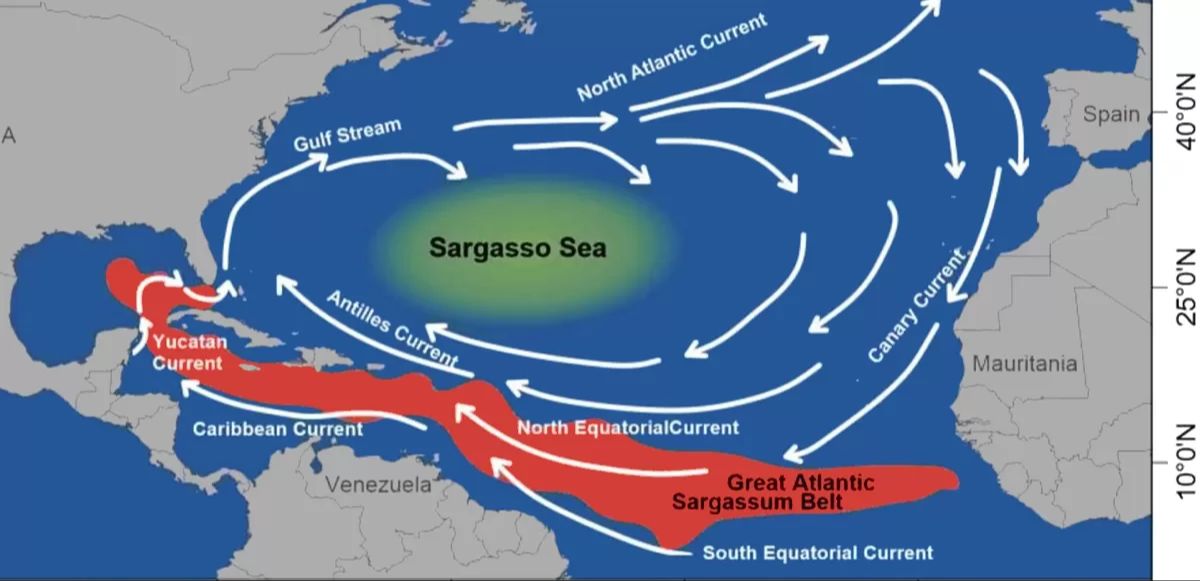
All stories of Caribbean pirates and round-the-world sailing refer to the Sargasso Sea and the Doldrums, a windless, currentless zone that had all the characteristics of a nightmarish ocean swamp where men and ships rotted inexorably.
In this zone, the Sargassum algae that gave this sea its name proliferate; these algae have the particularity of sometimes forming floating rafts as they accumulate on the surface. This zone normally extends over a width of around 1,100 km, and a length of 3,200 km, at the height of the Caribbean, running east from Florida to the middle of the Atlantic, between 20 and 35 degrees latitude.
Today, however, this landlocked sea is spreading into two new zones further south, forming a long ribbon 8,000 km long and 400 km wide, linking Africa to America, observable both on the surface and by satellite, and causing a cascade of undesirable effects that is growing in magnitude.
Whereas in the past, Sargassum was essentially confined to the Atlantic gyre formed by currents, today its offshoots wash up in shoals on the coasts of islands and continents, suffocating local ecosystems, seagrass beds, corals, sponges and any life that can't escape the invasion.
As a plague never comes alone, these accumulated algae decompose rapidly in the warm climate, emitting hydrogen sulfide (H2S), a toxic, foul-smelling gas that keeps wildlife and tourists alike away.
The economic impact is sudden and long-lasting, affecting both fisheries and tourism as well as the area's reputation, in addition to the cost of cleaning up thousands of tons of putrid algae that also emit methane.
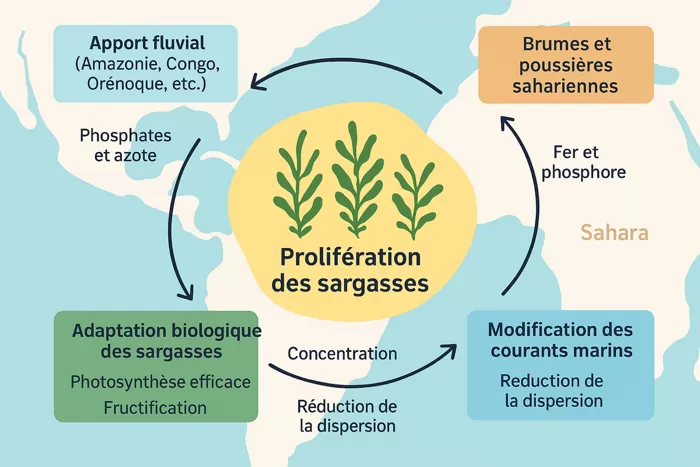
Various factors contributing to the phenomenon have been identified, and the interrelationships between them are complex, but it is known that they feed into each other in various feedback loops.
| Factors favoring the proliferation of Sargassum in the Atlantic | ||||
| Factor | Source / Mechanism | Effects | Consequences | |
| River inputs (Amazonia, Congo, Orinoco, etc.) | Massive discharge of freshwater and nutrients from major rivers in South America and Africa | - Phosphates (PO₄³-) - Nitrogen (NO₃-, NH₄⁺) | - Accelerates the growth of sargassum (eutrophication) - Extends their range northwards | |
| Saharan fog and dust | Atmospheric transport of mineral particles by easterly winds to the tropical Atlantic | - Iron (Fe) - Phosphates | - Iron activates photosynthesis and nitrogen fixation in algae - Enhances the effect of river nutrients | |
| Modification of ocean currents (oscillations, global warming) | Changes in the North Atlantic Gyre and the intensity of equatorial currents | - Redistribution of nutrient-rich water masses - Reduced dispersion of Sargassum | - Concentrates Sargassum in the "Sargasso Belt - Extends their survival time and growth zone | |
| Biological adaptation of Sargassum (Sargassum natans, S. fluitans) | Ability to float, reproduce by fragmentation, efficient photosynthesis, tolerance to variations in salinity and temperature | - Efficient use of iron and phosphorus - Rapid photosynthesis even in warm waters | - Exponential growth under enriched conditions - Rapid colonization of large areas | |
Researchers have observed that the nitrogen content of Sargassum tissue has risen by 55% in 20 years, and that ocean currents are partly drifting further south. They have also observed that the algae proliferate more rapidly and massively near the mouths of large rivers. These are not suppositions, but well-observed facts.
The impoverishment of riparian ecosystems diminishes their resilience, which indirectly contributes to amplifying the phenomena of both global warming and Sargasso blooms.
The climate continues to change, and seaweed will continue to proliferate on a planetary scale. The only realistic approaches, apart from reducing our CO2 emissions, are to
References
Sargasso Sea - https://fr.wikipedia.org/wiki/Mer_des_Sargasses
Valérie Stiger, marine biologist: "The whole central Atlantic is streaked with sargassum" - Voiles et voiliers
https://voilesetvoiliers.ouest-france.fr/environnement-littoral/rechauffement-climatique/interview-valerie-stiger-biologiste-marine-tout-l-atlantique-central-est-zebre-de-sargasses-0315b9d0-6f04-11ed-a3b1-6519d8a0f33b
The threat of the Sargasso Sea- Science-Presse - https://www.sciencepresse.qc.ca/actualite/2023/03/20/menace-mer-sargasses
Productivity, growth, and biogeochemistry of pelagic Sargassum in a changing world - Brian E. Lapointe, Deanna F. Webber, Rachel A. Brewton - Elsevier
https://doi.org/10.1016/j.hal.2025.102940
Illustration : https://commons.wikimedia.org/w/index.php?title=File:Great_Atlantic_Sargassum_Belt_2.jpg&oldid=836260501
Arctic Ocean: 3 million km2 of algae production added - Université Laval
https://cursus.edu/fr/30312/ocean-arctique-3-millions-de-km2-de-production-dalgues-sajoutent
Microalgae, between ecological and industrial challenge - Élodie Lestonat
https://cursus.edu/fr/10649/les-microalgues-entre-enjeu-ecologique-et-defi-industriel
You might also like:
Common sense and peasant common sense: a common wisdom?
Can common sense be taught? Among the variations of meaning, literature declines the literal sense, the figurative sense, the manifest sense or the common sense...
Speech or discussion with the public: two different postures
Realizing that the viewer or student can also refuse the proposed dialogue is not a failure, it is just a recalibration to be done.
Would you be willing to pay more to get rid of your guilt? Guilt is the well-founded or unfounded feeling of having committed a fault or a mistake. It affects all of humanity. Let's find out if guilt and marketing go hand in hand in Bénédicte de Peyrelongue's thesis entitled "The role of felt guilt in the willingness to pay: application to children's purchases and the purchase of organic food products".
The article analyzes new ways of forming groups around meals, and shows new possibilities for integration and inclusion around the table. The training meal is no longer a test of culinary conformity; it's a laboratory of civility where different standards can be learned to cohabit.
Will they send their children to this school?
Today, the proportion of new students remains relatively stable but the needs are diversifying. Politically, the movement is towards inclusion. National education is happening at the local level, where schools are located. Educational needs and practices are changing so rapidly that school organization and design are on the agenda.