We often think of ourselves as creatures capable of adapting to
anything. Indeed, we've managed to establish ourselves in environments
that defy common sense, whether in mountain ranges, near impenetrable
jungles or in deserts. As a result, we believe we can handle anything,
including, for some, living in the dark. Studies tend to show, however,
that this is far from the case, and that our minds are not designed to
be awake past midnight.
The danger of breaking your circadian cycle
We
all live by the rhythm of the circadian cycle, the 24 hours when our
organs act differently depending on the time of day. Virtually all
living beings have these cycles, and some body tissues even have their
own. This regulates everything from hormone production and temperature
to sleep and digestion. This cycle is often better known to people as
the biological clock. From the very beginnings of humanity, its cycle
has been based on the sun, since it was much safer to hunt and gather in
daylight than in the dark.
A normal circadian cycle might see a
rise in energy in the morning, with a drop felt in the afternoon, a
small surge until melatonin rises leading to sleep, and a floor reached
in the middle of the night until early morning. This can change
according to internal events, but also external ones such as the blue
light from digital devices, which inhibits melatonin production. As we
all know, this "ideal cycle" is rarely respected, and many people find
themselves wide-eyed and wide-awake in the middle of the night.
The effects of nightlife
Scientists
have begun to study the effects on the brain in the middle of the
night, and it seems that the brain is partly transformed during this
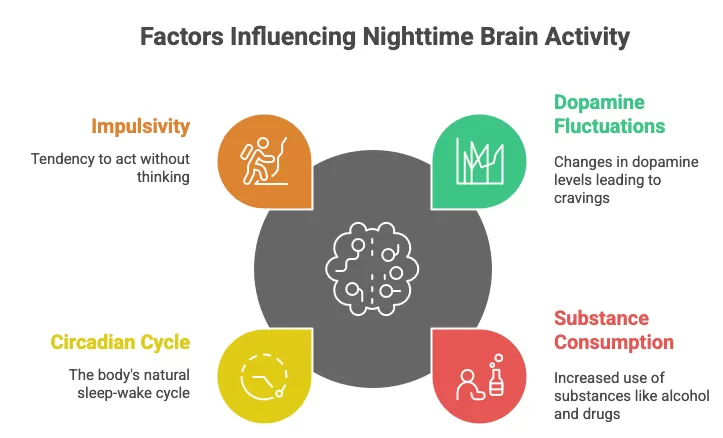
period. For example, researchers have noted that dopamine transmitters
fluctuate during the night. As a result, waking minds seek their
dopamine source (usually addictions) more often in the middle of the
night. Whether it's nocturnal cravings or alcohol and drug use, the
night is said to lead to an increase in substance use. A study carried
out over 24-hour periods in a supervised injection clinic in Barcelona
showed that it was at night that certain individuals, including homeless
people and women, would consume the most. There was a very slight dose
of non-fatal overdosing at night compared with during the day.
For
Harvard neurology professor Elizabeth Klerman, it's all based on the
post-midnight theory of mind. According to current data acquired by her
and other researchers, as the circadian cycle is designed for sleep from
11 o'clock in the evening, the brain would then begin to become more
impulsive and thoughtless at night than during the day. This would
explain a significant increase in suicides and violent acts at night.
There
are still unknown elements of the mind after midnight. Much research
needs to be done to better understand how the brain functions during
this period. Nevertheless, initial results seem to point to the fact
that we are not the night owls we may think we are.
Illustration - Night Life - 1771319117
References
The Human Mind Isn't Meant to Be Awake Past Midnight, Scientists Warn, https://www.sciencealert.com/the-human-mind-isnt-meant-to-be-awake-past-midnight-scientists-warn
Dopamine transporter function fluctuates across sleep/wake state: potential impact for addiction, https://www.nature.com/articles/s41386-020-00879-2
Learn to sleep well, https://cursus.edu/fr/26876/apprendre-a-bien-dormir
Circadian Rhythms, https://www.nigms.nih.gov/education/fact-sheets/Pages/circadian-rhythms
Impact
of 24-hour schedule of a drug consumption room on service use and
number of non-fatal overdoses. A quasiexperimental study in Barcelona, https://www.sciencedirect.com/science/article/abs/pii/S0955395920301134
The Mind After Midnight: Nocturnal Wakefulness, Behavioral Dysregulation, and Psychopathology, https://www.frontiersin.org/journals/network-physiology/articles/10.3389/fnetp.2021.830338/full
Biorhythms in training, https://cursus.edu/fr/21416/les-biorythmes-en-formation
Staying Up Past Midnight Might Make Us More Impulsive and Cynical, https://www.discovermagazine.com/staying-up-past-midnight-might-make-us-more-impulsive-and-cynical-48160
Think
your midnight hustle is harmless? Harvard scientists warn the brain
isn't wired for late nights, and the risks may surprise you, https://economictimes.indiatimes.com/magazines/panache/think-your-midnight-hustle-is-harmless-harvard-scientists-warn-the-brain-isnt-wired-for-late-nights-and-the-risks-may-surprise-you/articleshow/124690016.cms