
Top 2022 - Thot Cursus' most popular publications
1.4 million visitors came to the Thot Cursus site in 2022. Among the several million pages they viewed, some articles stand out. Which ones did you notice?
Publish at January 07 2026 Updated January 07 2026


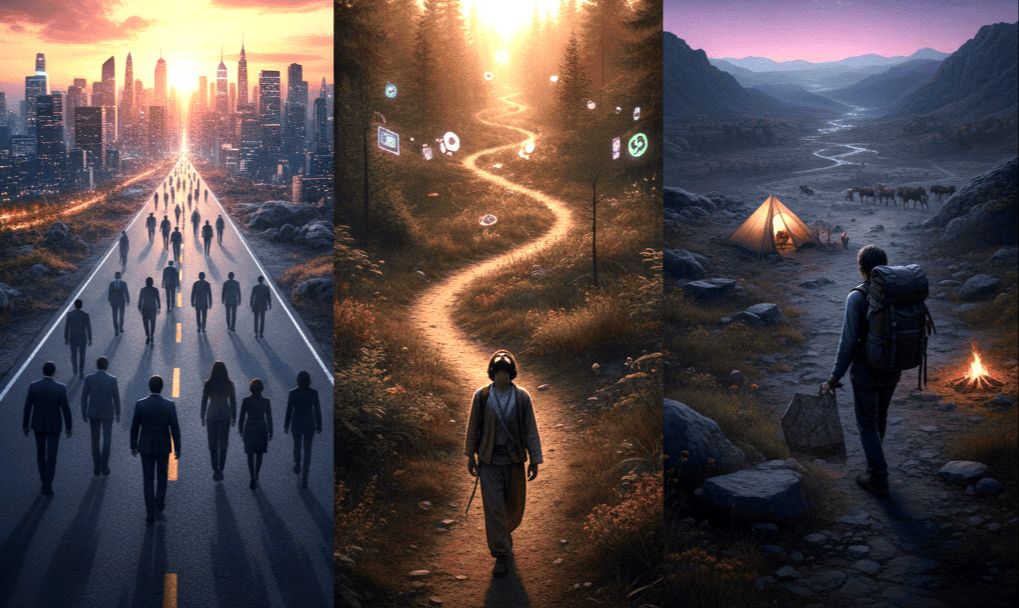
It's often said (Seneca being the first) that you have to set a goal in order to move forward. Yet, without a personal goal, we can follow the path of our parents, we can follow the flow of fashion or networks; we can also adopt nomadic practices that combine respect for the environment with personal choice. What's important, after all, is movement, you might say! It's just that personal commitment to the path, to wandering or to nomadism doesn't start from the same place and doesn't provide the same satisfaction.
Following a well-trodden path is very reassuring. It often allows us to consolidate our skills or showcase our talents. The paths mapped out for us by others can be the result of atavism, constraint or unexpected opportunity.
Indeed, growing up in a family of scientists prepares you to become one one day. Few professional musicians did not grow up in a musical family environment.
"In 2019, more than 80% of children born into a family of executives hold the same type of job as their parents when they leave school. This enduring social reproduction involves both socio-professional category and income." (1)
We can deplore the inequality this represents, but also a form of non-choice for children inclined towards a career, sometimes without realizing it. It has to be said that resisting daily social and family pressure, however gentle and benevolent, is a delicate challenge.
Once launched on a career path, changing one's path at the turn of a bend or an incident can be an ordeal that many give up on, keeping at the heart of their desires wishes that will never materialize.
Sometimes we choose our path out of obligation. If the road I had planned to take is cut off, or if traffic jams prevent access, I will naturally choose another. Reaching a saturated job market in the career I'd chosen forces me to change direction. The environment then chooses for us, leaving us unsteady in the face of unforeseen options. It's towards "the least bad choice" that we then head, out of spite or force. Young people are often faced with choices they didn't initially foresee.
The closure of a site often leads to tragedy when it becomes necessary to accept a change of profession or location. An accident or illness can change people's lives through no fault of their own. These upheavals can have happy consequences, as is sometimes the case following a life incident.
"The conductor Seiji Ozawa was destined [...] for a career as a pianist, but at the age of 16 he suffered a rugby accident in which he broke both his index fingers. Seiji Ozawa went on to study music and orchestral composition, and went on to conduct some of the world's greatest orchestras.
Leon Fleisher had a career as a virtuoso pianist all mapped out for him, but when he suffered from focal dystonia in 1964-65 at the age of 36, he "thought of giving up everything. The piano and life". But Leon Fleisher was first and foremost a musician, and he devoted himself to teaching and conducting. Over the years, he has built up a solid reputation as a pedagogue and conductor." (2)
Following one's path, even if it's constrained, is not inherently bad. It's probably the awareness of being on it, and of feeling as good as possible on it, that makes it possible to flourish. Unconsciousness of being on a path is more akin to wandering than to walking.
Wanderers let themselves be carried along by movement and flux. They lead an unordered, aimless life, never settling on a project or an idea.
"They both belonged to the adventurous race of life's vagabonds, those worldly vagabonds who closely resemble (...) the bohemians of the highways (Maupass., Bel-Ami, 1885, p. 298)".
Indeed, vagrancy is not exclusive to the homeless. You can choose to be a vagabond tourist, letting yourself be carried along by the ebb and flow of a city or country, without setting yourself a goal or a precise place to visit. Following a trend, scrolling through social networks or even getting lost on the Internet at the mercy of a link or image that sends you to other sites, bouncing from one theme to another without really choosing, also borders on wandering. Wandering experiences, whether physical or mental, often feel like a waste of time and energy.
Nomads move with the flow. One of the concerns of people on the move is the environment. Even today, transhumance is an example of this opportunistic nomadism, which seeks its resources wherever they are. Like migrants seeking a more favorable climate, it's an interesting posture to seek out that which fosters our fulfillment and enables us to recharge our batteries; we sometimes persist in struggling in situations in which we feel out of place, in which we exhaust ourselves, in which we lose ourselves. Finding ourselves also means finding the path where everything will be easier, and where obstacles will be less frequent and simpler to overcome.
"Nomads move because it's vital to them: to stand still is to die. To moor, like a ship in port, is to rust. To anchor is to dissolve; to tie down is to disappear. Whether they're Roma, Bedouins, Tuaregs or globetrotters, nomads find life in movement. They stabilize in imbalance, build in change. In this case, change becomes a kind of stability. Movement is reassuring, and it's the pause that's frightening. Man does not change within himself. He finds his alignment in novelty and non-attachment." (3)
Heinz Weinmann, professor of literature at Cégep de Rosemont in Quebec, shares his etymological reflections on nomadism and sedentarism. He sheds light on the difference in space-time between nomads and sedentary people.
"At first glance, "nomadic" covers an activity, migration, aimless wandering; "sedentary", a state, that of being definitively settled in a place. In fact, the etymology of the Greek word "nomos" shows that this opposition is only secondary, derivative.
First and foremost, "nomos" implies the idea of distribution, not distribution in the sense of sharing out something given and then dividing it up, but "distribution of those who distribute themselves in an open, unlimited space, at least without precise limits", a distribution that escapes all "territorialization", all spatial limitation and definition. Generally speaking, the nomad refuses to accept any spatialization of the Being: the spatialization of time, of the Divinities, etc. Kant has shown that space is, in short, nothing but fixed time. However, to escape this spatial fixation, nomads live according to ever-changing, unpredictable rhythms and flows, temporalizing their existence.
Space thus becomes the nomad's time. Space is, of course, physical space, but it can also be understood as intellectual, mental or spiritual space.
Kenneth White, the inventor of geopoetics and author of The Nomadic Spirit, in reaction to a sclerotic, infantilizing world, proposes a global nomadic spirit to regain control of our destinies.
"The nomad in each of us, like a nostalgia, like a potentiality, has no notion of personal identity. [...] Saying neither 'I think' nor 'I am', he sets himself in motion and on the way, he does better than 'think', [...] he enunciates, he articulates a space-time with multiple focal points that is like an outline of a world." (4)
It is crucial for Kenneth White to see in nomadism a respect for the land and the environment.
"In nomadism, there is a relationship to the land that is neither exploitative ("natural resources") nor sacral [...]. The relationship is one of journey, of itinerary. We don't plant, we don't pray, we take our bearings: such and such a rock, such and such a ridge, such and such a tree...". (Déambulations dans l'espace nomade, 20-21)
To nomadize is to embrace all that surrounds us as a whole, in which we can choose what is favorable to us before what is imposed on us. It also means building bridges between our artistic, professional, sporting and personal lives. Compartmentalization is the first reflex of a sedentary lifestyle.
All this while respecting the ecology of what surrounds us: using without possessing, enriching without damaging, living without taking the place of the living.
References :
1 Young people: social mobility in decline since the 2000s Vie publique - République Française- October 13, 2023-
2 Destinées de conducteurs, how to become a conductor after an accident - Médecine des Arts -
3 Autocoaching efficace- Yann Coirault- Ed. de l'Homme- 2011
4 L'esprit nomade- Kenneth White- Ed.Grasset- 1987- p11-12 h
You might also like:
Top 2022 - Thot Cursus' most popular publications
1.4 million visitors came to the Thot Cursus site in 2022. Among the several million pages they viewed, some articles stand out. Which ones did you notice?
