In a context of constant demands on attention, the question becomes less "what to pass on" than "how to make learning possible".
Publish at March 25 2026 Updated March 25 2026


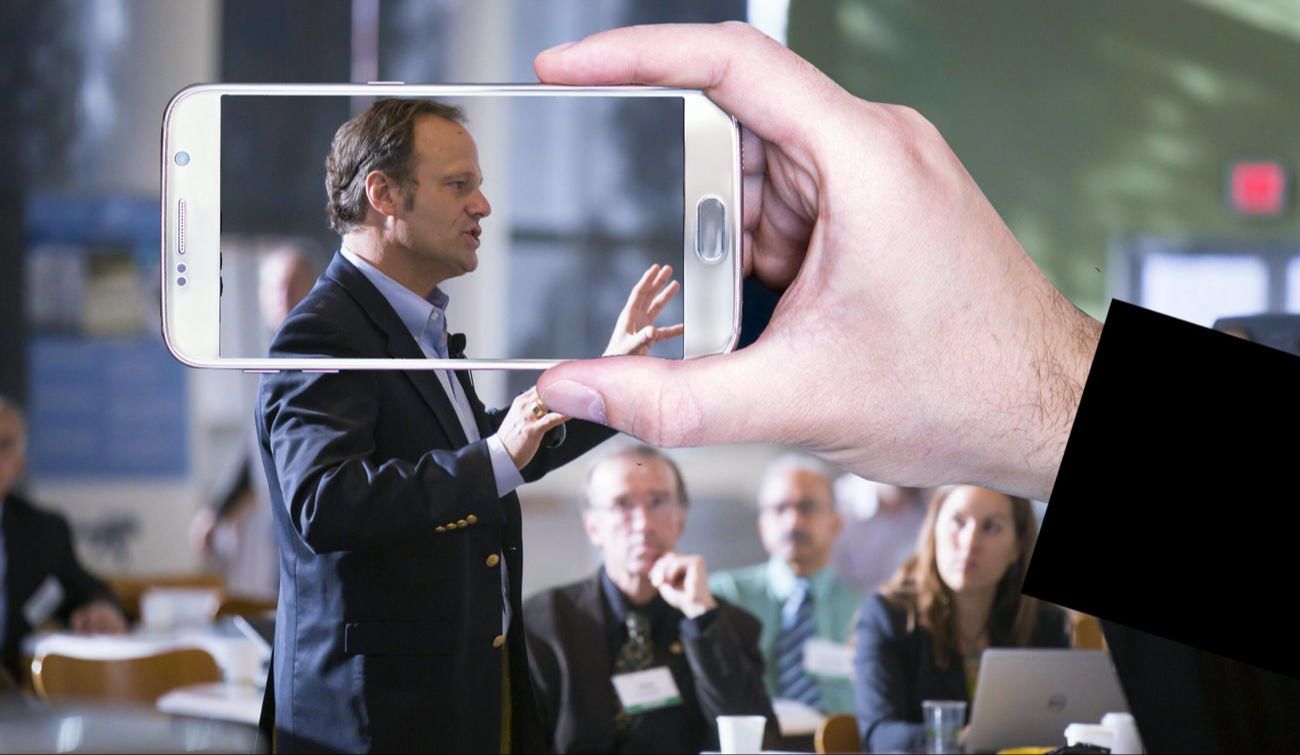
What is presence in an individual? How do we recognize it in ourselves and in others? What difference does it make to speakers, trainers and artists? How do we develop it?
At a time when our society favors media visibility and communication games, the question of individual "difference" is often reduced to a quest for impact or performance. In the world of education and training, however, this injunction to shine comes up against a more subtle reality: that of encounters. We hear talk of influence, natural authority or charisma, but these terms often mask what's essential: the quality of presence.
For if visibility is acquired, presence is experienced. It is not simply a self-image, but a physical and mental commitment that conditions our relationship with others. There can be no presence without interaction. "Bodily presence exists only through the gaze of the other, and more globally through, for and with the other. An ambition to make oneself visible and intelligible to the other". (Marsault and Lefebvre)
Human beings are programmed to constantly evaluate reality. In the beginning, this ability enabled us to guarantee our survival by distinguishing between what was dangerous and what was not. We still use it today for the same reasons, but our judgement is influenced by multiple factors that can distort our conclusion.
"A tenth of a second is all it takes for us to form a firm and definitive judgement about someone. This attitude is the result of our "animal survival instinct", which requires us to identify potential dangers as quickly as possible". Claude Terrier.
Studies on the question of first impressions show that we instinctively classify strangers into two categories: friendly (I can trust him) or competent (I can respect him). We (our society) are used to considering reliability (competence) as the most important quality. The education we receive, the studies we decide to pursue, aim to develop it. We also tend to choose decision-makers, elect politicians, primarily on the basis of this quality.
The majority of employers also formally recruit on the basis of this quality. And yet, in our day-to-day relationships, our trust is more spontaneously placed in those we consider likeable. These are the people to whom we will give our friendship. They're the ones we'll look to for support when we're down. It is with these that we will make our lives. These are the people with whom we want to cooperate.
And yet, at no point in our learning process are we taught to develop this quality. We're taught to try and show ourselves as strong and competent first, and we want others to see us that way, when what we really want is human warmth. What a paradox, isn't it?
How can we appear both friendly and competent, receive trust but also be identified as reliable? Many psycho-sociologists will tell you that the solution is presence. It's a matter of matching your body language - your non-verbal language - your thoughts and words, being clear about your intentions and managing your emotions. What others would call "centering" or "anchoring". Be yourself and have self-confidence. Don't try to build a self-image, but aim for authenticity and simplicity. To achieve this, you need at least two things: to live in friendship with your body and to develop your emotional intelligence.
It's not so simple, however, because we need to know exactly what we're talking about when we speak of presence. Is it primarily a question of being present to oneself and to what exists around us, or of acting on our environment by the very fact of being there?
What does it really mean to be "there"? If physical presence is an anatomical given, the state of being present is a conquest. It's no longer a question of figuring in space, but of inhabiting the moment. For practitioners of mindfulness or active listening, this shift is obvious. It marks the transition from a peripheral existence to full attention. But for ordinary people, this boundary often remains blurred. So how do we identify that state of grace when self and world finally resonate?
This ambiguity - between the internal state (being present) and the external radiance (having presence) - finds its privileged playground in the performing arts. In the theater, presence is a raw material that directors sculpt, track down or sometimes fear. For some, it's the Holy Grail of authenticity; for others, it's a magnetic artifice to be wary of. This aesthetic debate reveals an essential truth: presence is not a monolithic block, but a constant tension between what the actor feels and what the audience perceives.
"Presence is the soul. It's the divine in an individual" (Gilles Maheu)
"Presence is a connection to one's environment. It's felt through a kind of tension that's hard to describe. An energy, an awareness of the center, an awareness of the living body and the spiritual body, a mental awareness" (Nona Ciobanu).
"Presence is a depth of concentration, a communion with the audience, a desire to be there and a gift of self. (René Richard Cyr)
"Presence is initial impact, then support. It implies a link with breathing and the will to communicate". (Dario Fo)
"Presence is an imposing personality that depends on the ability to give more than the physical: what you carry within you" (Franca Rame).
Presence is "a force of attraction in the eyes and a radiance of the person, a power that imposes the actor's breathing rhythm on the spectator" (Jacques Lassalle).
Presence is
"an acceptance of the present. (Labourdette)
"... playing with danger". (Richard Schechner).
"... opening the doors of possibility" (Labourdette).
"...a connection to the emotions (Peter Sellars).
Presence lies somewhere between self-awareness and connection to others. It is a creative tension between inner anchorage and openness to the world.
Presence is also a certain quality of being, which can involve animality and even sex appeal. It's a way of speaking, walking, occupying space and attracting attention. For Téo Spychalski, being present is effortless. For Poly Teale, presence necessarily has a sensual dimension.
If the theater is the laboratory of pure presence, the classroom is its daily field of application. For, like the actor, the trainer is only convincing if he or she is inhabited by his or her message.
Whatever the definition, the bodily dimension seems central. In other words, there can be no presence without an embodied body, with all that this implies: emotions, vocal expression, facial expressions and gestures (non-verbal), as well as movement in space.
Presence is "...a connection to the emotions (Peter Sellars). "The voice is perhaps one of the things that gives most presence to certain actors. (Georges Lavaudant)
"Since the work in phenomenology (Merleau-Ponty, 1960), which recognized the body as a premise for engagement with the world, bodily presence has had several facets: "being there", "being here and now", "being in front of" or "being close to" (Marsault and Lefebvre).
From this point of view, having presence in front of others by relying on one's body means :
Presence can also be interpreted as the manifestation of a certain vibratory frequency emanating from the body: "So, basically, we could see ourselves as a vibrating mass present in a vibrating universe, more or less harmonious or disharmonious (...) Our vibratory presence can have a great impact on the outside world, and we can resonate very strongly with the outside world, even in moments of silence". (Labourdette).
This vibration is translated into the biological reality of our micro-gestures, our breath and our muscle tone. It is this infra-linguistic presence that enables "body-to-body" communication, in which the speaker's intention is perceived by the audience in a quasi-organic way, via the reading of the non-verbal, the perception of sound and the breathing rhythm, long before it is intellectualized.
In training, bodily presence fulfils pedagogical functions, as a tool to be optimized for effectiveness. It is envisaged as a posture-mimo-gestural (Tellier, 2021), i.e. a set of gestures to be acquired or constructed, in short, to be embodied (Marsault and Lefebvre).
"Body staging is imposed (most often unconsciously) as a condition for effective teaching". This knowledge of "presenting oneself to others" from a bodily point of view makes one's intentions visible and intelligible to others. (Visioli, 2016)
"Presence is a coherence that is, let's say, mysterious, simply because it's difficult to explain with scientific criteria. It's a particular coherence between an actor's body, face, phonic system and imagination. (Jean-Pierre Vincent)
To be identified, listened to, trusted or even admired, you need to be congruent, i.e. to convey the same message with your words, voice and body (gaze and gestures). When this isn't the case, studies show (notably Albert Mehrabian, 1967) that human beings first take into account the non-verbal message (55%), then what the voice expresses (38%), then what the words say (only 7%), with some nuances depending on each person's ability to better mobilize one or the other.
The way things are said is therefore more important than what is said. Knowing, moreover, that our emotions and thoughts strongly influence our observable bodily manifestations, including our vocal expression, the only way to be congruent, and therefore credible, would be to believe in what we say.
Presence is "... being congruent with what you do". (Robert Lepage)
"What is presence? It's what acts on the spectator (...) Credibility is the fundamental word. (Eugenio Barba)
The question then arises as to the link between the capacity for presence and personality. Is presence, as some think, an exceptional faculty, a gift, a talent, given to some but not to all?
"Does the notion of presence simply refer to a physical state, or does it involve considerations of the subject's mental state? It's all a question of the assertive (I'm here) and the qualitative (such and such a quality or modality of being here)". (Féral).
What is a personality made of? For some directors, it's a construct that actors should get rid of. For others, it's a particular form of energy, of being in the world, a particular form of expression, but one that can be modified (masked or affirmed) according to context, and evolve over time. For Buddhists, personality is merely a manifestation of a cumbersome ego, from which we need to be able to abstract ourselves.
Charisma is defined as a kind of magnetism, a very special aura that fascinates others. It's a way of making an impression on others, a capacity to inhabit space (bodily, verbal and vocal) and capture attention. How does this differ from "mere" presence? It's not entirely clear.
Some link it to the notion of personality or self-awareness: "Perhaps this notion only exists once the actor has found himself! (Claude Poissant). Charisma is a form of seduction, but for some, "seduction ends up killing presence" (Jean-Pierre Ronfart).
Once again, in live performance at least, there's a tension or paradox between being present and having presence, as one can be incompatible with the other.
"An embodied leader is recognized by his or her stable, open and aligned presence" (Presence and Leadership Institute). Leadership therefore depends on authenticity, and therefore on being present with oneself in order to be congruent. It's not certain that this definition would be validated in all spheres of business and management.
According to Wikipedia, "Leadership or primacy is the political, psychological, social, etc. influence of an individual on a group of individuals or of a group of individuals on another group. The leader has personal skills that enable him or her to be listened to and followed by a group of people". The notion comes from the English word "leader", meaning chief or leader.
Various theories attempt to define and explain leadership, based on the notion of power (Max Weber), identified behaviors (behavioral theories), particular qualities possessed by the individual (trait theory), fundamental hypotheses on which the leader bases his or her behavior (theory X and Y), the system in which the leader evolves (theory of the four systems), and so on.
For some, leadership is above all "intentional energy": to be seen, to be heard and to inspire confidence. Here we return to the characteristics of presence identified earlier in this article. Leaders also inspire, impact, influence and innovate. He has a vision, is emotionally intelligent, communicates persuasively, knows how to make decisions and helps others to develop. Being present to oneself is one of the keys identified as fundamental.
For Pierre Goirand, international coach in collective intelligence, the presence of a great leader is "quite simply that he gives off something when he enters a room", and he possesses two qualities: openness and the ability to include, on the one hand, and the strength of his presence, on the other, which comes from his stability (anchoring, calm) and alignment (congruence, concentration). Pierre Goirand also emphasizes that leadership requires being completely present in situations, in order to decide quickly in a context of complexity and constant change, by spotting sometimes subtle signals and taking into account all the parameters of the situation. E
inally, he insists on the essentially corporeal dimension of presence. There are three key aspects to a leader's personality, and these must be developed if you want to become one: 1) body posture, 2) a controlled relationship with space, and 3) the development of the qualities you wish to transmit.
We all know that the personality and communication skills of a teacher or trainer have a strong influence on motivation to learn, and perhaps even on the ability to learn. We can all remember teachers who fascinated us with a subject and made us want to learn more... or vice versa.
This influence has been studied under the name of "pedagogical presence", the characteristics of which are described below (Marsault and Lefebvre):
Fluid, controlled bodily presence is considered an indicator of a trainer/teacher's professional expertise. "This presence reveals an ability (to do, to say, to listen) or a skill acquired in communication, interaction or information gathering". (Boizumault and Visioli)
"Presence is not "seduction". Nor is it simply a matter of gesticulating to attract attention. It is an essential requirement in the very transmission of knowledge content. (Runtz)
For most directors, presence cannot be taught. It's an innate talent, a gift. It's a matter of the inexpressible and of personality. For pedagogues, on the other hand, presence can be learned; it's an ability like any other. It involves becoming aware of the levers of communication and putting feelings into words.
Developing presence is directly linked to the question of authenticity, and therefore to developing self-awareness above all else.
Presence cannot be taught as a grammar rule, but it can be cultivated as an ethical posture, that of an educator/speaker who accepts to make himself fully visible to enable others to awaken.
To sum up, the key words for presence are :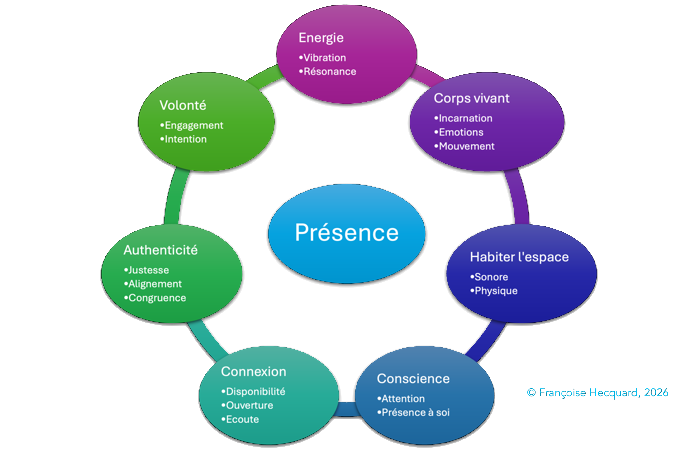
Resources
Brûler les planches, crever l'écran : la présence de l'acteur / sous la dir. de Gérard Denys Farcy et René Prédal. Ed. Entretemps, 2001. https://www.amazon.fr/Br%C3%BBler-planches-crever-l%C3%A9cran-pr%C3%A9sence/dp/2912877105
How to cultivate natural charisma, the secret of a magnetic presence. October 2025. On AdValvas.be:
https://www.advalvas.be/fr/blog/comment-cultiver-le-charisme-naturel-secret-presence-magnetique/
CUDDY, Amy. Show them who you are. Marabout, 2018. https://www.amazon.fr/Montrez-leur-qui-vous-%C3%AAtes-Cuddy/dp/2501128435
Féral, Josette. Présence et effets de présence, essai de définitions. On Uquam.ca
https://effetsdepresence.uqam.ca/upload/files/documentation/presence-effets-presence_josette-feral.pdf
Goirand, Pierre. What is the link between presence and leadership? YouTube video.
https://www.youtube.com/watch?v=ffeZAtKFSZ8
Hecquard, Françoise. Sympathetic or competent? On: Dynamiquesdechange.fr.
https://dynamiquesdechangement.fr/2017/01/01/sympathique-ou-competent/
Labourdette, Benoit. Philosophie de la présence - https://www.benoitlabourdette.com/les-ressources/propositions-philosophiques/philosophie-de-la-presence/
Lancart, Cyril. Charisme et leadership, développez votre présence par la parole. January 2026. On elevetavoix.com
https://www.elevetavoix.com/blog/charisme-leadership-communication
Marsault, Christelle, Lefebvre, Lisa. Body presence for teachers, trainers and coaches. 2022. On Open Edition Journals: https: //journals.openedition.org/rechercheseducations/13068
Pons, Clémentine. Charisma begins with presence. March 2026. On Linkedin: https: //www.linkedin.com/pulse/le-charisme-commence-par-la-pr%C3%A9sence-cl%C3%A9mentine-pons-jnsse
Presence and Leadership Institute. Living authentic, embodied leadership https://www.presenceleadership.net/leadership-incarne/
Runtz, C. - E. Enseignant et comédien, un même métier? ESF, 2000. https://www.amazon.fr/Enseignant-com%C3%A9dien-m%C3%A9tier-C-Runtz/dp/2710114461
Terrier, Claude. Non-verbal communication. On: https: //www.cterrier.com/
You might also like:
In a context of constant demands on attention, the question becomes less "what to pass on" than "how to make learning possible".
Nomadic technologies have a strong impact on our daily lives. The constant availability of tools and information creates dependencies, but can also be understood as an opportunity to enhance the use of ICT for learning purposes.
Trust, the currency of collaborative consumption
If there is one area in which the Internet has transformed practices, it is that of consumption. Alongside e-commerce is indeed growing an alternative mode of consumption, which uses peer-to-peer networks and is based on the capital of trust between sellers and buyers.
There is some doubt about the generalization of metaverses. Would Meta lose its bet on the metaverse?
A matrix of societal changes is leading our children to "Nature deficiency".
Rediscover common sense, balance and self-confidence. It's easy to blame video games, TV, the Internet, the car, when a matrix of societal forces is being erected, all working in the same direction: to frame and make profitable the slightest moment and space of life and attention.