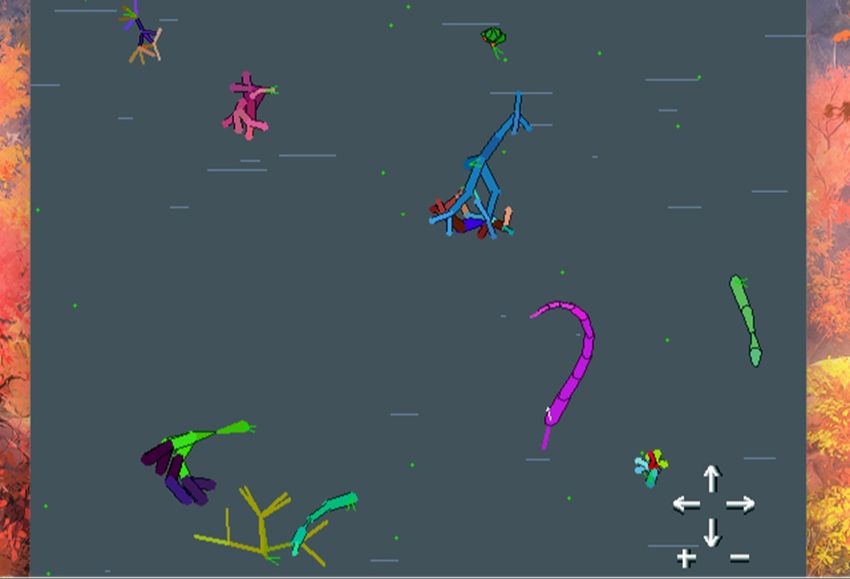
A virtual aquarium to understand Darwinian evolution
Is it possible to understand evolution through simulation? It would seem so. A very interesting resource for high school science classes.
Publish at March 30 2026 Updated April 02 2026


We live in a world divided by thousands of kilometers of borders. Have these lines, which are anything but neutral, always existed? Absolutely not. When it comes to our distant cousins in the animal kingdom, primates do indeed have an idea of territory. However, it all depends on the race: chimpanzees are more territorial than bonobos. Why are chimpanzees more territorial than bonobos? It all has to do with the abundance of resources. There's less need to protect territory when food, among other things, is abundant.
Many people see the appearance of the Roman limes as the first human frontiers in the strict sense. But they were not. Above all, they were sea or land passageways guarded by legions to repel enemy incursions. However, these lines were porous and served mainly for trade.
The Middle Ages won't exactly simplify things, since the limits of a domain or kingdom depend on who's there, alliances and so on. These moved around a lot, and it wasn't until the 30 Years' War - an incredible slaughter - that the concept of the nation-state was born in Europe, along with the first real borders.
Yet borders have appeared on every continent. Colonialism led to the creation of these "fictitious" territories decided upon by European colonizers, sometimes forcibly uniting peoples with nothing in common.
This explains why internal conflicts are still frequent in Africa and other parts of the world. It wasn't until the First World War, however, that the idea of passports requiring identification to enter territories and limit population movements emerged.
Today, we find ourselves in a world that has never been so marked out, yet places like the Shengen area show that it is possible to do things differently.
Running time: 24min10
Learn more about this resource
You might also like:
A virtual aquarium to understand Darwinian evolution
Is it possible to understand evolution through simulation? It would seem so. A very interesting resource for high school science classes.
Reflecting on agroecology through play
There's nothing simple about being a farmer. You have to plan your activities throughout the year, make sure you have the right machinery, maintain it and so on. All with a view to ecology. A serious French game seeks to teach agroecology.
Tests of vigilance and attention
Measuring attention remains a concern in many settings. Some work tasks are not very error tolerant. Here are a series of sample tests to measure attention in children and adults.
A fun game about heredity and genetics - Welcome to Thingdom
How do you talk to children about genetics and heredity? A British museum has come up with the method: design a game in which you create a line of adorable creatures with precise objectives. The game is fun, colorful and easy to learn. Even adults will succumb to the charms of the bugs and their large families.
"Space Shelter: Google's cybersecurity game
All our lives have an online component. As a result, a large proportion of Internet users are at risk of being tricked by hackers. A short game invites Internet users to remember certain elements of cybersecurity using a space theme.