Learning in the dark of winter
Winter deprives us of light and the desire to learn, so why not stay under the comforter?
Publish at April 21 2026 Updated April 21 2026


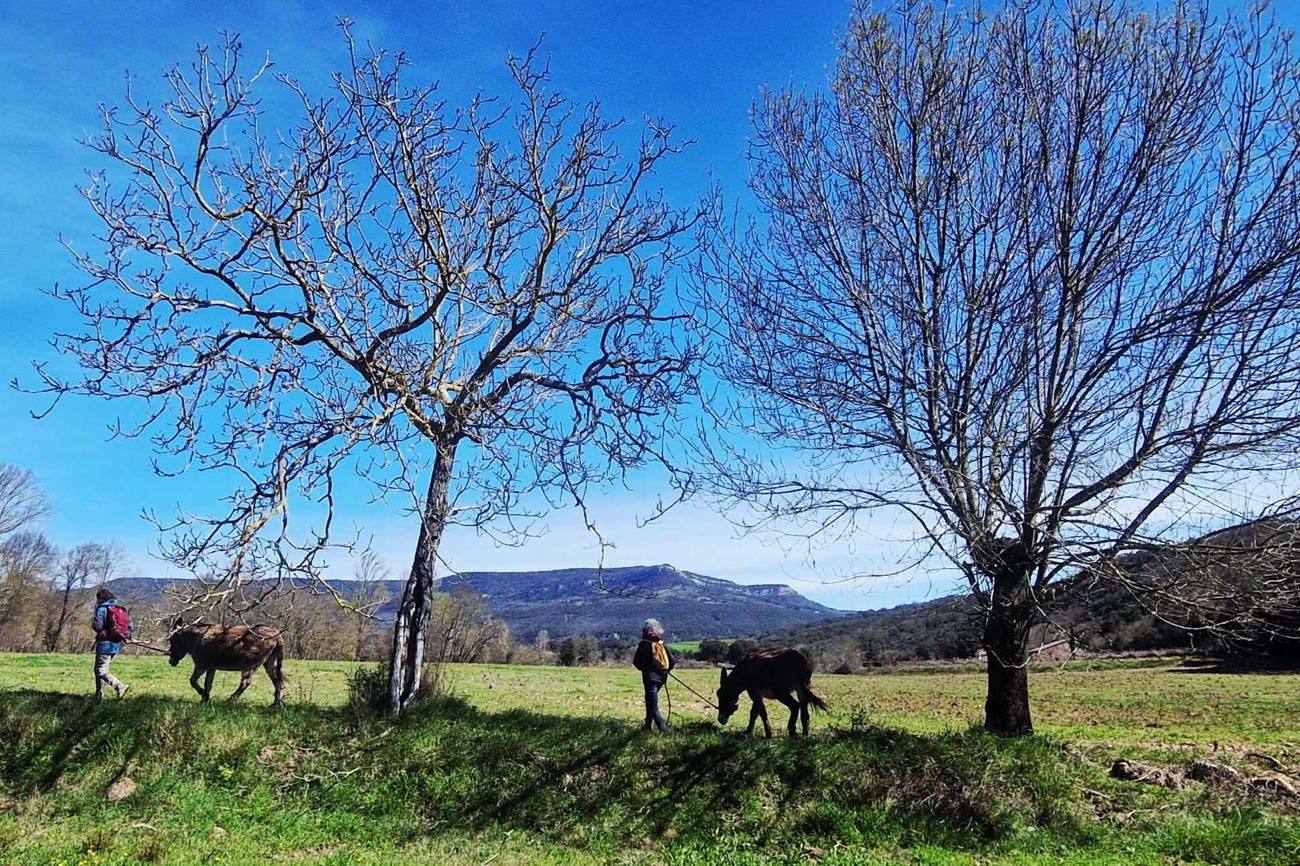
The Rêve de Dan'A educational innovation laboratory organizes learning expeditions with donkeys within the framework of continuing professional training, particularly on themes relating to the transformation of ways of learning. The surprise is to see an unexpected public joining the itineraries: mother-daughter couples.
Learning is often thought of as an individual process, embedded in formal systems and measured in terms of acquired skills. However, a growing body of research suggests that learning should be reconsidered as a relational, situated and embodied experience.
In this respect, the mother-daughter relationship is a particularly fruitful observatory. It reveals forms of learning in which intergenerational transmission, identity-building and the co-elaboration of lived experiences are interwoven. What's more, when it involves interaction with living things - plants, animals, natural environments or human otherness - it opens the door to a broader understanding of learning as a way of inhabiting the world.
Empirical research confirms the existence of a specific educational transmission between mothers and daughters. The mother's level of education has a significant influence on educational trajectories, but this relationship cannot be reduced to a mechanical effect of social reproduction (Khalid, 2023). It involves more diffuse dimensions: relationship to knowledge, self-confidence, language and effort.
Recent studies show that this transmission is part of a complex intergenerational process. Motherhood experiences, educational styles and representations of the feminine evolve from one generation to the next, combining continuities and transformations (Yüksel, 2025). In this dynamic, the daughter is not simply a receiver: she interprets, transforms and reconfigures what is transmitted to her.
The mother-daughter relationship thus appears as a space of embodied transmission. Learning takes place in everyday practices: cooking, caring, organizing, dialoguing. These ordinary situations are places where tacit, often invisible but crucial knowledge is acquired.
When these practices are linked to living things - gardening, walking, observing the seasons - they mobilize another dimension of learning. Research on the connection to nature in childhood shows that experiences shared with significant adults help to structure lasting forms of care and responsibility towards the environment (Chawla, 2020).
In the mother-daughter bond, these experiences take on a particular intensity: they articulate affective transmission and a relationship with the environment. Learning then becomes a way of attuning oneself to rhythms larger than oneself.
Contemporary research is calling into question the unidirectional model of transmission. The mother-daughter relationship is characterized by educational reciprocity, where the roles of teacher and learner circulate.
Recent research shows that mother-daughter interactions contribute to the co-construction of identity and lived experience (Chaudhary & Dutt, 2025). This dynamic is particularly evident in narrative exchanges, discussions of personal experiences and day-to-day relational adjustments.
The quality of this relationship has measurable effects. It influences self-esteem, social skills and the ability to regulate emotions (Casas Monteserín & Moral Jiménez, 2025). Learning takes place in the relationship itself: learning to talk, to listen, to situate oneself.
In contemporary contexts, this reciprocity is reinforced. Technological, social and cultural transformations are creating situations where daughters accompany their mothers in new apprenticeships. This partial role reversal does not call the relationship into question, but reconfigures it.
The living world can play a mediating role in these processes. Research into animal mediation shows that the presence of an animal promotes empathy, emotional regulation and cooperation. In a mother-daughter relationship, the animal can become a shared focus of attention, a medium for indirect dialogue.
Plants introduce another form of mediation. Its slow temporality and relative indifference to human intentions shift interactions towards observation, attention and patience. Gardening together, for example, involves a form of apprenticeship in which neither mother nor daughter fully masters the process. The living being then becomes an educational third party, redistributing positions and opening up a space for co-experience.
What this work reveals is a broader conception of learning. The mother-daughter relationship appears as a milieu where cognitive, affective, social and environmental dimensions are articulated. It reveals a relational ecology of learning.
Within this ecology, several characteristics stand out.
For those involved in training, these elements call for a rethinking of teaching methods. Integrating intergenerational relations, valuing knowledge gained through experience and opening up learning to contact with the living world are all concrete avenues to explore.
Experiments already exist: mother-daughter workshops in environmental education, family learning programs, intergenerational storytelling. Research shows that these approaches foster commitment, depth of learning and quality of relationships (Chawla, 2020).
However, these orientations need to be situated with caution. While the effects of mother-daughter bonding and interactions with the living world are well documented separately, their articulation remains little explored empirically. This is a promising avenue of research, provided that a clear distinction is made between established results and hypotheses.
Learning between mothers and daughters, in contact with living things, cannot be reduced to a pedagogical device or tourism. It's a relational experience that weaves together ways of being in the world. In a context marked by the acceleration and fragmentation of experiences, these forms of learning offer resources for reinscribing education in living, relational and shared environments.
References
Casas Monteserín, L., & Moral Jiménez, M. (2025). Impact of mother-daughter relationships on self-esteem and social intelligence. Electronic Journal of Research in Educational Psychology.
Chaudhary, N., & Dutt, A. (2025). Mother-daughter relationships and femininity construction. Feminism & Psychology.
Chawla, L. (2020). Childhood nature connection and constructive hope. People and Nature, 2(3), 619-642.
Khalid, A. (2023). Mothers and their daughters' education: Beyond simplistic narratives. Oxford Review of Education.
Yüksel, Ç. E. (2025). Intergenerational changes in motherhood: A qualitative study.
Dan'A Dream https://apprendre-autrement.org/reve-dana/
You might also like:
Learning in the dark of winter
Winter deprives us of light and the desire to learn, so why not stay under the comforter?
Resuming the course of your life and the learning you want to do with it requires the ability to know how to press the pause button. This is far from a given in a world of hyper-solicitation.
Charting a course through museum collections
Museum collections include thousands of works. It can be overwhelming or even daunting for visitors. Some museums are taking advantage of their digital space to integrate difficult-to-access works with narratives that give them a new dimension. Demonstrating the power of storytelling.
Drawing inspiration from Chinese philosophy, and in particular from slow transformations, we propose a strategy for facilitators who want to encourage learners' free motivation.
Becoming an artist-curator in a museum, real or virtual
Can an exhibition be written? It seems so. Since the mid-20th century, curators and artists have increasingly designed exhibitions with a narrative thread in mind. This curatorial role has become even more democratized with the advent of digital exhibitions. The limitations of space and money are disappearing in favor of the experience, real or virtual.