The three stages of local innovation
How does innovation germinate in silence, come to light in collective spaces, and then get taken up and institutionalized, albeit under certain conditions?
Publish at May 06 2026 Updated May 06 2026



The Canadian journalist and writer Carl Honoré raised a paradox in his work "Éloge de la lenteur" (In Praise of Slowness ). He points out that humanity has never had so many time-saving tools at its disposal. Despite this, we still feel a lack of time for all the things we do.
In our daily lives, for example, smartphones enable us to be available at all times, applications enable us to manage our diaries to the second, transport is evolving and speeding up, digital tools are used at work to speed up tasks and their follow-up; yet something resists. In short, we're looking for various ways to speed up what we do and make our lives easier; but deep down, our very being can no longer keep up with it all.
In fact, the WHO (World Health Organization) recognized this reality in 2019: every year worldwide, depression and anxiety in the office cost us 12 billion working days. Behind this figure, millions of suffering people can no longer get ahead. This lack of well-being is a boondoggle for the global economy, costing $1,000 billion in lost productivity.
In short, we run faster and faster, but we end up forgetting why.
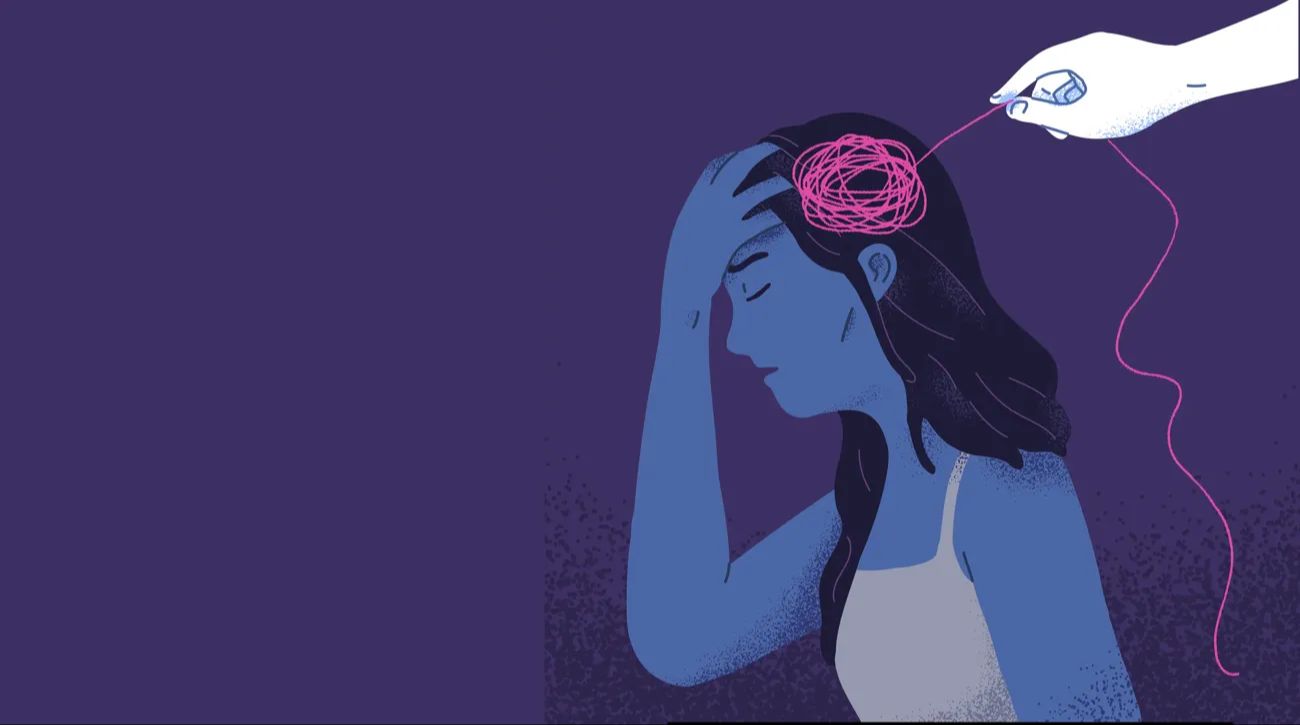
Exhaustion is sometimes invisible. You can smile, respond to others and be physically present, but inside, you've already stalled. It's a silent disappearance: before you crack for good, you gradually fade away from within; you're there, but your heart's not.
In the world we live in, being physically present is no longer enough. We live in constant urgency, and our minds are rarely in the same place as our bodies. We eat while answering messages. We listen to someone, preparing what we're going to say. We spend an evening with family, but our minds are on the next day's meeting.
Living this way turns us into ghosts. That's the price we pay for wanting to do everything too fast. We end up nowhere. This way of living silently, insidiously destroys us.
It's no coincidence that scientific research confirms this feeling. A team of researchers led by Stéphanie Cœugnet has demonstrated that, when the brain is under chronic stress, it can no longer process the environment with the same depth. This phenomenon is called "time pressure", and it means that human beings act differently. They spend their time sorting, trying to simplify everything or planning what comes next. And all the while, we're completely missing out on the present.
We want it, we just don't know how. We're so used to running that we've become addicted to it: as soon as we stop, we get stressed. When we don't do anything, we feel like we're losing our footing, and sometimes we even think that taking time for ourselves is a fault, because we always feel ineffective when we're not producing anything.
The consequences of disconnection from the present affect not only the person concerned, but also their relationships. It weakens them, be they family, friends or professional. You send message after message, but you don't really listen to the people you're talking to. You're sharing the same room, but everyone has already gone back to their own thoughts. In the end, we've not only tired our bodies, we've emptied our bonds of meaning.
So what do we do? Keep running until we collapse, or simply dare, at last, to choose our own pace? The idea is not to stand still, but to find the right rhythm for ourselves. A rhythm that energizes us instead of draining us. Adapting our speed to what we're doing, what we're experiencing and who we really are is the best skill. This allows us to keep up a good pace while completing our tasks on time or not.
In order not to get lost in speed, the goal is simple: be fast when necessary, but know how to slow down when it's important. This awareness enables us to keep our happiness while being present in what we achieve.
Science confirms this intuition. Researchers like Cœugnet have shown that we need to know how to vary the pressure of time according to the context. Some tasks require reactivity, it's true, but others, like deep thinking, human relations or creativity, need slowness or time to really get done.
In short, we can speed up actions for immediate tasks and go slower for what makes sense, otherwise we end up botching everything. Choosing to slow down doesn't mean giving up. It simply means opening your eyes and doing things consciously and with meaning. Often, we think we have to exhaust ourselves to succeed. In fact, the opposite is true: we're much more efficient in the long run when we take the time to reflect in peace and quiet. If we run all the time, we lose the ability to really be there.
Choosing slowness is not incompatible with the intensity of the moment. Whether at the office, with our loved ones or for ourselves, the presence of body and mind in the same place is the most important thing and will be part of our strength. Maximum speed, on the other hand, always ends up damaging it. Choosing the right speed is really choosing to live.
Illustration: Unsplash - vf7NiRQtLxE
References
Time pressure: a complex phenomenon that urgently needs to be studied - Stéphanie Cœugnet, Camilo Charron, Corinne Ribert-Van De Weerdt, Françoise Anceaux and Janick Naveteur
https://shs.cairn.info/revue-le-travail-humain-2011-2-page-157
WHO and ILO call for new measures to tackle mental health problems in the workplace
https://www.who.int/fr/news/item/28-09-2022-who-and-ilo-call-for-new-measures-to-tackle-mental-health-issues-at-work
You might also like:
The three stages of local innovation
How does innovation germinate in silence, come to light in collective spaces, and then get taken up and institutionalized, albeit under certain conditions?
Why Good People Do Things They Disapprove Of
There are two distinct paths that lead one to act against one’s own values: a gradual shift that goes unnoticed, and a state of confinement in which past decisions close the doors one by one. Consistency is less about the difficult moment itself than about everything that is built up leading up to it.
Crafts are regaining popularity
Craft industries seem almost anachronistic in a digital world. However, the crisis has shown the usefulness of this sector which sees a growing shortage of personnel. Thus, many are retraining to prepare baths, weld materials or work with wood. The French vocational training field has even adjusted its approaches to this reality.
Congruence, the key to credibility
The importance of congruence among teachers to be credible in the eyes of students. To ensure this, self-evaluation through techniques such as viewing one's own lessons and personal reflection are effective tools. The pleasure a teacher takes in teaching has a direct influence on student motivation and involvement.
Numerous tests have been developed to identify individual and group skills. How can we measure all the dimensions of learning?