Wars, climate, viruses, etc.: the mass media expose us to information that arouses our most primal reactions. Headlines are becoming ever more "putaclic", because these media need to attract an audience, and fear is a very good hook for clicks.
Faced with this, citizens want to be protected, and the authorities are responding to this demand: applications on our phones alert us, public policies anticipate our bad choices even before we make them. We live in an age when authority decides, often with sincere benevolence, in our place and for our good. This omnipresent protection seems like progress. But is it really?
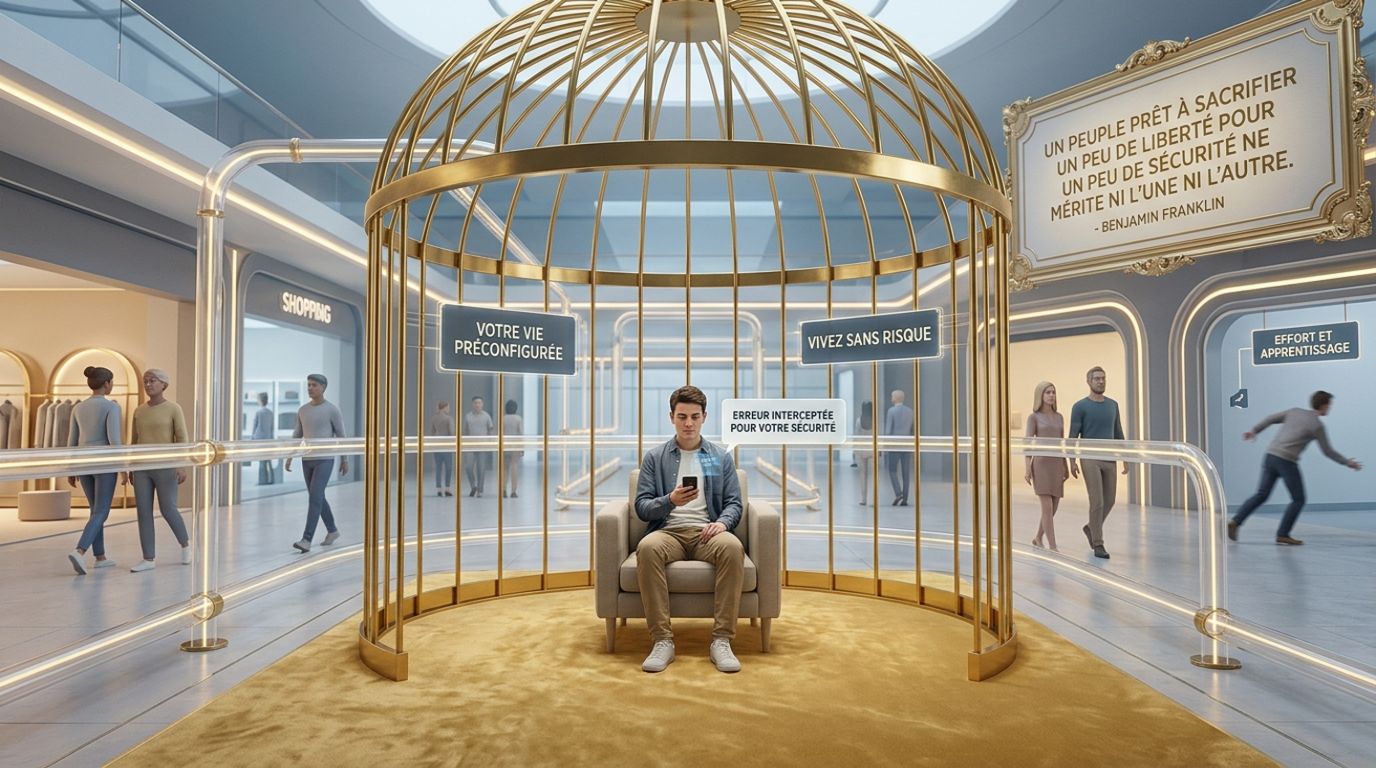
Benjamin Franklin wrote in 1755: "A people willing to sacrifice a little liberty for a little security deserve neither, and end by losing both."
This isn't a libertarian slogan. It's a warning about the hidden cost of security: the progressive atrophy of our ability to judge for ourselves and defend ourselves. Because when every risk is neutralized upstream, we stop exercising our judgment and our abilities. We develop what some researchers call a contentment bias: a tendency to passively accept our environment because it seems to function without our active intervention. We become, without realizing it, the docile tenants of a particularly well-decorated prison.
The golden prison: gentle surveillance and biopolitics
Contemporary surveillance no longer has the brutal face of the authoritarian regimes of the last century. It is administrative, preventive and often presented as a service rendered.
To understand this transformation, the work of sociologist Ulrich Beck is essential. In his theory of the risk society, Beck shows that fear - be it health, climate, security or economic - has become the main driving force behind the extension of social control. The more risks are publicized and amplified, the more institutions legitimize themselves by promising to manage them. Fear is not exploited cynically: it is sincerely felt. But it produces the same result: an individual who delegates his or her sovereignty in exchange for a promise of protection.
This mechanism finds its most profound analysis in Michel Foucault and his concept of biopolitics. The modern state no longer simply punishes deviant bodies; it manages life itself: birth rates, health, nutrition and mobility. Individual autonomy is no longer a natural right, but a security of concession: we are allowed to choose within the limits of what the administration has previously validated. Freedom becomes a marked corridor.
The management of flows of people, information and behavior replaces frontal repression. We are no longer enclosed by walls, but guided by invisible corridors that we voluntarily walk down, just like in an IKEA store, convinced of our own freedom.
The extinction of agentivity: when protection paralyses us
This preventive architecture has a profound psychological cost, which psychologist Albert Bandura has rigorously documented. His theory of human agentivity is based on a fundamental principle: we are not just beings who act, we are beings who need to believe that our actions have a real impact on the world. This feeling of self-efficacy, the conviction that I can influence my situation, is the very condition of our mental equilibrium and development.
But what happens when everything is secured in advance? When every potential mistake is intercepted before it happens? The individual gradually loses experimental proof of his own competence. He never falls, so he doesn't know how to get up again. He never really chooses, so he no longer knows how to make a decision. He becomes, to put it best, a spectator of his own life.
This is not so much a dramatic metaphor as a clinical description of a documented phenomenon: overprotected people have more anxiety, less resilience and a greater dependence on external structures to validate their choices. We have built systems so effective at eliminating discomfort that they have simultaneously eliminated personal development.
The paradox of total security
Risk homeostasis according to Gerald Wilde
Total protection is not just a philosophical problem. It's also a technical error.
Psychologist Gerald Wilde has formulated what he calls the theory of risk homeostasis: each individual unconsciously maintains an acceptable level of subjective risk. If the environment becomes objectively safer, behavior adjusts to return to this familiar threshold. The automotive example is striking: equipping a car with advanced safety systems leads drivers to adopt a more aggressive driving style, partially cancelling out the benefits of protective technologies.
Let's apply this principle to the social scale. By systematically eliminating the right to make mistakes, by guaranteeing that bad decisions will be corrected by an institutional safety net, we are not creating more cautious citizens. Instead, we create short-sighted and structurally fragile individuals,incapable of assessing real risks because they have never had to assume the consequences. Total security does not produce wisdom. It produces irresponsibility within a reassuring framework.
The result is widespread disempowerment.
Nudges: the most sophisticated form of golden prison
The most subtle criticism of our times concerns so-called nudges, theorized by Richard Thaler and Cass Sunstein. These behavioral "nudges" consist of guiding individual decisions without explicit constraint, by modifying the architecture of choices to make the "right" option more accessible or visible. Elegant, because we technically retain our freedom to choose... but, in reality, a perfected form of the golden prison.
Nudge preserves the appearance of choice while dictating the desired outcome. It assumes that a central planner knows better than we do what's good for us, and that it's legitimate to surreptitiously steer our behavior in that direction. This gentle paternalism is all the more insidious for being invisible. We don't feel the pressure. We believe we are choosing freely, when in fact our decision has been architecturally preconfigured. It's a benevolent manipulation, to be sure, but a manipulation nonetheless, and it erodes exactly the same muscle as all other forms of overprotection: our ability to truly deliberate.
Interdependence of effort: scaffolding versus cage
It would be reductive to conclude that all protection is bad, that all regulation is tyrannical, that the state must withdraw from our lives. To do so would be to fall into an individualism as naive as the paternalism we criticize. True autonomy is not built against others, but with them. The question is not whether we need a social structure, but what form that structure should take.
The fundamental distinction is this: a structure can be a scaffold or a cage. Scaffolding helps people to climb; it's temporary, adjustable, and its ultimate purpose is to become useless. A cage prevents you from falling, of course, but it also prevents you from moving, exploring, stumbling and learning. Our contemporary systems, with the best of intentions, gradually slide from one to the other without our realizing it, and often with our enthusiastic consent.
To claim the right to make mistakes is not to claim the right to impunity. It's about claiming something more fundamental: the right to be a sovereign subject, i.e. a being whose decisions have real consequences, and whose mistakes belong to his or her own journey.
It means recognizing that failure is an irreplaceable pedagogical fact, that vulnerability is the condition for growth, and that confidence - in oneself and in others - cannot be decreed administratively. It is built in the raw experience of the real world, with its un-neutralized risks and uncushioned falls.
The golden prison is comfortable, and precisely for this reason it is also dangerous. The scale of our freedom is not measured by the absence of visible constraints, but by our real capacity to make mistakes, to accept the consequences, and to rise up different. Until we have regained this elementary right, we will remain managed subjects who believe themselves to be free, and this is perhaps the ultimate form of confinement.
See more articles by this author