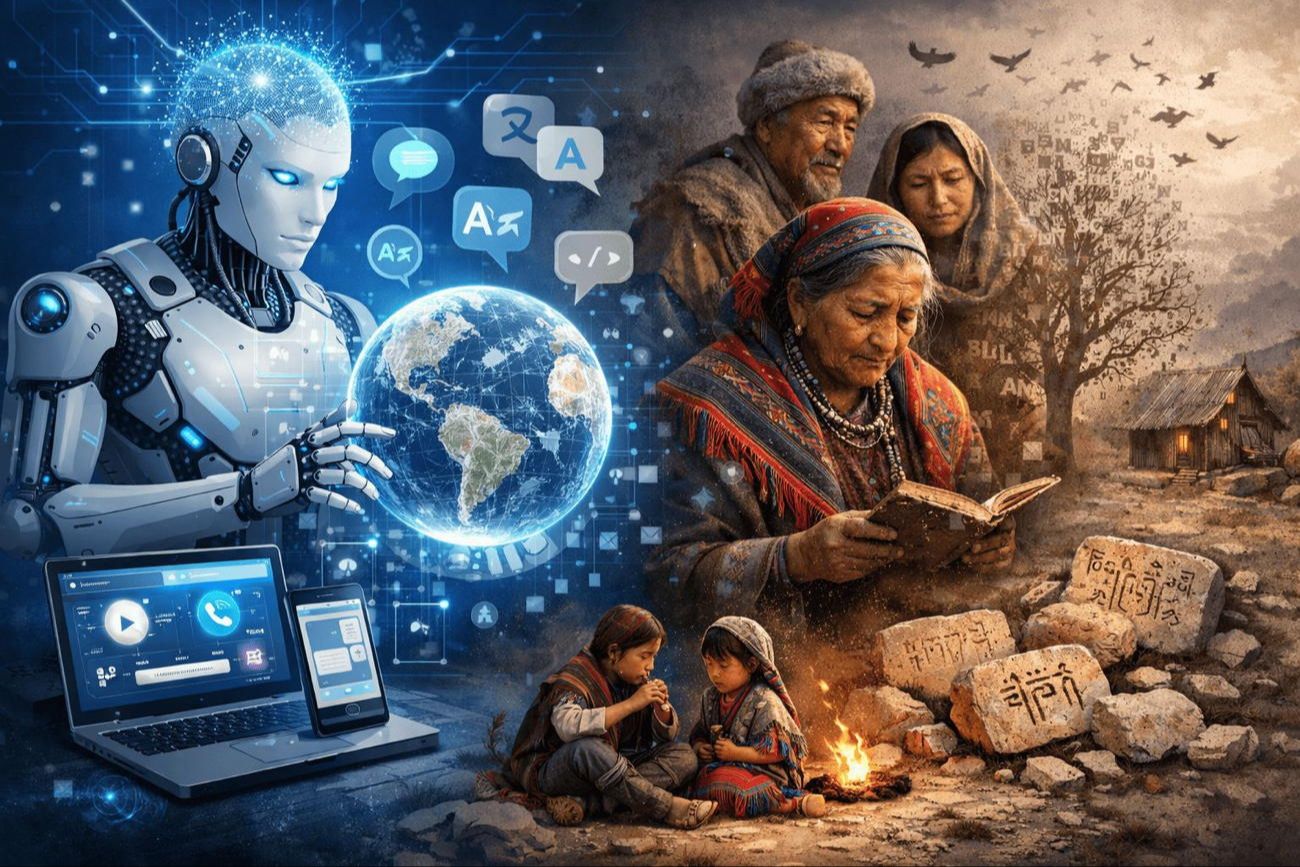
In the world of language services, one subject is at the heart of discussions: what will become of the translator's profession in a context where translation engines such as Deepl, Google Translate and other new tools are becoming more and more powerful? These technologies come close to human translation, without some of its limitations.
While we agree with Claire Larsonneur (2023) that "the translation market is complex and the story of the great replacement [is] still largely a fiction", as demand has increased, we can still ask the question when it comes to minor languages. Indeed, in this growing demand, minor languages are also becoming opportunities for translators.
However, technology tends to ignore them, and so a paradox arises: these languages may disappear in the face of ubiquitous technology, but they can also become niche employment areas.
What are "minor languages"?
A minor language is one that only exists in a context where a major language dominates. To define a minor language is to define a major language. Giles Deleuze and Felix Guatari (1978:28) consider a major language to be a
"lengua que en un contexto sociocultural dado, ejerce alguna forma de dominio y está en una posición hegemónica con respeto a otra"
(language which, in a given sociocultural context, exercises a certain form of domination and occupies a hegemonic position in relation to another).
From this definition, we can deduce that minor languages are those that suffer from the hegemony of dominant languages. This is the case, for example, of the Bubi language in Equatorial Guinea, the Fang language in Cameroon and the Ibo language in Nigeria, where the major languages are Spanish, French and English respectively.
These languages are little spoken, non-standardized or less standardized and, above all, have little numerical presence. They are also in the process of being institutionalized, with work being carried out on their alphabets, grammars and so on. These languages also suffer from difficulties linked to their accessibility. These include the lack of corpora, teaching resources, orthographic standards and so on. But all these shortcomings don't mean that they shouldn't be taken into account in translation, especially as speakers should also benefit from exchanges with others.
Challenges for minor languages
Before presenting the difficulties that minor languages can encounter in translation, we need to look at the process of machine translation. AI translates mainly through machine translation systems that have evolved from statistical approaches to neural models (and now more recent systems based on generative AI). The key idea is that these models learn from data: the more quality texts, corpora and resources a language has, the more reliable the translation produced will be (Alida Maria Silletti, 2023-2024).
In the case of minor languages, this dependence is a basic problem, as the lack of data can lead to approximate translations, or even errors that risk becoming established as a reference.
This preponderance of major languages can lead AI to use the orthographic grammatical structures of dominant languages or approximate translations. This has been particularly noticeable in the MLO AI project, which aims to translate texts in several African languages. These languages, such as Hausa, Ibo and Swahili, are not necessarily minor languages in terms of the number of speakers, but they do not have a strong enough numerical presence. Faced with this lack of data, there is a loss of diversity: AIs tend to simplify or standardize translations related to these languages.
Data bias leads to poor translation quality. In this way, the AI can produce errors, invent terms or "bypass" the meaning, resulting in erroneous translations that can become "benchmark" references. Indeed,
"Linguistic A.I. is thus part of the data economy, both upstream and downstream. Upstream, and because the quality of A.I. productions is directly linked to the quality of corpora, the market for parallel corpora is essential. But building good corpora requires substantial work on linguistic data. Millions of examples of sentences or syntagms have to be collected, generally on the web: statements or exchanges that have been posted freely are thus exploited without payment to the authors." (p4).
Technological independence and job opportunities
Even if technology cannot yet make the translator's job disappear, it has to be recognized that the new translation-related services are less well paid:
"Business is shifting to other types of service: post-editing, transcreation, project management, linguistic computation. It should be noted, however, that the rates charged for revision and post-editing of pre-translated texts are much lower than those for human translation (Larsonneur, 2023: 5).
As a result, translators who wish to continue to benefit from the favorable rates can turn to minor languages. Christian Élongue, head of Kabod Group, a translation company in Ghana, often confides that he has difficulty recruiting translators in several African languages, in a context where the languages of colonization are major. It's a niche market for translation. In addition to translation, it's also an opportunity for data collectors to structure these languages.
The creation of corpora from recordings, assisted transcription, the creation of dictionaries, lexicons, terminology (particularly for digital, medical, etc.) are other areas of work for language service providers. However, we mustn't be fooled, as such work requires major investment and a real political will or major interest on the part of the industries responsible for developing technologies in this direction.
Minor languages are under pressure. The danger is not just the hegemony of speakers of major languages, but also technological development. Technological development can encourage the structuring of minor languages, as it offers the tools to integrate them more fully, but at the same time, these same technologies pose a risk to them.
Only time will tell. The danger and the opportunities exist, but everything depends on the choices(data, governance,validation) that will be made and pursued from now on.
Image source, Copilote: The impact of AI on minor languages
References
Larsonneur, Claire, "What are the stakes for linguistic AI? Retribution, risks, regulations", De Europa - European and Global Studies Journal, 2023, pp 37-60. ⟨hal-05121276⟩
https://hal.science/hal-05121276v1/file/article%20Larsonneur%20droit%20ia%20langues%20.pdf
Silletti, Alida Maria, "Artificial intelligence and automatically generated translation", 2023-2024,
https://www.uniba.it/it/docenti/silletti-alida-maria/attivita-didattica/silletti-a-a-2023-2024/la-traduction-generee-automatiquement.pdf
Deleuze, Gilles y Guattari, Félix, Por una literatura menor, México, 1978.
See more articles by this author