How to approach AI as a case study in elementary school?
It's easy to broach the subject of AI with university students, but how can we do the same with primary school children?
Publish at January 16 2011 Updated May 18 2023


The classroom is a complex environment in which many actors interact. New teachers placed in front of twenty or so students sometimes discover the weight of an unfortunate word or inappropriate attitude, or a poorly constructed instructional sequence, the hard way.
It should come as no surprise, then, that in the United States, virtual role-playing has been taken as a way to familiarize future teachers with their future work environment.
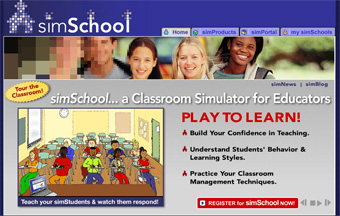
Education Week featured two experiments in progress in early January 2011. Indeed, two products are currently in the testing phase in the U.S.: a fully virtual environment called simSchool and a hybrid device going by the name of TeachME.
SimSchool will evoke many things for young aspiring teachers familiar with the popular Sims game: interacting as a teacher with temperamental avatars, answering their questions, and having them complete assignments. TeachME works in a completely different way: a student-teacher gives his lesson in front of a screen on which he sees five virtual students. These are interpreted by an actor located in another room. Depending on what is done and said by the teacher, he plays according to the personality sheet created for each of the student profiles.
While Teach ME is more realistic, as it incorporates real human-to-human interaction, simSchool - more impersonal - is more easily integrated into a teacher training course. The interactions may seem mechanical at first, but the software continues to develop and already offers millions of character and attitude combinations for its avatars. In fact, the site offers a free trial version that gives a taste of its vast possibilities.
In both cases, the goal is the same: to limit the risks students face when confronting the classroom environment for the first time. Indeed, mistakes made by the apprentice teacher have much less impact on fictional characters than on real students. This is in line with the objective pursued by simulators and other virtual environments developed for the health professions, for example.
Lisa Dieker, an education teacher at the University of Central Florida who helped design Teach ME, puts it this way:"
It allows the teacher to fail in a safe environment. Real students, believe me, will remember in May the things you told them months earlier. You can't reset them."And all you have to do is take a quick quiz on simSchool to realize that you can easily blunder and then have to deal with a psychologically tricky situation. Some students react poorly to being told off by a brittle teacher, others will only respect you if you go that route. Some love group work, others feel uncomfortable in it and prefer solitude.
Of course, these simulations are no substitute for practicing in a real classroom. David C. Gibson, creator of simSchool, confirms this. His tool is primarily an additional aid to understanding the impact of the teacher's actions on the students. The latter, just like the Sims characters, have learning, well-being and emotion curves that evolve according to their actions. TeachME, on the other hand, acts on the same springs. In both cases, these devices prepare the teacher for the real situation by allowing him to anticipate in a risk-free environment.
For now, these projects developed in Florida (Teach ME) and Oregon (simSchool) are only in the experimental phase. The University of Central Florida is offering all student-teachers the opportunity to use Teach ME, but it remains optional and at their discretion. As for simSchool, the University of North Texas has approved the use of the software as part of the required classroom observation hours for prospective teachers.
Other universities are tempted by these devices, which nevertheless remain expensive; and some are waiting for them to be more developed before opening their wallets.
Nonetheless, the University of North Texas examined the simSchool effect on teacher education in spring 2007. Analyzing two classrooms that had used the tool, researchers perceived more resilience, adaptability, and openness for alternative teaching solutions in the students.
SimSchool is a powerful tool for teaching and learning.
Simulation of the classroom situation is thus taking its first steps in the United States. Nevertheless, initial feedback and studies suggest that it brings a different understanding and approach to the profession, better equipping - according to these initial observations - future teachers with the modern realities of a classroom without eliminating the importance of field experience. A new way to play teacher in a digital environment?
simSchool, the official website
"Virtual Students Are Used to Train Teachers," Stephen Sawchuck, Education Week, January 5, 2011. Registration required and free to read the full article.
You might also like:
How to approach AI as a case study in elementary school?
It's easy to broach the subject of AI with university students, but how can we do the same with primary school children?
Graphics and thought construction
Among the means used to expose a project, a reasoning, we note the existence of varied graphic tools, digital as much as analogical. To make a clear message circulate, it is then necessary to deconstruct the object to valorize it, in an overall dynamic. The graphic design is as much a means to build, to expose and to enrich a questioning.
Assessment in Health Care and Education
Assessment guides much of what we do, particularly in school. However, while it may be inconsequential in some cases, it can become counterproductive in others if not properly managed. In the context of student support services, assessment may seem absent when viewed through the lens of standard criteria; yet it remains, focusing on elements beyond the purely academic realm.
Integrating the guidance approach into teaching - in detail.
The guidance approach aims to make students autonomous, positioning them as players in the process of building their own career path, by equipping them with the skills they need to make the choices they will have to make. In addition to knowledge, know-how and interpersonal skills, the ability to become a key competence in a constantly changing and uncertain world. Orientability is becoming the keystone of 21st century learning.
Critical pedagogy aims at emancipation, i.e. freeing them from patterns of thought and action that hold them back in their development. Can we really solve problems with the paradigms that produced them?