If we really want lifelong learning to become a reality for all citizens of the world, we must work to remove the technical, geographic, economic, and cultural barriers that currently impede or prevent access to works that are part of the world's heritage.
You certainly cannot put the pyramids of Khufu in your living room. But one can admire them and learn a great deal about their history from the books, films, lectures and digitized articles now available on the web.
Will we be eaten by the Google ogre?
To whom does the monumental task of digitizing the visible traces of our cultural heritage fall? How to guarantee free access to these works? The European Commission has been looking into the subject for several years, following in the footsteps of European states that see with undisguised fear the ogre Google making an increasing number of agreements with libraries and museums in Europe.
The European Commission has been working on the subject for several years.
A report published last January takes stock of the subject. In its summary in French, we read that its co-signatories unhesitatingly recommend that public institutions take their responsibilities and ensure control over the digitization of works, as well as guarantee access to them. This, if necessary (and the need is immense...) by making agreements with the private sector, which can ensure the digitization of the works and keep the exclusivity of their use for a period of 7 years. The authors of the report take a stand here against the exclusivity agreements signed between Google and several European libraries, with an initial duration of 25 years, recently reduced to 15 years.
.
It is easy to understand the fear of European institutional actors of seeing Google take over European cultural heritage. Especially since vigilant observers of Google Books have noticed that the search algorithm used by Google favors book titles and the number of copies sold. In other words, you'll find your way around Google Books better and faster if you enter words from a title into the search window rather than keywords you'd want to find in different texts, such as to gauge the timing and success of a phrase or idea. "Google Books is looking more and more like a bookstore and less and less like a library," Hubert Guillaud says in a post titled The Limits of Google Books. Google engineers counter that they base their algorithm construction and adaptation on average searches, so as to satisfy an equally average user. But it is hard to believe that this famous "average user" is rushing to the millions of books exhumed from the reserves of European libraries where they had been sleeping for years, even centuries...
Europeana, the Spanish inn of European cultural heritage
![]()
The European riposte to Google Books is called Europeana. Opened in 2008, the European culture portal already contains more than 15 million works: images, texts, sounds and videos, provided by more than 1,500 heritage institutions such as the Rijkmuseum in Amsterdam, the British Library in London or the Louvre in Paris. The above-mentioned report, written at the request of the European Commission, recommends that by 2016, all the public domain masterpieces of the EU member states should be integrated into Europeana. The time seems quite short for this titanic task... and very expensive, since the co-editors of the report estimate the cost of digitizing the entire European cultural heritage at 100 billion euros!
.
In its current state, Europeana already has much to offer us. In addition to providing access to very rare works, it allows us to discover Europe's public heritage institutions, since each resource can be seen in context, i.e., on the site of the institution that made it publicly available online. Moreover, Europeana is not limited to printed materials. There are also paintings, objects and sculptures. Yet it is hard to see how the European portal could in terms of art compete with Google the giant, whose Art Project offers us the best of what exists in terms of digitizing works...
But as well-populated as they are, both Google Books and Europeana suffer from a major flaw: searching there is like an obstacle course. In this area, quantity is the enemy of quality. Of course, Google has favored a more popular approach than Europeana, which is clearly a scholarly tool. Nevertheless, it is on Europeana that we have recently found a first manifestation of the consultation aid, in the form of an exhibition devoted to Art Nouveau. A short exhibition, but one that gets off the beaten path by presenting little-known works. Please come along with us! Help us find our way through these hundreds of thousands of references, not only through a search algorithm made for the "average" user that we are not, but by pointing out the most interesting pieces in the field we are interested in. The various discovery options offered on the homepage of Gallica, the online library of the Bibliothèque Nationale de France, are a great help in this regard.
Harmonizing access to content from across Europe
The developers of Europeana face a daunting task. The portal currently suffers from an obvious lack of homogeneity, which is only a reflection of the lack of harmonization of the laws and practices of the different states of the union in terms of access to their digitized heritage: heterogeneity of consultation and reuse rights between institutions (Europeana not only hosting works that have fallen into the public domain), lack of translation of records, disparity of digitization formats... You currently have to be highly motivated, when you are not a polyglot expert in documentary research, to use Europeana.
But the game is worth the candle. The European heritage, accumulated over thousands of years, deserves a substantial effort on the part of the States, public and private institutions, patrons, and on the part of the Union itself, to be made available to as many people as possible, so that our common memory can be strengthened and creativity can do its work, since it is true that we never create from scratch, but rather by revisiting the traces of those who have gone before us. And the battle between Europeana and Google will perhaps not take place: Google says it has no objection to the works it has digitized being integrated into the European public portal. Google "just" reserving the exclusive right to make money from the digitized works for 15 years... or 7 years, if Europe's institutions manage to assert the collective interest.
Digital books: Europe wants to counter Google. Euractiv.co.uk, 12 January 2011.
The New Renaissance - Report of the Committee of Wise Men on Putting Europe's Cultural Heritage Online - January 2010. summary in French of the original report in English (.pdf)
The limits of Google Books. H. Guillaud, La Feuille, November 15, 2010.
Europeana Portal
Google Books
Illustrations:
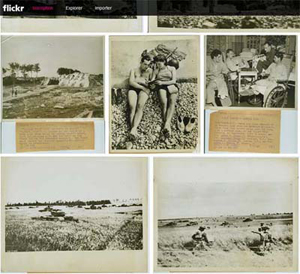
Top: gallica.bnf.fr/ Bibliothèque nationale de France
Bottom: screenshot of the Europeana portal homepage
See more articles by this author