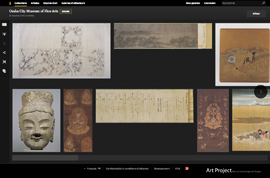
More than a year after its launch, Google Art & Culture has firmly established itself in the cultural landscape of the Web. Initially, the site featured 1,061 works from seventeen locations around the world. Today, 151 museums and art venues have joined the adventure, contributing to an impressive catalog of 32,000 works. The 3D digitization of each of these works enables Internet users to view paintings, sculptures and installations in high or very high definition. The experience also includes a virtual tour of the exhibition venues, which are often architectural masterpieces. In France, for example, the Château de Versailles will delight the curious from all over the world.
How to use the site
The site is easy to navigate. Three main sections allow users to search by artist, work of art or location. Users can also create their own gallery by selecting works of art.
The quality of the images is absolutely breathtaking, and this is the main attraction of this service. The paste of the paint, the grain of the paper, the density of the wood or the weave... all leap out at you. In addition to viewing, the site offers many additional services, such as explanatory notes, maps, audio guides... An education section (in English only for the moment) has also been set up, to support teachers in their lessons. Google has also announced that an experimental section will be designed, in partnership with artists, to demonstrate their use of new technologies during the creative process.
Virtual visit, real visit
The project's director, Amit Sood, explains that he hopes the project will "enable [the public's] innovative interaction with art, and hopefully encourage them to actually visit the site". For while the Google Art Project offers an exceptional insight into what can be found in museums where it may be difficult to go, it is clearly no substitute for a physical visit.
The project is not intended to compete with on-site visits, which is why each museum is free to integrate the creations of its choice, in addition to considerations of ownership. For example, it is currently impossible to admire Picasso's famous Guernica, currently on display at the Reina Sofia Museum in Madrid (which is impossible to admire up close there anyway!). The Spanish museum has authorized Google to integrate 59 works on the site. There's no substitute for travelling, but the Google Art Project gives those who aren't so lucky valuable access to culture.
The Google Cultural Institute
On October 10, 2012, Google launched the Google Cultural Institute, an interactive site dedicated to History and Culture. Featuring a wealth of content relating to key events in the history of the 20th century, more than 6 million archival documents, classified according to 42 themes, are available online free of charge: documents, photographs, manuscripts or films, from the 17 museums and institutions partnering in this project.Each section is designed as a digital exhibition, with slideshows of photos and captions. It should be noted that most of the content is not translated into all the languages available, but is mostly in English.
Is Google taking over culture?
Google continues to index the world's masterpieces. While the Google Books initiative has been strongly criticized by publishers and libraries, very few dissenting voices (with the notable exception of the president of Wikimedia France) have so far disrupted the chorus of praise surrounding the Art project. This is certainly because, unlike some of the books digitized and added to Google Books, the works reproduced in Art project are already in the public domain.
But things may change the day some people want to use the photos of works taken by Google: these are protected by copyright, even when the works themselves are in the public domain. This is not a specific limitation of the Google project, but let's bet that Google will know how to use it. What's more, on the subject of Google Institute , the Rue89 website reports that the American company has more than just a philanthropic vision when it comes to investing in culture. This project doesn't make money, as its director Steve Crossan points out, since it's part of the 2010 investment plan in France. The article also echoes a quote from Mr. Crossan to the New-York Times, explaining "an investment logic in this. [...] Having good content on the Web, in open standards, is good for the Web and for users. Investing in what's good for the Web and for users will pay off."
Further information:
Image credit: screenshot from the Google Art Project website.
See more articles by this author