What makes history special in the Web 2.0 era? Have historians' practices changed as the web has become increasingly participatory? Two texts provide a clearer picture of the components of this new digital history. The first, Y a t-il une Histoire Numérique 2.0? presents a long and detailed reflection on the subject of digital history. The author, Serge Noiret, is a specialist in information, history and civilization at the library of theEuropean University Institute. Available online at Academia.eu, his article was published in the Collection de l'Ecole Française de Rome, following a presentation at a seminar on the changing practice of history in the face of computerization.
The second text, Ce que le numérique fait à l'historien.ne, dates from May 2012. Claire Lemercier, research director at the CNRS Centre de sociologie des organisations, answers questions from Elisa Grandi and Émilien Ruiz, PhD students in contemporary history (2012), about digital history and the role of the historian in the development of digital technology, taking a close and detailed look at her own practice. Published online at studistorici.com, the researcher's answers are simple and clear, and her explanations interesting even for the non-history specialist.
Serge Noiret: Is there a digital history 2.0?
In this article, Noiret examines the mutations taking place in the historian's professional concepts, such as the durability of sources, a concept made precarious by digital technology, as documents are subject to continuous modification and revision. There are also new ways of describing documents, preserving them and making them accessible. Research tools are changing, as are communication, reading and publication practices. The author also highlights the emergence of non-traditional interdisciplinary practices in history, such as historians collaborating with computer scientists. Moreover, academic authority is being undermined by the increasing provenance of history studies on the web. The notion of author itself is partly redefined in favor of collectives. In the face of these changes, Noiret sees a need to recompose scientific methods. For him, disciplinary commitment is also essential when it comes to technical choices concerning access to documents and software codes(open access, open source). In his view, understanding what is at stake in these changes will help us to govern them more effectively, not least in terms of text allocation and content validation.
Web 2.0
Noiret recalls the general principles of Web 2.0, where the roles of editor and reader are changing, and where participation in social activities is paramount. People interact by creating content, and historical discourse is constructed through collaboration. An eloquent example of this is the Wikipedia encyclopedia, which uses user generated content (UGC) to create content. After the collaboration between authors via e-mail in the more static and stable Web 1.0, data modifications are now made directly in the text. In history, this collaboration is reflected in the construction of programs with accessible code (Zotero, for example, for research), and in open archives where knowledge, primary sources, documents and information are shared, particularly those whose distribution has not yet been validated. For the author, it is very important to "dominate" these UGC spaces for historians: social networks, blogs, podcasts, tagging as well as technical components such as mash-ups, widgets, etc.
For example, libraries have gone looking for users where they are, on social networks, notably Facebook, which represents a gateway and a catalog distribution tool. Noiret explains that this use of the web has also transformed the catalogs themselves, where, for example, clouds of keywords can be provided to users to refine and pursue their search.
The author points out that, in Web 2.0, users no longer simply double-click, but participate in the development of content, can add meaning to it and benefit from suggestions for further research, even outside the site where they are located. Contacts are made directly via social media rather than e-mail. From now on, web users act rather than browse on dynamic sites that are continuously and interactively updated.
Advantages and disadvantages of Web 2.0 for history
Noiret quotes Dan Cohen of CHNM, who outlines the advantages and disadvantages of Web 2.0 for the discipline. The new web facilitates communications by enabling synchronous and asynchronous communications between historians. The new tools enable an accumulation of information and knowledge, primary sources and documents to be transmitted everywhere, to everyone. Revision and indexing is carried out by all, and the openness of program and software code enables historians to better "interact with digital content". The disadvantages of this Web 2.0 for historians relate to the precariousness of digital information, the accelerated obsolescence of technologies and the difficulty of decentralizing scientific authority to properly identify information.
Wikipedia
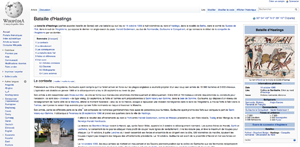 Noiret sees great potential in the collective writing undertaken in the non-commercial context of the Wikipedia encyclopedia, if used by historians in a scientifically reliable environment. The digital historian would be one who understands the reasons for Wikipedia, which"aims to improve the historical knowledge of a large number of readers who could benefit greatly from the knowledge of specialists". The author poses this question:"Why shouldn't the historian, in the cultural service of society, whose role is to improve collective critical knowledge of the past, use the instrument of mass dissemination to spread contagious history, active and participatory discussion and adopt the principles of digital history 2.0". Noiret sees particular opportunities in teaching, where students and researchers complete entries or improve existing articles, revising, correcting and developing their critical faculties in the face of the web. The role of historians in Web 2.0 would be to filter, organize and interpret data contributed by the general public. Noiret mentions the importance for academic historians of moving beyond the passive use of reading data on the web to promoting the active use of new interactive media in their discipline.
Digital projects in history
Digital projects in history have become interactive platforms where users are actively involved in content, for example in wikis, blogs, tagging and livetweeting. The modalities of contact (and of the implicit contract) between specialists and readers are being modified, notably by crowdsourcing, which follows on from massive digitization projects in cultural organizations and libraries. By multiplying the number of digitized primary sources, we are changing the possibilities for research and teaching. In addition to easier access to theses, information and documents, history websites now offer the methods required to organize crowdsourcing.
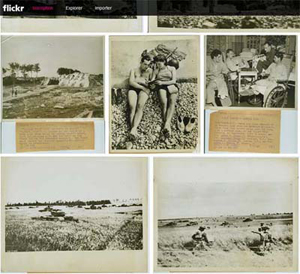
 Digital history can be used to build academic content using new forms of scientific writing. Digital history provides an opportunity to reflect on the means and channels of discourse transmission. For Noiret, the web could complement traditional dissemination. The author cites numerous examples of history sites that are genuinely open to the public, with the aim of creating new discourses. Photos Normandie, on Flickr, is a collective work instrument for re-documenting photographs, a tool used in academic works and whose annotations are verified by specialists. Parallel Archive is another example of an open project cited by Noiret. This open archive at Budapest's Central European University not only makes sources accessible, but also offers the possibility of creating a personal research space, a collective study environment (additions, annotations, discussions) or describing documents using metadata.
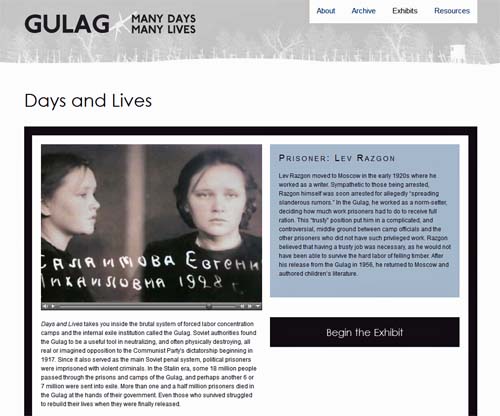
The Gulag Many Days, Many Lives online exhibition, a CHNM project built using Omeka open-source software, aims to connect with as wide an audience as possible. Internet users comment and share their thoughts on their experience of the Gulag, as the project aims to collect new sources from all over the world. The Central Database of Shoah Victims' Names, another digital project that opens up history, calls for direct participation from the Internet world to create an archive of the disappeared through new testimonies. This is also the case with the September 11 Digital Archive, which collects and presents digital images and e-mails linked to the tragic event of 9/11, and which has been integrated into the Library of Congress.
Noiret concludes that digital history is made up ofdiverse stories from communities, families or individuals, sometimes through direct testimony, without the mediation of scientists. Finally, he stresses the need fortechnological knowledge to make history exciting and socially useful for the general public, through participation in content. For him, digital history 2.0 can also give a place to those left out of history, and it's important to convince professional historians of the usefulness of the web in enhancing their work.
Claire Lemercier: What digital technology does to the historian
Claire Lemercier, interviewed by Grandi and Ruiz, defines digital history and its components first and foremost as the electronic editing of sources. As a contemporary historian, she makes extensive use of IT tools for a variety of purposes: access to bibliography and sources, scientific watch, communications with colleagues, writing texts as a group or on her own, editing and building databases of sources, quantitative processing of sources. For Lemercier, digital history must be more than just the practice of geeky historians, and for her, it is urgent to give it a more precise content.
The question of structuring historical information is once again raised by the multiplication of information and the tools for processing it; historians can derive very positive results from the constitution of bibliographic databases (for example, using the Zotero tool) and the possibility of structuring metadata to make it useful for their research.
Transformation of the historian's profession
The research director considers that everything has changed in the last 10 years in terms of the way things are done, although the basic principle of source criticism must be maintained. One of these changes, the proliferation of e-mail, increases worldwide scientific communication by facilitating interaction, even from a distance, but, in her view, this is detrimental to traditional research work, and in particular to writing. The digitization of documents, for its part, opens up new possibilities for dialogue and discussion in research, but raises the question of its limits. Where does the researcher stop in the innumerable mass of documents to be checked and analyzed? A key issue is the trade-off between time spent gathering information and time spent reading and processing it. Access to sources and how to read them has also changed. Sources are accessible but scattered; they do not form part of coherent corpora. Moreover, even if it is no longer necessary to physically visit the place where the documents are kept, the question of the origin of the collections must continue to be raised. For the author, there has also been a genuine revolution in the way we relate to sources. For example, has the description of a digital photograph or the transcription of the text of photographic sources become superfluous? According to Lemercier, all these transformations raise questions that need to be discussed collectively.
The development of collective research is another component of the digital history described in the interview. Crucial revision and sharing tools have positive psychological effects on researchers: revisions are better accepted because they are transparent and traceable by the authors. She sees another advantage in the sharing of bibliographic work and source repositories: this makes it possible to share data processing work and collaborate remotely, despite practical problems (standardized identification of files, standardization of computer equipment). However, such collective research is less highly regarded in the academic and professional world of history, where it is still based on individual work. What's more, certain types of work, such as diaries and collective databases, are simply not recognized.
As far asonline scientific publishing is concerned,"open access seems to me to be the rule", asserts the research director. For her, it's a good thing that out-of-print or royalty-free documents, the products of civil servants and works with no lucrative prospects are accessible through platforms such as the Internet Archive or Zotero Commons. She also stresses the importance of properly documenting digitized sources (an immense but indispensable task) so that they can be useful to others. The scientific world is still wary of digital publishing, but the author points out that editorial boards are just as demanding as for paper journals. There also seems to be confusion between putting "scientifically selected materials" online and opening up archives to unpublished objects, preliminary writings and work in progress that can be commented on. In her opinion, the"unvalidated nature of the object must be clear to all".
For Claire Lemercier, the problem of managing the mass of information is a very real one. In 2012, the elements of her research are varied in form and dispersed: paper elements, digital files, documents in both forms. Documentation is more voluminous than for her thesis defense in 2001, thanks to easier access to information. It is not possible to reread the documents for all the chapters of the research because it is never finished; there is always access to other elements, which causes the historian a feeling of doubt, which she overcomes by choosing the central elements in line with her vision of the subject.
The tools that have changed her practice as a historian are monitoring instruments. Even if they take up a lot of her time, they are beneficial to her teaching and the development of her research. In particular, she reads the Lettres de OpenEdition, the Liens-socio, digests such as histoire_eco and research diaries such as those on the Devenir historien website, which take up time from her leisure time and professional activities, and which she stops reading in periods of more intense work. She also uses quantitative data processing tools and free, flexible formal analysis software. For the researcher, changing tools in digital history can lead to collective reflection on the foundations of work, for example on methods and practices such as reading or note-taking on a source.
References
Serge Noiret Y a t-il une Histoire Numérique 2.0? on Academia.edu: http: //www.academia.edu/739198/Y_a_til_une_Histoire_Numerique_2.0_ [accessed September 14, 2013]
Interview with Claire Lemercier by Elisa GRANDI and Émilien RUIZ, Ce que le numérique fait à l'historien.ne on Diacronie Studi di Storia Contemporanea, www.diacronie.it, N. 10 | 2|2012 Digital History: la storia nell'era dell'accesso: http: //www.studistorici.com/2012/06/29/grandi_numero_10/ [accessed September 14, 2013]
Header image: PhotosNormandie, on Flickr, CC BY-SA license
Body text: Wikipedia, Battle of Hastings article; Gulag History site.
See more articles by this author