Instructions for bridging the gap between experience and results
Instructions are probably the biggest training activity in terms of frequency and volume worldwide. Who hasn't watched instructions on YouTube?
Publish at March 16 2015 Updated May 21 2026


For more than a decade, creativity has been the watchword in training. From cookery courses to management training, teachers need to encourage their students to think outside the box, to come up with new ideas and concepts.
But when it comes to language teaching, practice makes perfect. The teacher must transmit a "correct" language, avoiding regionalisms and, in the case of French, shunning anglicisms. Indeed, language is often perceived as an unchanging, untouchable domain. We refer to "official" dictionaries, not only to find out what a word means, but also to find out whether it's right or wrong to use it, i.e. whether it actually exists.
Yet it's not the existence of a word in a dictionary that makes it "real". Indeed, let's ask ourselves: who creates the words in official dictionaries? Linguists? Academics?
For English language professor Anne Curzan, dictionary authors are in tune with the evolution of the language, they collect and integrate new words into the dictionary, but they are not the authors - we are all the authors! We define which words become "real" through our daily usage. We decide by repeated use of a word whether it really meets a need and fills a language gap.
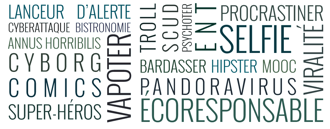
Far from fear-mongering about the loss of "good" language, she reminds us that many words that are perfectly acceptable in the English language today were the subject of heated debate just a few years ago. For her, the English language is not in trouble. It's alive and simply evolving with the times. Online dictionaries such as theUrban dictionary reflect this idea, collecting new English-language words and expressions used in everyday life but not yet included in official dictionaries. For the French language, " le dico des mots qui n'existent mais qu'on utilise quand même " (.pdf), lists words in everyday use that don't appear in any dictionary.
Other sites, such as wordnik.com, launched in 2005 by lexicographer Erin McKean, offer users the chance to create new words themselves (see Christine Vaufrey's article on this subject). To do this, she suggests six rules, such as mixing two words to form another, or, more simply, "stealing" words from other languages! For this specialist of the English language and, as she calls herself, a "dictionary evangelist", creativity doesn't have to stop at the realms of art and technology. "Language is funny and should continue to be.
But how do you incorporate this idea into a language course? Does linguistic creativity really have a place between learning grammar and studying its evolution?
To answer this question, let's take a concrete example proposed by Anne Curzan. When she begins a new course in the history of the English language, she asks her students to teach her two new words. This simple exercise does two things: firstly, it makes learners realize that the language is alive and constantly evolving, and secondly, that they are the authors of it. So there's no stigmatization of "street" language, but rather an appreciation of the ability of its users to make the language evolve in line with changes in society and lifestyles. When can we expect a course in linguistic creativity?
Illustration: Teachers' rooms
References
Erin McKean's TED talk, "Go ahead, make up new words!", November 2014
http://www.ted.com/talks/erin_mckean_go_ahead_make_up_new_words
Anne Curzan's TED talk, "What makes a word 'real'?", March 2014
http://www.ted.com/talks/anne_curzan_what_makes_a_word_real
TED Talk - Redefining the dictionary - Erin McKean
https://ed.ted.com/lessons/erin-mckean-redefines-the-dictionary
You might also like:
Instructions for bridging the gap between experience and results
Instructions are probably the biggest training activity in terms of frequency and volume worldwide. Who hasn't watched instructions on YouTube?
How does a peer help us learn?
Peer-to-peer learning, also known as pair-emulation or pairagogy, is all the rage right now, but how does it work in practice? It's the purpose of this analysis to go back to the roots and specify how it works.
Drawn reportage, a few keys to get started!
Crossing narrative styles, mixing illustration and text... Reportage drawing has been a real success for a few years with an adult and teenage audience. Some principles and techniques to understand the genre and use it in class.
Puzzle classes to integrate minorities in schools
When the laws of racial segregation disappeared in the United States, social homogenization did not take place as easily as hoped, especially in schools. An American pedagogue then imagined a new way of organizing learning, breaking radically with the competitive practices in force at the time. His method is still relevant in increasingly heterogeneous school environments.
The fascinating collection of scientific effects
A good speaker spares no expense, just like a seducer, a writer or a cook. Or an engineer or an entrepreneur. For those who know their "rhetoric", the set of effects they can exploit gives them an immense advantage with which they can improvise to achieve their goal... those who know causes can create effects.