Record absenteeism, but I'm not worried
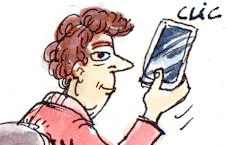
Like every day, we start class with a selfie. It's not that we're narcissists, but we've replaced the sign-in sheets or the roll call that preceded class just a few years ago this way. It's faster, more reliable, but I admit that after ten months, I still don't know my students' names...

I have to admit that the class is not well filled. We squeezed the tables together to feel less lonely.
For the past few months, I have only had a few learners come to class. They often sit in the back of the room and tap on their tablets. And yet, I'm not worried...
The absent students are watching the course on a screen from their homes, from the terrace of a café, or even from the classroom... The two students sitting across from me don't look at me. They find it easier to see me live on the screen. They have headphones or earphones, because the sound is better on their tablet than live in the lecture hall. And I get the questions they ask me via text or on the forums in real time.
Being a teacher 2.0 means giving students a choice of media: live, video, or audio podcast...


From time to time, the two students present raise an arm. It's not to ask me about a point in the lesson, but to photograph the board. This is their way of taking notes.... They will sell the files to their colleagues. At two cents a file, it's paltry, but the volume of sales is enough to have given them the idea to create their start-up.
A trip to the museum
This afternoon, though, we go to the Museum of Natural History with the class. I'm a little stressed. After all, I've never seen most of them. I know their avatars and usernames, but I don't know their names or faces. We made an appointment via Doodle for this grouping. They seemed enthusiastic.
Because museums have changed.
Thanks to augmented reality, all you have to do is aim at the main elements of a mastodon skeleton to get the essential information. And aiming at the QRcodes next to the exhibits allows you to compile information about them, to do a curation job. Each student builds his or her e-book from the items they have selected. Dozens of books that no one will probably ever read...not even their author.
We plan to use a madmagz type of application. Thework of the 3rd 4 class of the Louis Pasteur high school in Brunoy seduced us. We wish to be inspired by it.
And why not go further by creating your own augmented or enriched reality elements. They present me with a slideshow that finally convinces me. Why not? Being a teacher 2.0 isn't about producing multimedia resources, it's about giving students the opportunity to produce them.
The applications are numerous. My students introduce me to izi travel. Rather than the classic lecture or report that follows the tour, why not offer a tour and additional information to other visitors?
Virtual or real?
But being teacher 2.0 is not without its surprises. We enter a dimly lit room with a yellow light, less aggressive to the skeletons and skins on display. Barely visible, a guard is sitting, he stares at us or rather seems to stare at us because a reflection in his glasses does not allow us to know where he is looking. One of my students is enthusiastic. Fascinated by augmented reality and videos of Hatsune Miku, he convinced himself that the guard was a hologram. Mocked by the other students and stung, he wanted to prove that he was right, and slapped the guard. He was wrong.

The museum's management walks out of the office. The matter seems serious. The young student offers to explain himself in the director's office. In twenty minutes, he convinces him to install polyglot holograms, capable of monitoring and informing visitors through hundreds of pre-recorded phrases.
The Evaluation
Until last year, grading papers and student work was the dark part of my job for me. I would get to the point of talking to myself out loud while grading. Colleagues advised me to check out François Jourde's note on assessment.
I use a recording application, and just make a few coded annotations in the margins... No need to write anymore. Students feel it's more personalized.... This habit I had developed of speaking aloud is quite useful, although I have to be careful to structure my remarks, and to stifle the swearing that comes naturally.
Sometimes students record their voices in the same file, to respond to this or that remark, and the sound file takes on a dialogue-like quality.
Of course, everything already exists, and behaviors have already changed significantly. These technologies are an opportunity to test other learning situations, to give the learner a different place from one day to the next, or even to let the learner define the place he or she wants to take. The real-life resources below can inspire you, too!
Illustrations: Frederic Duriez
Resources
Some sources of inspiration and techniques that inspired this text:
For classroom appeal:
http://www.statim.fr/appelenclasse.html
For the use of augmented reality and QR codes
http://fr.slideshare.net/annedelannoy/realite-augmentee-et-qr-codes-en-ducation
Emmanuelle Jardonnet - "Hatsune Miku, trajectory of a virtual diva", accessed June 18, 2015
http://www.lemonde.fr/culture/article/2013/11/14/hatsune-miku-trajectoire-d-une-diva-virtuelle_3513952_3246.html
on curation: key learner skill
Learning circuits Curation, a core competency for learning professionals accessed June 18, 2015
http://learningcircuits.blogspot.fr/2012/03/curation-core-competency-for-learning.html
On assessment:
Francois Jourde: Recording and Communicating Oral Feedback - https://profjourde.wordpress.com/2015/06/04/feedbackaudio/ accessed June 16, 2015
See more articles by this author