For more than three years, from May 2011 to the fall of 2014, in an underprivileged elementary school in the Quebec City area, a team of 16 teachers, 2 remedial educators, and a school principal invested in learning to function as a professional learning community (PLC).
Professional Learning Community
We talk about it, we read about the benefits of such learning communities, but when it comes time to act on it, the comfort of the status quo often prevails except that, in this school, we no longer wanted the status quo: we wanted children who would start out on a better foot in life, despite unfavorable starting conditions.
With the support of the principal, resources to foster both communication and collaboration among teachers, and also ongoing teacher training, CAP took root and is now part of the regular operation of the school.
As a result, not only has the sense of competence increased among teachers, the rigor and effectiveness of interventions improved, and a quality organizational culture developed, but also, and most importantly, students have benefited with, of course, better results in reading, writing, and comprehension, but also their motivation to read and confidence in their abilities has increased, disruptive behaviors have decreased as well as disciplinary interventions, in favor of pedagogical interventions tailored to each individual.
While in the past teachers mostly noticed the best and worst students, mostly ignoring the mass in the center, now all receive teacher attention and support.
But how? By the data!
First, the supervision of this experiment was provided by two female professor-researchers and two research professionals from the University of Quebec in Outaouais who provided the training and support for the school to progress as a PLC.
What they have done is to get the entire faculty to function as a team that can support each other and systematically ask these kinds of questions:
- What essential knowledge or skills do students need to acquire?
- What instructional strategies would be most effective in getting students to acquire that knowledge or develop those skills?
- How to sequence interventions to optimize learning?
- What data would be useful in judging the acquisition of essential knowledge and skills?
The last point being the basis for a shift in operation. Now we rely on data, the data that will be at the heart of collaborative encounters.
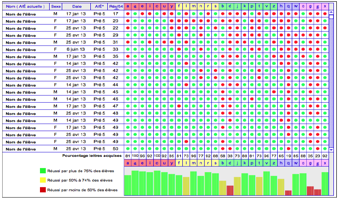
For example. in response to the question "How do we know if our students are making progress? Do we have evidence (data)?" we will need to get relevant data. From there we can know which students are of concern and begin to look for ways to improve interventions or find the expertise to overcome the identified challenge.
Using data collection tools has become both a skill to master and the key to setting intervention priorities and properly targeted interventions. The change in organizational culture has built on this foundation. It seems that now, a majority of interventions are based on data and not only on teachers' instincts.
Data support differentiation and inclusion practices (no one is left out anymore) and they facilitate the spirit of collaboration and concertation between different professionals (orhopedagogue, teachers, management) because all have developed a common language and references.
Are you interested?
The challenges of this mode of operation can be summarized in four categories:
- the adoption of classroom management necessary for more frequent data collection;
- the use of observation tools;
- the concern about having to cover the official curriculum;
- more effective meetings to better address individualized student needs.
"The context of continuous improvement assumes that schools must never be satisfied. " This is how "success for all" makes sense!
To Read
Primary Success for all, a Utopia? Lived Experience of a Professional Learning Community Aiming for this Success
Martine Leclerc, Madeleine Piché, Roger Prud'homme, Catherine Dumouchel
https://hal.archives-ouvertes.fr/hal-01182840/document
See more articles by this author