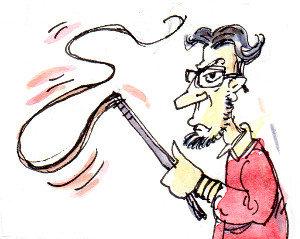
How can we give power back to learners? Fernand Oury, a militant teacher in the 20th century, gives us some very useful and concrete ideas for getting out of a school locked in hierarchical relationships... But this article also looks at some more contemporary solutions, following the University of Medicine in Caen, and its innovative use of tablets.
Against the barrack school
Born in 1920 and died in 1998, Fernand Oury, strongly inspired by Freinet, was one of the teachers who fought hardest to give power back to pupils.
Oury campaigned against what he called the "barracks school". Founded on discipline, selection and architectures that facilitate surveillance above all else, the barracks school demotivates both teachers and students. It produces bureaucracy and standards, and flattens out personalities. It is built on a fixed hierarchy, from the ministry to the student. The picture is bleak. But we warned you: Fernand Oury is a militant.

How can we give power back to the learner in such a hierarchical system?
Fernand Oury suggests turning the classroom into a place of expression. Learners no longer simply communicate knowledge and methods, but also their emotions and feelings.
Whereas the barracks school is closed in on itself, Oury's class exchanges with other schools through correspondence. From a more contemporary perspective, teachers are creating blogs, twitter accounts, or digital correspondence by simple e-mail.
At the heart of Freinet's pedagogy lies the printing press. Oury and his pupils publish a newspaper. In this way, they learn a new method, organization and contact with letters... Students are confronted with thetechnical and materialaspects of newspaper production. Today's teachers have the same kind of experience when they produce blogs or films, and enter with their learners into the aspects of coding, compression, format or font choice. The skills required are not exactly the same, but there's a real "hands-on" feel to it. And above all, students and teachers work together in an experience where there's no ONE right answer, but where the aim is to grope our way towards a solution that's acceptable and accepted by all. Pupils work rather than do exercises, the answers to which have already been formalized.
Oury encourages his students to carry out outside investigations. They are a way out of the closed architecture of the classroom.
Printing, investigation and correspondence avoid the dual relationship between teacher and pupil, which would encourage fascination, manipulation or conflict. We always exchange ideas around something, an object, a project or an action that mediates the pedagogical relationship.
The cooperation council is another tool that breaks down the pyramidal organization of the classroom. Pupils and teacher establish rules that are binding on everyone. Roger Beaumont, a teacher in the Rhône region of France, gives a practical demonstration of how this works and what its aims are.

Regaining power over the school-building that Oury condemns, of course, also means reorganizing space. Oury speaks of the 4 Ls: Limits, Law, Language and Place. Limits and law are set in the cooperation council. Language is the sole vehicle for exchanges between students and teachers. Place is the space that students make their own, where words, objects and group productions circulate.
Finally, and without wishing to summarize this approach, the classroom is built around group activities and roles. Roles change over the course of the year, but they are numerous, rewarding and clearly spelled out. Muller and Peretti propose a large number of them in their book Mille et une propositions pédagogiques . . . and François Muller details some of them on the Diversifier website.
Contemporary perspectives
In the preceding paragraphs, the pedagogies implemented do not require the Internet, electronics or even electricity... How can 21st-century developments take this a step further, and empower learners?
The choice of means
Pedagogical objectives are still defined by the teacher, and even by official texts. But new technologies give pupils and students a choice of means. So, rather than a traditional reading sheet, they can produce a comic strip, a collage, short films, prezi, etc.
Empowerment also means enabling learners to participate in their own assessment. Self-assessment and peer assessment are a far cry from the kind of punitive approach that Oury avoided.
Winning back students
But technology has changed all that. Going to class is now just another strategy for preparing for an exam. Teachers have to compete with other approaches (online course summaries, self-assessments, etc.). "What's the point of school if Google tells us everything?" as Ibrar Bhatt puts it ...
When the students in the lecture hall have just sacrificed themselves to come and take the class and broadcast it over the Internet to the others... When those attending the lecture spend part of their time on their smartphones, both present and far away, the teacher no longer feels he or she has any power. It's the students who choose. They vote "with their feet", by coming to class or not.
How can we regain our power of attraction?
During the Journées de l'éducation pédagogiques in Caen, organized with Communotic and the Basse-Normandie region, Damien Legallois put forward some very concrete ideas.
Slideshows and courses are posted online, via the Moodle platform. Students can consult them before the course. They can then be registered on a voting application. The course no longer consists of slideshows, but questions on concrete situations. Students vote on possible solutions to a given case. To vote, they use their smartphones.
Answers are projected in real time. If everyone gives a correct answer, we move on to another situation. If not, the trainer develops the answer, and may interact with the audience.

Damien Legallois is rather modest, and doesn't claim to demonstrate that it's a total success. But by giving students back the opportunity to make choices at the University of Medicine in Caen, this system has brought students back to the lecture hall.
Illustrations: Frédéric Duriez
Resources
Jeanne Yves, "Fernand Oury et la pédagogie institutionnelle", Reliance 2/2008 (n° 28) , p. 113-117
www.cairn.info/revue-reliance-2008-2-page-113.htm .
Jean Pierre Pourtois and Huguette Desmet: "Fernand Oury" in Pédagogues contemporains ed. Jean Houssaye, Armand Colin 1996
Damien Legallois "Dynamiser son cours en amphi avec un système de vote" Journées innovation pédagogique normande 2015
https://www.canal-u.tv/video/centre_d_enseignement_multimedia_universitaire_c_e_m_u/09_dynamiser_son_cours_en_amphi_avec_un_systeme_de_vote_jipn_2015.18448
Adora Svitak Five ways to empower students - Edutopia http://www.edutopia.org/blog/empower-students-adora-svitak
Roger Beaumont Le conseil, pourquoi, quand et comment ? Freinésies - January 1998
www2.ac-lyon.fr/etab/ien/rhone/lyon8/IMG/pdf/conseil_R_Beaumont-2.pdf
Kim Haynes Empower Students to take ownership of learning http://www.teachhub.com/empower-student-to-take-ownership-of-learning
André DE PERETTI, Francois MULLER Mille et une propositions pédagogiques pour animer son cours et innover en classe Editions ESF 15/05/2013
Conor Burton 5 ways to empower students in their learning
https://teacherly.io/blog/empower-students-in-their-learning/
See more articles by this author