Localize, localizer, localization
By the end of this article, you may feel that you can be "positioned" by anyone. That's true if you're willing to put in the effort and the resources. But there are so many possibilities!
Publish at November 25 2015 Updated September 11 2024


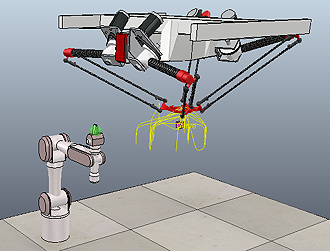
Robotics first entered our imaginations, but now it's becoming part of our lives without us even realizing it.
Robot drones fly overhead, robot vacuum cleaners are on sale in stores, toy robots entertain children, others provide assistance to the sick and more and more products, from telephones to cars, from clothes to food, are assembled by robots.
But before that, there were robots in movies and video games, programmable virtual robots, and before that, robots in literature and robot toy figurines. In short, robots are approaching us and will become part of our daily lives. We might as well be better prepared to master them.
A question of cost
A complete, sophisticated educational robot costs over 5,000 euros ($7,500), so most schools won't be starting out on that scale. Fortunately, there are ways of getting by for less than 500 euros with a few motors, a printed circuit board and the right drawings to cut or print the parts, as with the "Ergo" articulated arm or Lego Robots or a Thymio-type robot. You can start there.
To get used to the idea, even better
If you've yet to demonstrate the relevance of robotics in your environment, you can try out robotics for free with a virtual robot.
The principle is simple: commands are sent to a virtual robot instead of a real one. Simulation software integrates several models of real robots, so everything learned and realized on the simulator can be transferred and used directly on the real models, eventually...
Even with modest means, everyone can participate, as the real robot stage can be shared between several virtual projects, with most of the work taking place in a virtual development environment.
The educational issue
Robotics enables the direct integration of several disciplines:
What the robot does in practice, what it's programmed to do, enables it to touch on all other fields: from the arts to health, from science to leisure. Its practical educational value means that it can keep you busy for years. Many robotic projects touch on social, environmental, scientific or artistic fields.
This video shows how you can move an arm across a table without legs. Handy for putting out fires or flattening pancakes. And what if we added wheels?
References
Robots
Virtual robots
You might also like:
Localize, localizer, localization
By the end of this article, you may feel that you can be "positioned" by anyone. That's true if you're willing to put in the effort and the resources. But there are so many possibilities!
Meet Q, the voice of the 3rd sex
Can we really leave these clichés behind, namely the particularly stubborn one of this helpful, reassuring and trusting hostess? Here, it is no longer simply a question of digital or technological prowess, but of reworking our preconceptions.Q proposes an egalitarian voice, without discrimination, a non-gendered voice...
Your customized A.I. specialist
A.I. then becomes a major element of social influence that you'll have to learn to control. Do you want the truth or what pleases you? Institutions with access to a lot of personal data are all in a position to use and abuse these technologies.
The educational uses of geopositioning are currently being explored. What does geolocation bring to training in practice?
Expert systems: a practical response to complexity
The expert system compiles data, rules, and contexts and produces inferences inferred or induced. It can take into account a vast amount of data and thus improve decision making. By enabling the transmission of knowledge between old and new employees, It also contributes to business stability and production quality.