All kinds of methods have been used to generate commitment, whether in business, at work or at school.
Among the various tools, there's one that's frequently in the news today: gamification. Indeed, after years of media distrust of games (particularly video games), journalists have finally turned their attention to the positive characteristics that explain why gamers spend dozens of hours a week playing them.
Inevitably, they wanted to reproduce the model in many professional and educational fields. But do we really know what makes a good game? What tools are essential for successful gamification? Until the early 2010s, there were very few studies and documents providing an interesting framework for gamification principles. Then along came Yu-Kai Chou, who literally revolutionized the field and became a guru thanks to his octalysis analysis grid. But what am I saying? A grid? More like an octagon...
Under the octagonal magnifying glass
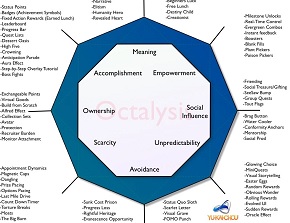
Chou's work can be summed up in an octagon representing the eight aspects of gamification analysis.
- The sense of the epic or the call to challenge : video games succeed in making players believe that they must accomplish grandiose feats to emerge victorious, that they are participating in something greater than themselves. It's this feeling that gamification is designed to reproduce, in part. For example, Wikipedia participants were seduced by the idea of contributing to the largest, most accessible encyclopedia in human history.
- Development and achievement : players like to feel that they're accomplishing something, and that they're being rewarded for it. That's where game successes and player rankings come from. Provided there's some difficulty in getting there.
- Empowerment and feedback: Games that allow you to be creative give a powerful sense of power to the player. This explains the durability of the Lego phenomenon and, more recently, Minecraft. Clear, frequent and positive feedback also contributes to the feeling of empowerment.
- Acquisition and possession: The feeling of owning something is very important to gamers. That's why many gamers spend a great deal of time developing their avatar. It's THEIR character, unique in their eyes. In the same way, gaining wealth or status during a game is also very important to them, and they see it as a precious possession.
- Social influence and connection: This category covers everything that forms the social cohesion of the game. Whether in competition, where the best players inspire others to reach their level, or collaboration, where everyone works together towards a common goal.
- Scarcity and impatience: this is a fundamental characteristic of gaming. Indeed, why does a player spend hours slaughtering monsters or venturing into hostile places in survival games? Because the former's desire to reach a higher level, and the latter's desire to obtain materials to improve their shelter, drives them to continue playing. Even if it means waiting a while for a window of opportunity.
- Curiosity and unpredictability: Good games offer enough suspense and sudden events to make players want to continue the game to see what surprises the adventure has in store. The feeling is similar to that of a reader devouring a novel.
- Loss and avoidance: Finally, players don't want to lose what they've acquired. Consequently, he will avoid traps or bad behavior that will force him to start again or be literally eliminated from the game.
All gaming experiences can be analyzed in terms of these eight aspects. Of course, very few titles correspond to the perfect octagon. The aim is to enable objective analysis of a game or a playful principle.
Extended application to teaching
Consequently, almost any approach can be made more playful. As this page shows, a history course could benefit from gamification.
For example, instead of simple lectures explaining the Middle Ages, children could be sent on a quest for knowledge by the mythical King Arthur (in the epic sense). In the course of their adventures, they will earn coats of arms (achievement) and protections, which can be lost if they misbehave or fail to hand in assignments (loss and avoidance). Students will have avatars (acquisition) that will be deployed on a quest map by group (social influence) representing jobs. However, these will not be numerous (rarity), although some mini-quests may crop up from time to time (unpredictability). As the adventure unfolds, the teacher will give frequent feedback to the students, and may even distribute benefits to them.
The octagonal analysis grid thus provides a good benchmark for developing gamification at school or in the workplace. For those who would like to make the creation of gamification even more playful, they can try out this card game of Spanish origin, available free of charge on this site. It features 35 gamification tools that need to be placed in six parts of the game. The aim is to create an experience that will captivate all players (students or workers) until the end of the game experience.
References
Chou, Yu-Kai. "Octalysis: Complete Gamification Framework." Yu-kai Chou: Gamification & Behavioral Design. Last updated October 9, 2012. http://yukaichou.com/gamification-examples/octalysis-complete-gamification-framework/#more-2275.
Fautrero, Pascal, and Sarah Lachise. "Gamify Your Sequence!" Délégation Académique Au Numérique éducatif - Académie De Versailles. Last updated: April 4, 2016. http://www.dane.ac-versailles.fr/nos-projets/jeux-et-apprentissages/gamifiez-votre-sequence.
Manrique, Victor. "The 35 Gamification Mechanics Toolkit V2.0." Gamification by @victormanriquey. Last updated: October 15, 2013. http://www.epicwinblog.net/2013/10/the-35-gamification-mechanics-toolkit.html.
See more articles by this author