The quality of historical knowledge depends on how information is processed, and from what angle.
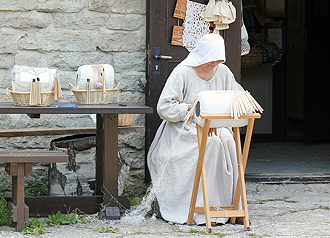
In high-level re-enactment of ancient times, re-enactors use experimental archaeology to reconstruct the knowledge, ways of being, ways of doing and ways of living together of an era.
This is an interesting example, given its 360° dimension, as opposed to literary historical studies, which unfold at 90° according to the x and y dimensions of the paper or screen, and archaeological studies, which take on a 180° dimension through the inert object.
Reconstitution is a constructionist approach to history, based on living and doing, which rests on the constructivist foundations of archaeology and literature, which are projections of history in the mind, on paper or on the Internet screen. The historical reconstruction associated with archaeology and historical knowledge covers the whole range of knowledge typologies that can be confronted with missing links in the history of mankind. How to approach them, how to evaluate them and how to present hypotheses?
Filling the gaps
The primary sources for historical reconstruction are the physical archaeological traces of the period, mainly in museums or private collections. These are always combined with historical studies that contextualize the objects and traces. It's a sort of puzzle made up of tools, jewelry, clothing, historical sites, writings and, for recent periods, audio or video recordings.
The further back in time we go, the fewer puzzle pieces we can find that fit together, and the more we notice the presence of gaps in the memory of places, facts, craft skills and the lives of their inhabitants. In the example of Roman jewelry, we find some very rough and some extremely sophisticated.
If we look at the most delicate, some are made of gold threads finer than a hair's breadth. Today, the mystery is complete as to the know-how behind their creation. It's a missing link in the time-space of historical knowledge. And this lost knowledge is intertwined with an understanding of the world that revolved around this technology, and therefore with the semantics of history. How despairing it is to see in a museum tools that have been preserved as they were on the first day, but whose use has not been passed down to us, and for many is lost forever.
If we look at women's clothing in the Middle Ages, we also see that there is hardly any women's underwear to be found on the entire European continent, whereas men's underwear is more readily available. What does this mean? That women didn't wear underwear? Or that women's underwear was made from materials that have not stood the test of time? What attitude should we adopt when faced with this kind of mystery?
In the world of historical archaeology, some highly specialized re-enactment groups have decided to base their work solely on proven sources. This means they only wear historical costumes reconstituted on the basis of what they find in historical sources. Imagine that the ladies in this case don't wear underwear. This is purely historical from the point of view of the state of research, but not from the point of view of women's everyday lives.
Imagine a woman working in the fields who, for the rest of her life, has only one item of clothing, which she adapts to her anatomy by adding or removing pieces from her dress as she becomes pregnant, for example. Her garment is therefore precious to her.
Yet, according to historical sources, she can't guarantee her personal hygiene. If this were the reality at the time, her dress would have to be replaced frequently, and therefore could not be worn for the 20 to 30 years of this peasant's adult life. In fact, it's impossible. Roman women wore undergarments, Renaissance women wore undergarments, but medieval women didn't?
Faced with the facts, we can broaden our vision with the concept of DNA.
Faced with this purist branch. There's another branch of historical reconstitution that tries to imagine the missing links and experiment with them as we would in a technology lab. This is a historical prospective approach. The approach is based on a DNA close to the history under the magnifying glass and the technological development of the object under observation.
It's fairly easy to do this for older periods, when there are no paradigm shifts. Fashion evolutions in the Middle Ages had little impact on the lower classes, so their lives were little affected. The evolution of working-class costume from the 11th to the 15th century was very slow, with top and bottom lengths changing and cuts evolving, but very, very slowly and in waves over the centuries.
The longest evolution is undoubtedly that of the 11th-century under-dress, which is very close to the Roman dress that preceded it 1,000 years earlier. It was very, very wide and only had lacings. Whereas 5 centuries later, at the end of the Middle Ages, clothes were cut very close to the body, and buttons and pockets became more common. Fashion then evolved on the scale of decades.
We can therefore approach reality by iteratively approximating the model hypothesis. The model hypothesis is similar to the technology used to reconstitute the DNA of extinct animals. We take the DNA of an animal or typology that we assume to be close to us, and superimpose or graft the historical DNA onto it. The result is a coherent, viable ensemble of the subject studied.
The choice of DNA is essential. Is it Roman DNA that should be applied to our underwear problem, or 15th century DNA, or even Renaissance DNA? It's a contextual choice, especially in a multi-speed society. For the nobility, without hesitation, the choice will be towards the 13th century, excluding the exception of the very exuberant 14th century and its complete opposite, the 15th. But to make this choice, you need a thorough knowledge of history and context. Without contexts, we can make serious projective errors. Today, for example, if extraterrestrials arrived on Earth and relied on the complexity of language as DNA to assess which is the most evolved species on our planet with which to communicate, they wouldn't talk to humans, but to whales.
The right context for the story
It's all a question of how you look at things and what you're looking for. We can apply this method to genealogical research, for example. Today, you can do a lot of research on the Internet. There's the Mormon database online from Salt Lake City, which is gigantic, and software that matches common or potentially common ancestors in your tree with those in other family trees.
In some parts of the world, there has been little intermingling of populations, and we can find closed communities that lived on their own until the mid-19th century. It's a configuration that often generates genealogical DNA chains. One of the most obvious is the chain of first names.
In the Vallée de Joux, a Swiss valley in the Jura mountain range, life was hard and the roads difficult to access, especially in winter. And, at the same time, we can find traces in parish registers, for example, of several Messrs Rochat all living in the same village and having the same first name. They were all cousins and knew it. They had nicknames to distinguish them from one another, nicknames that have sometimes been perpetuated over the centuries to distinguish one family from another. What's interesting to observe is how first names were passed down. These were often families with 10 children, and generally the first children had first names that corresponded to the extension of their patronymic identity.
Imagine 5 Messrs Aubert from the same siblings, whose first names are Nicolas, Pierre, Henry, Auguste and Louis. They were born about ten years apart, and will have children. There's a very good chance they'll name their first sons Nicolas, Pierre, Henry, Auguste, Louis, in the same way they pass on their family name. And the small village will end up with 10 or more Nicolas, Pierre, Henry, Auguste, Louis siblings. The same applies to the daughters born into these same siblings.
Classical genealogical research is linear, because it's based on research in physical or virtual archives about our parents, our great-grandparents, their parents, their parents' parents, going back dozens of generations if we're lucky. However, if the chain is broken, then it's virtually impossible to go any further. The chain of ancestors is broken.
Today, we have access to gigantic databases that are sometimes interconnected, but often orphaned or disconnected from their family trees. By referring to the notion of DNA and context, we can enrich knowledge, and even help to find missing chains of knowledge. If we take the example of the first-name chains mentioned above, we can't authenticate the direct filiation link, but we can associate orphaned chains with families, and through micro-details on dates of baptism, death, nicknames... we may have the chance to link them to a precise position in a defined tree.
This is akin to genetic analysis, which can also associate one individual with another as a relative or cousin, without any knowledge of family history. Context can also be important in genealogy. If we stay in the Vallée de Joux and surrounding area, here's another example.
We have two women with the same first names, the same surnames, born in the same place, baptized on the same day at the same time, verified ancestors of two distinct families, and each of them had children earlier than the other with their respective husbands, who both lived to a ripe old age. They had one child each in the same year. And both children were baptized within months of each other. These two women had many Catholic descendants scattered across France, who developed several family trees. They recognized each other in their respective trees, but there was never any confusion between the two trees. They are then two distinct people.
Except that, in reality, they appear to be the same person. The trees were analyzed with Catholic eyes. If these descendants had been predominantly Protestant, then the link would have been made much earlier. The difference between the two communities that interests us is the notion of divorce and blended families. What was forbidden among Catholics was practiced among Protestants.
Just as today, some family histories were not straightforward. We can assume that, after having several children with her first husband, this lady left him for another in a divorce. She married her new lover, who also had children of his own, and had many more children with him. Where it gets more complex is the birth of two children, born in the same year and recorded in the parish register by their baptism on dates close to each other, but different in each of the families, each recognized by each of the husbands. We know that in those days, a child belonged first and foremost to his family, before to himself, because he guaranteed arms for the fields and for his parents' old age.
What's more, a child in those days wasn't necessarily baptized immediately after birth. If they were, it was because they feared for their lives. We can therefore assume that these were in fact twins who had been split between their father and mother, and that one of them was undoubtedly unwell.
Context can change the weave of history. And the DNA of an object, a way of doing things, an individual's family can help open up new fields of possibility in the face of historical black holes with a capital H or a small H, which can become semantic black holes if left unresolved.
Image source: Mars87 on Pixabay
Source
Virginie Guignard Legros, genealogist and head of Swiss historical reenactment companies for the CERS, author of the article.
See more articles by this author