When researchers encounter or confront other ways of thinking
Science versus the paranormal or common sense
When they leave their labs, scientists meet people for whom the universe is not made up of equations. Paranormal enthusiasts conjure up obscure forces and chains of causality riddled with contradictions. Others, on the contrary, use the results of their research to demonstrate anything and everything...
Some can't stand it, and jump into the fray, abandoning their research for a while in favor of polemics, in an attempt to explain what science is all about.
Denouncing magical thinking
Georges Charpak is a chemist. But not just any chemist, since he was awarded the Nobel Prize in 1992. Together with Henri Broch, he wrote a book with the attractive title "Devenez savant, devenez sorcier" (Become a scientist, become a sorcerer) in 2002.
More precisely, the book sets out to make us more knowledgeable and demystify "sorcerers". Charpak and Broch denounce the rhetoric of astrologers, graphologists and dream analysts.
They explain that astrologers use a frame of reference linked to the sun and not to the sidereal stars to study the movement of the stars, and are therefore mistaken by more than a million kilometers about the position of the earth.
But many will reply: "And yet what this or that astrologer says is true... I recognize myself in it". In response, Charpak and Broch cite an experiment in which students gave some information about their star signs and dreams. Some time later, the researcher brought them a document showing their profile, and most of them recognized themselves in it. But what they didn't know was that they'd all been given the same sheet, with the same profile... Charpak and Broch see this as an illustration of the "well effect", which means that the more vague and hollow something is, the more you recognize yourself in it.
The book goes on to explain the magicians' tricks. One might have wondered about the relevance of a Nobel Prize-winning scientist fighting against astrology, but wanting to demystify magic is an even more surprising undertaking. Who still believes that magic tricks are magic? They make us dream, they amaze us, they reveal that our attention and perception play tricks on us, but everyone knows there's a trick. And it's quite likely that most of us don't want it explained to us, just as we don't want details of special effects when we watch a film.
Fighting against the use of scientific results to demonstrate anything and everything.
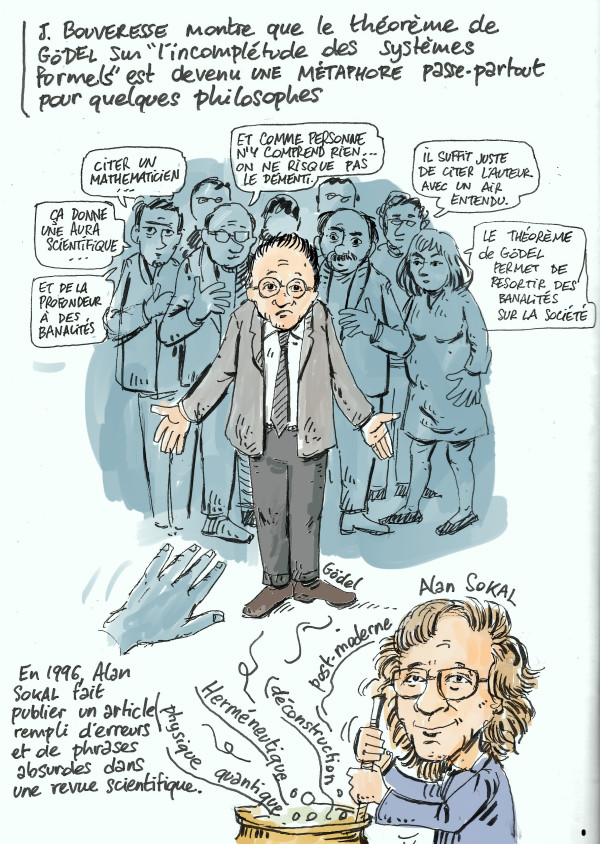
In 1996, Alan Sokal wrote an article for a scientific journal. He slipped in a number of scientific errors, but above all, he multiplied references to quantum mechanics, mathematics and post-modernism in sentences that made little sense. As soon as it was published, he denounced the deception and wrote a book with J. Bricmont on scientific impostures.
Twenty years on, it's hard to imagine the impact of the affair in the mainstream press, and the violence of the exchanges between the book's supporters and its critics.
The authors denounce the extrapolation of results from physics or mathematics into other sciences, by people with little knowledge of them. For example, Gödel's theorem on formal systems in mathematics has been used to explain the workings of human societies, or to justify religions... Philosopher Jacques Bouveresse has in turn denounced the abusive use of metaphors in the human sciences and philosophy.
Perspective and modesty
Étienne Klein's book Galileo and the Indians takes a rather different view. It's no longer a question of opposing two ways of thinking, or determining who's right. The beginning of the book sets out two fundamentally different representations of the world, which can nevertheless be respected.
The physicist sees the world through equations, figures and concepts. The Kayapo Indians, on the other hand, live in a world where perceptions and sensations are essential. This encounter raises questions for the physicist: "Does science as taught by Galileo distance us from nature?"
The world of science is far from watertight. Because they fascinate, we're tempted to use them as a grid for analyzing our daily lives or more existential questions. Because they lend aura to a discourse, we sometimes use them as a metaphor...
In the 17th century, Pascal was already denouncing half-wits, who he considered far worse than those who didn't dabble in science.
With the Internet, these polemics have taken on added force. They add sarcasm and invective to the rectification or correction of errors.
Illustrations: Frédéric Duriez
Resources :
French Association for Scientific Information: consulted on October 21, 2017 https://www.afis.org/
Le scepticisme scientifique - balado-diffusion - consulted on October 21, 2017 https://www.scepticisme-scientifique.com/ we only regret the lack of detail on the objectives of the site, the definition of "scientific skepticism" and a presentation of the speakers.
A good way to avoid worrying too much about the future is to take it day by day; that way our probability of seeing the next day always remains high. But the media love to show us something to worry about, even tomorrow. The best way not to worry about tomorrow, or even about the future, is to take care of it, and that starts at school.
Based on educational trips, a vision of the forms of educational leadership in England, India, Quebec, Finland and France. We can take different reference systems to orient ourselves towards quality learning.
The question of the emergence of technologies and their impact on learning will take more and more place in the debate. Teachers must also find ways to take into account these tools in their learning and why not, integrate them usefully.
One is precise and rigorous, but slow and lazy. The other is always on the lookout and on the move... but lacks precision. That's a fine scenario for a film in which two anti-heroes line up clumsily. Except that here, it's inside your skull that the story is played out!