Technologies have their good and bad sides. In fact, they create tools that depend on how people will use them. AI or Artificial Intelligence is controversial and if some find in its breakthrough a major scientific advance, others are more alarmist. For those who need a deeper understanding or assistance on this topic, consulting expert essay writers can be beneficial.
In this article, let's see what can be the effect of AI-based tools in education.
AI allows to translate, write, rewrite or correct texts
The latest progress of AIs has been spectacular. Artificial Intelligences now know how to render many services.
- One of the best known AI services is Deepl. Deepl allows you to translate texts in different languages. The quality of the translations is very good and much better than what Google Translation offers.
- Also, there are text writing tools. Text writing tools do what is called NLP (Natural language processing - not to be confused with NLP (neuro-linguistic programming)).
- In the tools available there are also tools for rephrasing texts.
NLP, GPT3, what is behind these obscure acronyms
That which is not well known disturbs, let's try to understand the terms and the functioning.
NLP
According to IBM's website, here is what NLP is (for the purposes of demonstrating the article, explanation from IBM's website has been translated from English to French with Deepl):
"Natural language processing (NLP) or natural language processing refers to the branch of computer science - and more specifically the branch of artificial intelligence or AI - that aims to give computers the ability to understand text and spoken words in the same way as humans.
NLP combines computational linguistics (rule-based modeling of human language) with statistical, machine learning and deep learning models. Together, these technologies enable computers to process human language in the form of text or speech data and "understand" its full meaning, along with the speaker's or author's intent and sentiment." IBM source
GPT3
According to educative.io (translated text),
"GPT-3 is short for Generative Pre-trained Transformer 3. This is the third version of this tool.
In short, this means that it generates text using pre-trained algorithms, meaning that they have already been given all the data they need to complete their task. Specifically, they were provided with about 570GB of textual information collected by crawling the Internet (a publicly available dataset known as CommonCrawl) as well as other text selected by OpenAI, including text from Wikipedia."
Generating text with an AI
In many people's mental representations, a machine (or in this case an AI) will write fairly basic texts, with simple sentences and sometimes errors in meaning, grammar or vocabulary. This is even more imbued in the imagination when it comes to the French language, which is considered complex.
For the purposes of this article, a text was generated by an AI based on a simple title for any instruction or prompt (this is the term used for "writing instruction terms" given to the AI). The topic is directly related to the topic of the article, "Doing Homework with an AI". You can find the text at the end of the article. The choice was made not to proofread or edit the text so that you can see what an AI is capable of when it comes to writing text.
Why have an AI write text?
Various audiences may find value in using an AI for writing text.
- Web copywriters, SEOs or website managers can use an AI to write optimized text to help their SEO.
- The press has already been using bots to write articles for years, like the Washington Post. The world of the press has changed well and the obligation to publish continuously in order to create a constant flow on their websites force newspapers to produce new writings all the time.
- Scientific studies: the paradox went so far that an IA wrote a scientific study about herself.
- And what we're particularly interested in: students and pupils.
Reformulating texts with an AI
AIs are also very good at reformulating texts. In fact, they correct, by rephrasing, possible mistakes in French. Again, the quality is often there, the best being an example:
Here is a text that is on the cursus.edu homepage (this is a screenshot to avoid duplicate content)
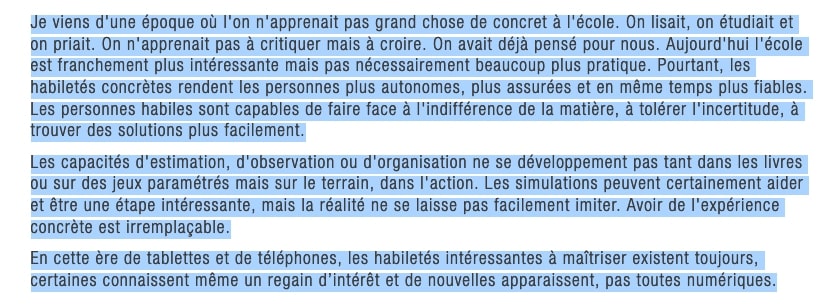
Here's the rephrased content:
"I was born in the days when we didn't really learn any concrete material in school. We read, prayed and studied. We didn't learn to criticize, instead of believe. We already had an idea of ourselves. Today's school environment is certainly more exciting, but it is not necessarily more practical. Yet practical skills make people more self-reliant, more confident, and more secure. People with a solid foundation are able to deal with and accept uncertainty in the subject matter, to find solutions more quickly.
Observation, estimation, or organization skills are not taught in books or parameterized games, but in the field, in the real world. Simulations can certainly help and provide a stimulating experience, but reality is not easily replicated. Experience gained in the field is invaluable.
In the age of smartphones and tablets, there are interesting skills to master. Some are experiencing a revival, some are newer, but not all are digital."
Consequences of the emergence of these tools
The most direct consequence is that plagiarism detection tools will no longer work. These tools already do not detect translations. But with rewriting tools, they will be inoperable in their current form. To understand this, you need to know that they work by searching Google for identical strings of characters through the use of quotation marks. They therefore massively search small passages of the text to be checked.
If the text has been reworded, it only takes one character in the string to change (let alone a word) for it to no longer detect anything.
Assignments, writing assignments and dissertations that require writing are also affected. What is the point of a teacher correcting a text produced by an AI. And will the student have acquired the required skills by using this medium? The answers to these questions show that we will have to adapt and find other ways.
Is it wrong to have an AI write a text?
Value judgments are always very complicated to make. In the absolute sense, it's obvious that a learner who cheats is doing himself or herself a disservice. But if the process is easy, the temptation will be great, too great for some. Teachers must also find out how to take these tools into account in their learning and why not, usefully integrate them.
To the point of learning something from them
The progress of AIs will probably lead teachers to rethink some of the tasks they give to their learners and their assessments. The question of the emergence of technologies and their effect on learning will become more and more important in the debate.
Three years ago, an article on the contribution of AI in writing was published in Thot Cursus: How to save time with AI for your website?. Over that time, the progress made has been immense.
Here's the text produced by an AI with the title as "prompt" «what do you think?»
i'm not sure how much i'm going to pay for this. iI I'm be able do that. Doing homework with an AI
Artificial Intelligence is a rapidly growing technology with many possibilities. It is now capable of doing its own homework and correcting it. This feature is especially useful for students who are struggling to keep up with school or need a little extra help.
Why doing homework with an AI is a bad idea
Doing homework with an AI is a bad idea because it can lead to several problems. First, the AI does not always understand the context in which students are working and therefore may provide incorrect information. Also, the AI is not able to take into account individual differences between students and therefore may not be appropriate for their level. Finally, doing homework with an AI may lead to a loss of interest in studying because students will no longer have the opportunity to learn on their own.
The dangers of AI in learning
Artificial intelligence (AI) is increasingly present in our lives. It helps us perform everyday tasks, such as shopping online or planning a trip. It is also used in businesses, to optimize processes and make decisions. AI is even used in education, to help students learn.
However, there are potential dangers in using AI in the learning process. Indeed, AI is often based on algorithms that are not always reliable. These algorithms can sometimes favor some students over others. In addition, AI can lead to a loss of autonomy in students as they become increasingly dependent on these tools to learn.
Therefore, it is important to be aware of the potential dangers of AI in learning, so that they can be prevented.
Why AI can't replace teachers
Artificial intelligence (AI) is a concept that has garnered a lot of interest in recent years. Many people have envisioned AI as a threat to jobs because of its ability to automate certain tasks. However, it is important to note that AI cannot replace teachers. This is because AI does not possess the ability to think critically and make decisions based on a given context. Furthermore, AI cannot communicate with students in the same way as a teacher. Teachers are essential in the learning process because they are able to provide a safe framework and guide students through their academic journey.
The limitations of AI in learning
A few years ago, computers and cell phones were fairly limited productivity tools. Today, thanks to advances in artificial intelligence (AI), these devices have become powerful learning tools. Students can now use apps to do homework, learn to speak a new language or even study for an exam.
AI is especially useful for repetitive and tedious tasks, such as writing reports or grading papers. Software can perform these tasks much more quickly and efficiently than humans. In addition, they can provide students with instant feedback on their work, which can greatly accelerate learning.
However, for all its advantages, AI also has some limitations in learning. In particular, it cannot yet compete with humans for tasks that require creativity or intuition. In addition, the software is not yet perfect and can sometimes give incorrect results. Finally, AI is expensive and can be difficult to use for students who are not familiar with computers.
Why AI should not be used to do homework
As artificial intelligence (AI) applications proliferate, it's tempting to think that they could one day help us with homework. However, it is important to realize that AI should not be used to do homework. In fact, AI has several potential risks that could harm students.
First of all, AI is still in development, so it is not perfect. Therefore, it may make mistakes and students may not know how to correct them. Also, AI is not always able to understand the context of a problem and therefore may provide the wrong solution.
Second, using AI to do homework can lead to a loss of interest in learning. This is because if students know that they can simply ask an app to give them the right answer, they will have no incentive to learn themselves. Thus, AI may slow down learning rather than speed it up.
Finally, there is a risk that students will not be able to critique the solutions proposed by the AI. If students do not learn to critique the solutions proposed by AI, they may not know how to find the best solutions themselves. Thus, AI may prevent students from learning some important skills.
In conclusion, while AI has some potential benefits, it is important to realize that it also has several potential risks. For example, AI should not be used to do homework.
It's official, robots are taking over our lives. Now you can do your homework with the help of an AI. This may sound scary, but it's actually a good thing. Robots are able to do things much faster and more accurately than we can. That means you can focus on the things that really matter, like learning new things and spending time with your family and friends.
See more articles by this author


