Are waves the shapes, or do they create the shapes? Are shapes generated by waves? Why do we find the Fibonacci sequence in the shape of our ears, in the shape of certain plants... and in the movement of black holes at the bottom of the universe?
Publish at February 11 2018 Updated March 09 2023


Little by little, society is changing. In 1918, suffragettes succeeded in Britain in obtaining the right to vote for women aged 30 and over. It would take another decade to achieve 21-year equality like men.
This movement gradually spread throughout the West to offer women the right to speak out as full citizens. Nevertheless, 100 years later, despite the considerable progress, the fact remains that despite the impressions, equality between men and women is not yet established.
In early 2017, the High Council for Equality between Women and Men submitted a very harsh report on the situation of equality in schools. It deplored the lack of training for teachers on this topic and also the school textbooks that continued to encourage gender clichés with a predominant number of images of women performing a household task and, conversely, professional or sports men.
The stereotyping of teachers would go right into their interventions with students. For example, they will grade girls less harshly, praising their efforts while demanding more from boys. On the other hand, they will interact more with boys during math, science, or technology classes, which are considered "male subjects."
In this context, then, it becomes necessary to remind people of gender equality in the classroom, starting in early childhood. Fortunately, there are resources that teachers can incorporate into their lessons, in all subjects.
For example, the Matilda site, which has been around since February 2017, offers dozens of videos addressing equality and women's place. This way, teachers can find what they're looking for by teaching and grade.
For each video, they will be entitled to a page offering summary, an opportunity to obtain the transcript and a teaching scenario as well as additional resources. Those registered with the site will be able to access other features such as downloading the video to a device.
Those wanting to use YouTube channels could turn to Let's not talk much, but let's talk which deals with sexual, but also love topics addressing women and men in respect and consent. All with a humor that should appeal to teenagers. Here, for example, is one of their vignettes dealing with "slutshaming", a phenomenon of judgment on women:
Teachers wanting to reflect on inequalities in teaching materials may want to check out these videos that Canopé has offered on its "Equality Girls-Boys" page.
Among other things, inequalities in textbooks, in everyday life, and in reading and children's literature are discussed to note. This last work can also be done with the students themselves. For example, as suggested by this article, they could analyze the female characters in a story, how they are qualified and the relationships they have with the other characters.
The Canopé website also offers educational tracks for different disciplines at the first and second level of education.
Some resource sites suggest various ways to talk about equality. Charivari in School suggests, among other things, showing the importance of women in history, focusing on major female figures.
The Famous Women site offers biographies of personalities or figures of the female gender. Addressing those in the news can be interesting. Real-life situations as well are suggested. The author will tell of a class where the teacher proposed two different sports activities. To choose, he asked only the girls to vote. Obviously, the boys protested and the teacher then explained to them that they lived exactly the situation of their foremothers for many decades.
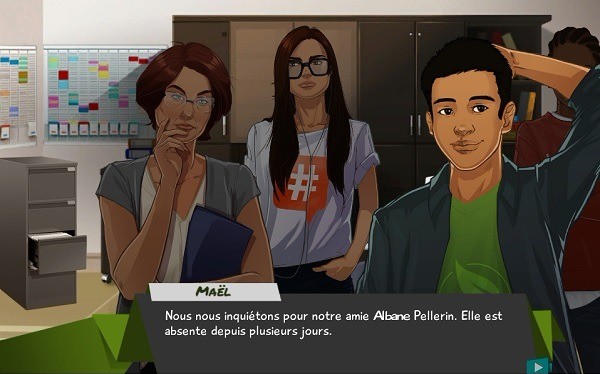
For its part, the Académie de Versailles suggests a long list of resources to address the issue, including serious games. The most striking example is that of the Charente-Maritime departmental youth council, which has created a game called "In Pursuit of Equality".
In this playful experiment, three young people investigate the prolonged absence of one of their classmates. Their investigation will show that the girl suffers a lot of prejudice because of the subjects in which she excels, the sexism shared on a daily basis (including by two of the three protagonists who are boys), etc. An excellent initiative that reproduces well the dynamics of high school and the ways of thinking of teenagers. Also, the multi-day investigation sheds light on different topics and extends the immersion.
Educational resources on the equality of boys and girls abound on the Web. Yet, it seems necessary to recall them since even today, schools continue to carry and transmit sexist prejudices to children. The subject is certainly delicate, but it is essential to deal with it and in more than one sauce.
References
"Girl-Boy Equality, Parity: How to Teach This In The Classroom?" Charivari à L'école. Last updated October 26, 2016. http://www.charivarialecole.fr/archives/1475.
Famous Women. Accessed February 7, 2018. http://www.femmescelebres.com/.
Matilda. Accessed February 7, 2018. https://matilda.education/app/.
"Gender Equality Tools." Canopé Network. Accessed February 7, 2018. https://www.reseau-canope.fr/outils-egalite-filles-garcons/agir-en-classe314.html#bandeauPtf.
"Some Tools To Fight Masculinist School Knowledge." N'autre école. Last updated October 7, 2013. http://www.cnt-f.org/nautreecole/?Quelques-outils-pour-lutter-contre.
Reboulleau, Laetitia. "A L'école, Les Stéréotypes Sexistes Ont La Vie Dure." Marie Claire. Last updated February 22, 2017. http://www.marieclaire.fr/,a-l-ecole-les-stereotypes-sexistes-ont-la-vie-dure,843849.asp.
"In Pursuit Of Equality." Accessed February 7, 2018. http://fille-garcon.charente-maritime.fr/le-jeu.
"Égalité Filles-garçons : Ressources Pédagogiques." Académie De Versailles. Last updated: February 2018. http://www.ac-versailles.fr/cid108523/egalite-filles-garcons-ressources-pedagogiques.html.
You might also like:
Are waves the shapes, or do they create the shapes? Are shapes generated by waves? Why do we find the Fibonacci sequence in the shape of our ears, in the shape of certain plants... and in the movement of black holes at the bottom of the universe?
Measuring. To control or to accompany?
Classical platforms provide us with data that is not enough to provide remediation when learners encounter difficulties. Database, cognitive psychology, and training specialists are trying to go further with cognitive tutors, and distance learning actors are expressing needs that go even further...
"You don't learn to swim by watching the lifeguard, or by debating the properties of water."
Communities of practice in education: stimulating!
Communities of Practice (CoPs) stimulate collaborative learning and motivation in education. They enable people to learn together with pleasure. The facilitator plays a key role in creating a virtuous cooperative dynamic. A real source of inspiration for reinventing school...
It's not so much a question of asserting a particular religion as it is of asserting human values in the public sphere, of tolerating a vision other than the objective, material values alone, which are poor guides when it comes to orienting oneself towards happiness.