In the '80s, the image of the Earth floating in the vacuum of space acted as a collective wake-up call: this is our planet, where we live. But beyond this awareness, true collective consciousness on a planetary scale needs many other conditions to manifest itself...
Powerful perceptions
Thousands of observation satellites are launched every year. These satellites accumulate a vast amount of data, and their observation capabilities are constantly improving, in terms of resolution (image precision), observed spectra (from radio waves to ultraviolet), telemetry (radar, lidar) and positioning. All these instruments are complemented by pseudo-satellites, autonomous drones with capabilities that can be adapted specifically to the needs of the moment.
More perception means greater awareness. Having the means to perceive is the first condition of consciousness.
Expandable memory
Data storage costs are becoming marginal and continue to fall. Every day, petabytes (1015) of satellite data are added - we're now talking about quantities of data in terms of exa, zetta and yotta (1024) bits. Memory is no longer an issue.
If you can remember the past moment, you can conceive of existing in time. The deeper and richer the memory, the broader the consciousness. Memory is a second condition of consciousness.
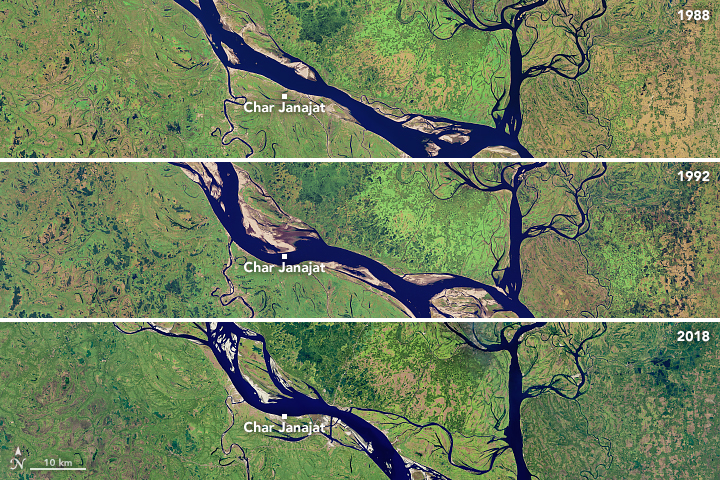 Untiring discernment
Data takes on meaning when it is qualified. The difference between "having books in a library" and "having read them and being able to retrieve their contents" is much the same with the zettabytes of data that have accumulated and that nobody really consults.
The challenge of classifying them has been solved for some time with geo-positioning and universal time, but the challenge of discerning and identifying what is being observed remains. A human being can examine a few hundred images and recognize elements, but when it comes to millions of images and data, the task is beyond anyone's comprehension and ability, and becomes insane. Fortunately, this is where artificial intelligence comes into its own.
Once a human has taught an A.I. to recognize elements, the A.I. then becomes capable of examining millions of images and discerning from them any object, boat, house, cow, river, truck, tree, human, indexing them but also, and above all, identifying anomalies: diseased tree, infestation, flood, new construction, fire, gathering, etc.
The ability to discern on the appropriate scale is a third condition of consciousness, and it is now operational.
Whose awareness?
At best an A.I. will signal what it is taught to identify, what it is taught to find important, valuable, desirable or to avoid, according to certain goals, needs and prejudices. It can become more or less autonomous, but ultimately it's a tool for increasing our awareness of the perceptible universe on an otherwise inaccessible scale.
In this sense, planetary consciousness is now possible - it's our consciousness we're talking about, the one we want to have or ignore.
In concrete terms: Images + Intelligence
Several companies have begun marketing the possibilities offered by satellite imagery coupled with artificial intelligence. The markets are alluring: agriculture, insurance, civil security, transport, environment, defense, journalism, urban planning, construction, mining and other areas to come, not to mention university research. This potential justifies the major investments being made and the resources available to these companies.
Here are the main ones:
Planet
has launched 207 satellites and has 31 ground stations. It continues to launch satellites on a regular basis. It records more than 1.5 million images a day , and offers a minimum of 500 very high-resolution images of every location on earth, making it possible to track the evolution of each site in a time sequence.
Thanks to artificial intelligence, this company is well on the way to identifying and inventorying every object on the earth's surface and exploiting its data. This is its declared ambition.
North Star
currently has 47 multi-spectral and infrared satellites and offers the same kind of services as Planet, but with the added possibilities of multi-spectral imaging and predictive analysis. Continuous monitoring of the planet, even at night, opens up possibilities that are scarcely imaginable.
Airbus Intelligence
does not offer as many similar satellites, but benefits from a wider variety of instruments, including radar satellites, and also has images that go back further in time. It too uses A.I. to extract meaning from the millions of images it records.
The company has developed a new tool whose potential for precision and availability opens up other markets: pseudo-satellites. In fact, these are lightweight drones (75 kg) flying at stratospheric altitude and recharging on solar energy. The Zephyr prototype flew for over 25 days without landing. These pseudo-satellites can be launched on demand, with no real limit on the number.
Government institutions
also have considerable resources at their disposal, and are often focused on research imperatives that currently offer little commercial interest, or on defense mandates that are usually secret. If useful data can be extracted, it will be marketed via private companies or government agencies. Most give access to part of their data free of charge.
Nasa Earth Observatory (United States)
Earth Data
USGS - Earth Explorer
NOAA CLASS
NOAA Data access
LandCover
European Space Agency (Europe)
Earth Online
Copernicus - Sentinels Scientific Data Hub ( ESA)
INPE (China Brazil)
Jaxa (Japan)
Bhuvan (India)
For a more detailed description of the services, see the "Directory of satellite image services" - Thot Cursus.
International system prefixes - Wikipedia
See more articles by this author