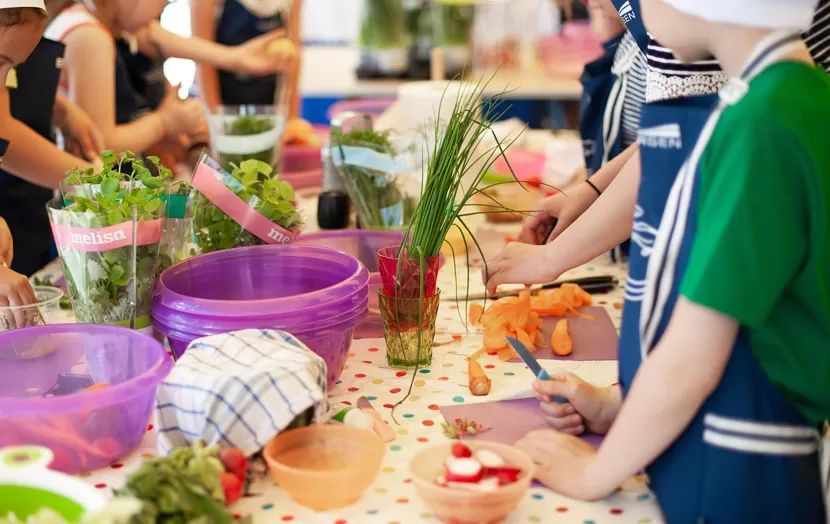
Cooking at school? An extensive repertoire of transformative activities already on offer. Smells and tastes great.
Publish at October 02 2018 Updated December 07 2022



Words often represent a concrete reality; for example, dim sum, hamburger, spaghetti, or vodka bring foreign words into our languages through the belly. Through the ears, concerto, rap, cantata, viola, disco, and rock are all foreign words that are well integrated into the musical culture.
The words and syntax we use bear the traces of our relationships. Greek thought and Latin civilization have deeply etched their influence into our languages. Arabic has permeated astronomy, arithmetic and even chemistry, Italian music and cooking, Japanese management, English commerce and technology...
In the words of each language we can trace the main influences. Unsurprisingly, there are more words of Arabic origin (500 common words) in the French language than words of Gallic origin (about a hundred, like "dru")! The Arabic influence has lasted much longer and the Roman influence has been culturally more sustained than the Gallic.
The "purity" of a language will seem an incongruous idea after this exercise. The language will appear all the more alive.
1- The exercise consists of taking a list of countries, regions, and languages and simply listing the common words from those lands or civilizations that are present in our own.
To many people, the number of foreign words that will be identified is quite surprising. We do the exercise for about fifteen minutes and let it rest.
2- The next day we resume.
As long as curiosity has been aroused. the participants will return the next day with new suggestions. It is easy to get caught up in the game and in two or three days, each participant will have at least contributed a few words.
Some examples:
3- From the list developed, discuss which influences are demonstrated by certain groups of words and in what areas. For example, Japanese cultural influence is clearly identified in martial arts, Spanish in dance. What are the other influences?
4- We can extend the game to the influences of dead languages (Greek, Latin, Aramaic, Celtic), or local (Breton, Basque, Shiaq, etc.). The cipaille (six pasta) of Lac-St-Jean or the gariguettes (variety of strawberries) of Provence are also part of our language and our imagination, depending on our region.
With Latin and Greek, a large number of words will be suggested, so in order to open up the game to more languages, we may not use these languages at first if the group is lively enough.
A language communicates ideas, emotions, memories, projects, desires... It speaks and writes itself with symbolic representations of what surrounds us. It lives and is open to the world, which does not mean that it does not have its own way of naming things. What she discovers belongs to her and she too can influence as much as she herself can be a carrier of the influences of others.
5- If there are immigrants in the group, we can complete this exercise with the English words that have penetrated their culture: ghosting, ride, manager..., what are theirs?
At the end of the exercise, everyone realizes how alive and influenced languages are and how they also influence others.
Reference
There are more Arabic words than Gallic in the French language
France-Inter - Ouafia Kheniche
https://www.franceinter.fr/culture/plus-d-arabe-que-de-gaulois-dan-la-langue-francais
You might also like:
Cooking at school? An extensive repertoire of transformative activities already on offer. Smells and tastes great.
Ancestor worship in Africa: a factor of social stability
For Africans, ancestor worship is a way of living in harmony and ensuring that life goes smoothly. It guarantees the social and family stability of descendants of the deceased.
Digital technology to anticipate or extend a visit
Adding up the kilometers traveled and multiplying visits in a limited time: that's what many tour operators offer. Yet many of us don't share this vision of tourism. Economic and health constraints, as well as the urgency of climate change, are prompting us to change the way we spend our vacations.
Dealing with the present moment
To improvise collectively, in fact, the main skill to develop is listening - to oneself, to others and to the collective sound. Genuine listening is therefore a skill that needs to be upgraded, and requires specific training.
Financing your studies like a pro
At Thot Cursus we frequently receive requests from dreamers who sound like they are fishing in the desert with a hammer or a guitar. Luck is not to be abused.
Numerous institutions and organizations are willing to assist any student who will demonstrate coveted or sought after qualities in the targeted field. Some suggestions.