The importance of teacher recognition
Recognition drives motivation and boosts self-esteem. Teacher recognition is vital.
Publish at January 13 2019 Updated February 22 2023


Faced with a changing world, uncertain, volatile, complex, ambiguous everyone seeks reassurance and imagines what the skills of a world that is being built might be. The knowledge economy implies an increasing manipulation, production and dissemination of data.
According to international or local agencies, researchers or consultants, the expressions 21st century skills, transversal skills, soft-skills or capabilities are used to describe this grail of knowledge that could help us transform ourselves along with our environment. But what are we talking about?
"Competence is an ability to act based on the effective mobilization and combination of a variety of internal resources (knowledge, cognitive ability, metacognitive ability, relational know-how, procedural know-how, physiological resources, emotional resources, ...) and external resources (networks, software, data banks, documentary resources, members of the collective, means of the professional environment, ...) within a situation in a given context." (Jacques Tardif -2006).
What do we need for the 21st century. What knowledge will be essential?
In 2013, the UQAM cites compilations by Dutch researchers, Joke Voogt and Nathalie Pareja Roblin, on UNESCO, OECD, and European Union benchmarks, which they compare to other Australian and American benchmarks. They note two types of skills:
|
The competencies mentioned in all repositories :
|
The competencies identified in the majority of the referentials :
|
In 2015, the refinement continues and Paris Innovation Review based on the work of the OECD, the international expert grouping ATC21S or even the American organization P21, asserts that the expression would bring together three major blocks. Generic learning skills, innovation and creation skills and collaboration skills seem to stand out.
In 2016 Margarida Romero, a researcher in educational technology, meanwhile, identifies 5 compétences clés :
Relating to the uses of technologies, Margarida Romero and Thérèse Lafferière identify five levels of technology use: passive consumption, interactive consumption, content creation, content co-creation, and, finally, participatory co-creation of shared knowledge within a learning community.
Cross-cutting competencies are another way of describing what can transfer from one situation to another.
The crosscutting skills guide identifies skills that are meant to be usable in all situations :
The difficulty of all these analyses by competence is precisely the entry by competences as shown by the review Knowledge, as early as 2013, competences do not exist in isolation, only exists " the social judgment of competence ". The entry by competences finally refers to a competitive vision of the world, precisely that which produces social, economic and climatological disorders. So what alternatives?
In addition it is possible to emphasize the behavioral angle, managers and leaders are also interested in what will make the difference. In the book soft-skills, 15 skills are identified.
|
1. Problem solving |
6. Time management |
11. Motivation |
As the lists vary from author to author as in the " Handbook of leadership theory and practice" co-edited by Kurhana in 2010, there are over 210 traits reviewed to position oneself as a true leader, so much so that the certainty on which trait is the best fit is not very credible. Perhaps if skills and soft-skills are insufficient to describe what is coming is that they do not embrace the complexity of situations.
Description is insufficient to successfully implement in organizations new ways of doing and thinking about action to adapt to the world that is being built. There are alternatives to the way of thinking its action in the world:
These three reflections are important because they remind us of the importance of the reality of situations beyond referentials or descriptions. They suggest that we think about the world without pre-constructed categories and push us to start from the work and what individuals actually experience. The heart remains learning to live together.
Finally, we should also unlearn ! This is perhaps the most difficult " demanaging ", " deprogramming ", " demoralizing ". Revisit our opinions and beliefs!
Sources
2016 Margarida Romero 5 Key Skills for the 21st Century https://margaridaromero.wordpress.com/2016/03/28/5c21-5-competences-cles-pour-le-21e-siecle/
2015 LAUGHTER - CTREQ 21st Century Skills Integrating 21st Century Skills into Science and Technology Education http://rire.ctreq.qc.ca/2015/09/competences-21e-siecle/
2015 Paris Innovation review http://parisinnovationreview.com/article/les-competences-du-xxie-siecle
2015 VTE Education Collaboration with Technology https://www.vteducation.org/fr/articles/collaboration-avec-les-technologies/usages-pedagogiques-des-tic-de-la-consommation-a-la
2013 OECD Competencies that Build Consensus https://oce.uqam.ca/article/les-competences-qui-font-consensus/
2013 Competence a struggling folk-concept https://www.cairn.info/revue-savoirs-2013-3-page-39.htm
2012 The Cross-Cutting Skills Handbook https://www.cpformation.com/guide-competences-transversales/2010 Handbook of leadership theory and practice https://hbr.org/product/handbook-of-leadership-theory-and-practice/12326-HBK-ENG
2011 Identity capital http://4cristol.over-blog.com/article-capital-identitaire-85328179.html
2010 National Vocational Training https://en.wikipedia.org/wiki/National_Vocational_Qualification
2009 21st Century Skills and Competences for New Millennium Learners in OECD Countries https://www.oecd-ilibrary.org/content/paper/218525261154?site=fr
2004 Bandura : a psychology for the 21st century ? https://www.cairn.info/revue-savoirs-2004-5-page-9.htmP21 http://www.p21.org/index.php
1998 Amartya Sen's Capabilities http://wp.unil.ch/bases/2013/07/amartya-sen-et-les-capabilites/
Thot Cursus - Training Managers for Uncertainty https://cursus.edu/9819/vuca-former-les-managers-a-lincertitude
You might also like:
The importance of teacher recognition
Recognition drives motivation and boosts self-esteem. Teacher recognition is vital.
The great resignation, consequences for professional training
The big resignation has big consequences on the training
AI and the robotization of practices
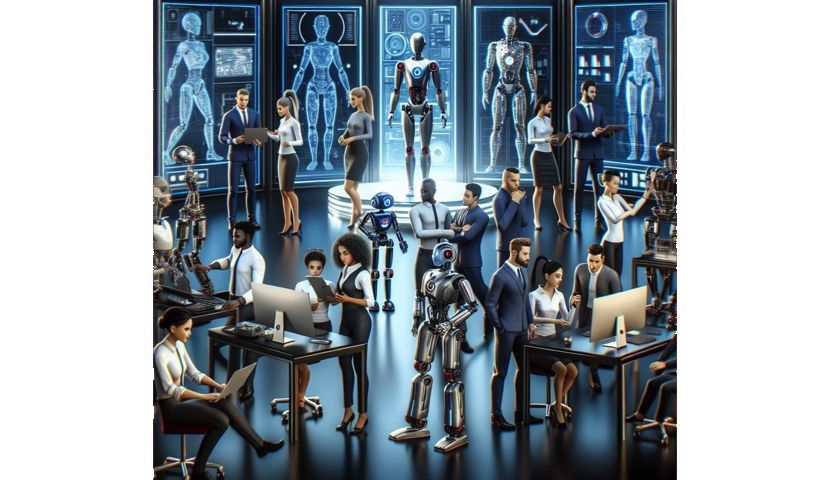
In an age marked by the rise of artificial intelligence, it would seem that we are losing what makes human beings special, due to the increasing robotization of human practices such as emailing and regular collaboration with robots.
Using social networks to engage students
Social networks are as much marketing tools for attracting new students as they are ways of engaging them with the establishment or energizing courses.
The AI era: from project interlocking to global efficiency
Artificial intelligence is profoundly transforming education by tailoring learning to individual needs, optimizing material and human resources, and reducing administrative burdens. Despite the challenges associated with its implementation, AI is paving the way for a more efficient, inclusive school focused on students and their needs.