“Storytelling is as old as time. Most experts say this form of communication is as old as human language. Early man used stories to make sense of his life and share his knowledge. Examples of this ancient form of communication can still be found in the Lascaux caves. The place where the first homo sapiens told stories in the form of cave paintings.
Source: Five things to know about storytelling by Romain Pittet - 2017
https://enigma.swiss/fr/2017/07/07/cinq-choses-connaitre-sur-le-storytelling/
Starting from the great historical sagas
When I asked my topic on the theme of storytelling, my editor, Denys Lamontagne, responded by telling me about models such as the Song of Roland, the Saga of Erik the Red and the story of Béowulf. So it is by the latter that I will enter the subject.
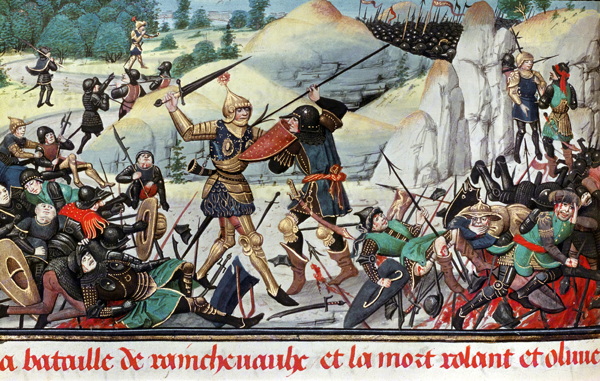 “La Chanson de Roland is a poem and a chanson de geste from the eleventh century sometimes attributed, without certainty, to Turold (the last line of the manuscript reads: Ci falt la geste que Turoldus declinet)... The Chanson de Roland contains about 4,000 verses (in its oldest version; it counts 9,000 in a manuscript from the end of the 13th century) in Old French, written in assonant leaves, transmitted and spread in song by troubadours and jugglers. It relates, three centuries after, the fatal battle of the knight Roland (or Hroudland), marquis of the marches of Brittany, and his loyal valiant men against a Vascon army, the battle of Roncesvalles in reprisal for the sacking of Pamplona.
Wikipedia source
.
https://fr.wikipedia.org/wiki/Chanson_de_Roland
Let's note, some essential parameters à our démonstration: a very dense story that rolls on 3 siècles. The peasant fashion of the Xth, XIth and XIIth centuries, for example, hardly changes during 3 centuries to finally start to evolve in the XIIIth century. In the same way that the underdresses (underwear) of then are cut almost on the Roman model, 2 pieces of cloths assembled including sleeves in the overall cut and adjusted to the body by games of lace. The time of then flows very slowly, beyond our modern understanding. It is an unchanging time. The history of the Chanson de Roland resembles it and the troubadours make their rounds with it during three centuries. We are in a continuity, a standard poetic block transmitted as it is over several centuries between oral tradition and written transcription.
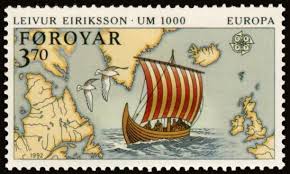 “The Saga of Erik the Red is a saga about the Norse exploration of Greenland and North America. The original version of this saga was probably written in the 13th century by an Icelandic cleric. The saga is preserved in two somewhat different manuscripts: the Hauksbók (14th century) and the Skálholtsbók (15th century). Modern philologists believe that the second version is the closest to the original.
The saga describes the banishment of Erik the Red to Greenland, then the discovery of Vinland by Leif Ericson, after his ship was turned away from its course and, above all, the journey of Thorfinn Karlsefni, who is in fact the real main character of the text. The geographical details given in this saga have made it possible to locate this land more or less. It is probably the first time that Europeans covered America, five centuries before Columbus.
Wikipedia source
.
https://fr.wikipedia.org/wiki/Saga_d%27Erik_le_Rouge
Here we have another saga, which speaks of a story of the X&th century, created in the XIII&th century and diffused in the XV&th century and XVI. The song of Roland followed a continuity between the story and its transmission, here the storytelling is more complex.
From the Middle Ages to the Renaissance, the first passage to complexity;
There is talk of a derecognized past from its narrative. The story, three centuries later than his role and two centuries later his bookish dissemination. In the same way, at the end of the XVth century, the underdresses are also more complex. They can be composed in 6, 8, 10 different parts. These are adjusted to the body to follow the fit of the dress and the overdress. There are the body of the dress in 4 parts (front, back, right and left parts), the sleeves, the armpit connection, the amplitude parts, the front and back. The whole is still lacé with the appearance of some buttons on the front and forearms.
The XVème siècle is a structuring era. The braids, exuberant colors of the XIVème are banished. We are in the creation of the pure line in the costume, in the adjustment to the closest to the body of the clothes, but also in the adjustment to the most accurate and clear ideas ... and therefore storytelling.
The XVIème is radically different to him, the underdress is part of the whole. It becomes again ample, freer and puts forward the collar by a game of cordon and note especially that it is the rigid dress comes to structure the set. It is no longer the content that structures but the container.
The troubadour of the XIIth century will appropriate the story to make it a model transposed in the daily life of his spectators, the one of the XVth century will place his role in a historical chronology, in a rigorous temporal line. This is noted in the text of Wikipédia which notes that the text of the XVème is the closest to the reality.
The XVI ième him is also different. The dressing restructures the form of the content as the dress modulates the shape of the body and uses the underdress as an accessory. If we consider that the human body is a transposition of the original story, that the underdress corresponds to the chronology of things, and that the dress is the way the story is told, then our vision of storytelling is radically transformed.
Out of the fairest to aggrandize the story of wishes précis as to the impact of the story on the reader, as that of the impact of the décolleté plunging on the viewer.
Towards a manipulation of idéologies
“Three red threads.
To proceed, we have woven this text of three interlocking red threads; each represents a hypothesis.
First, the sagas of Vínland would not have the sole purpose of paring an oral tradition, nor would they have the sole purpose of serving as entertainment, but they would also be engaged stories;They would also be committed stories that would aim to spread and root in the Icelandic society values stemming from the Christian culture. They would thus be realised for religious, even political and educational purposes. We will quote most of these authors in the course of this dissertation.
In the second place, as we mentioned earlier in another form, the use of the word « source » could not be applied to the so-called Vínland sagas when constituting a factual history of the tenth and eleventh centuries. As interpretations of older documents greatly influenced by Western literature and partly in the imagination of its authors, they would fall into the category of secondary literature.
Thirdly, during the Scandinavian expeditions to western Greenland in the year 1000, there would never have been any question of a land by the name of Vínland. This would be a literary creation that would have taken shape mainly between the eleventh and twelfth following the many cultural contacts that Iceland and the European continent have.
Source: Myth and History The Vínland in the Middle Ages by Deniz Ates - Master's thesis 2015 . https://www.denizates.ch/doc/memoire_de_master.pdf
Here we are far from the collective social hodgepodge model of the Chanson de Roland. Master's text underlies an idiosyncratic Christian colonization. It also speaks to us of fiction. From the factual texts of the Song of Roland, we move to the fictional texts.
But, fiction is not unique to the new texts of the sixteenth century. Fictions have always existed, even if they were based in existing contexts. Thus, Beowulf is one of the representative examples.
“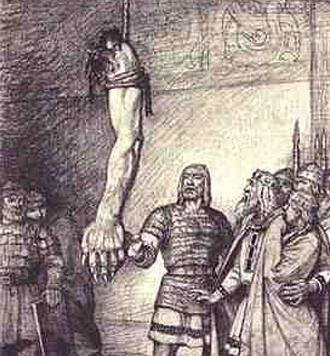 Beowulf is a major poem in Anglo-Saxon literature, probably composed between the first half of the seventh century and the end of the first millennium. The poem is inspired by the Anglo-Saxon oral tradition and transcribes a Germanic pop in verse, telling the exploits of the heroic Beowulf who gave his name to the poem, on which are grafted Christian additions...
Beowulf is an exceptional poem in the body of Anglo-Saxon literature. Rather than choosing a Christian subject, the poem recounts the deeds of the namesake, and his three main battles: Beowulf is a mighty Goth warrior (« Geat » a tribe in southern Sweden) who travels to Denmark to rid the court of the king Hrothgar of a terrible man-eating monster named Grendel. After defeating him, Beowulf doubles down by killing the mère of Grendel, then returns to the lands of the Goths to serve his people and their king, Hygelac. Much later, after succeeding the monarch, he dies in a final battle with a fire-breathing dragon…”
“As a historical story, based on a chronicle of high warrior deeds, Beowulf contains a strong collective and identity dimension.”
Wikipedia source: https://fr.wikipedia.org/wiki/Beowulf
Fiction can also convey culture, values, traditions. This isn’t just the prerogative of historical transcripts.
For the text of The Saga of Erik the Red, what is important to remember is the dichotomy between the desired, imagined idiosyncratic form and the factual or imagined background. It is a kind of contextual manipulation of the story in order to modify the thoughts of the readers. But, it is also probably the greatest source of inspiration to go and see the other side of the earthly record towards the west, ignoring all the associated fears.
In effect, because what is not learned by the human mind cannot exist because it is not imaginable. In the past the earth was flat and finite. At the end of the ocean was the ant. How to imagine a fertile horizon when historical belief saw only a fatal end?
How is it possible not to be able to imagine the unimaginable?
For example, for many people who saw the deportation trains pass by during World War II, the final solution at the end of the journey was not imaginable. What our brain cannot anticipate, cannot exist intellectually because it does not correspond to any pre-existing model, historical, real, that could allow us to anticipate this situation. Of course, this is not the case for all, some having more extensive fields of knowledge.
This was the case for the Austrian Karl Kraus who in 1934 wrote the book The Third Night of Walpurgis, which he never published in full during his lifetime for fear of possible reprisals against his family in pre-war Germany. The book was published in 1956 and translated into French in 2005.
“«There is one thing worse than murder, it’s murder with lies; and the worst of all is the lie of one who knows : the lie of one who does not want to believe in the crime but in the lie; the docility of one who makes himself as stupid as violence wants him to be.Karl Kraus, Walpurgis Night Three.
When Hitler became chancellor in 1933, the Austrian politician Karl Kraus described in the months that followed, in a 360-page text, the implementation of the Nazi horror mantra. Attacking mainly the press, which he holds responsible for the creation of National Socialism, his text is a cry that no one wants to hear: "If you cover your ears, you will not hear any more.
Karl Kraus died in 1936. Who heard him?
Source: Synopsis of the film by Swiss director Fréric Choffat inspired by the Book of Karl Kraus - 2008 -
http://lesfilmsdutigre.com/films/walpurgis/synopsis/
If Karl Kraus's anticipatory thinking did not serve to save people from the non-publication of his book, that of the Saga of Erik the Red is without a doubt the most important;Erik the Red is undoubtedly the most powerful source of inspiration that led Christopher Columbus and his contemporaries to the discovery of America. Whether the origin story was true or false, it is its impact on our world that is its true richness.
What about the storytelling of our era?
Today, stories are short, very short, ultra short. The pitches that present the projects are two minutes maximum to bring in a life, a technology, a story.
The, where yesterday's stories fit in blocks, books of hundreds of pages, today they fit in a movie of two hours, one hour, half an hour, five minutes. There has been a shift in the hierarchical importance between the vector, the storyteller, the comedian, the startup, between the content of the message, his book, his film, his project, between the quantity, long, medium, short, extra short and the meaning induced, the direction desired by the author.
The importance of a story was the content until the 90s, since the 2000s, it is the link between the various pieces of the story, their structuring that becomes the essential. This is a major change.
For example, yesterday the pitch talked about the project, its technology, its partners… and many other things. It lasted half an hour, an hour. Since then, the pitch is always interesting, but in the back office, in the background. What matters in the pitch is who is behind the idea? Does he have the aura, the ability to deliver it? Will his speech be able to convince all his future partners to follow him? The storytelling of today speaks to us about the assembler of the story. A story that can be localized in one place as in a book, or spread around the world as a treasure hunt.
The story of today is about the story assembler.
Storytelling can be used in family, business, professional settings… in fact everywhere in our digital world.
« one solution is to manage customer communication as a portfolio. This requires modern CCM (consumer communication management) technology that accesses data and content from multiple systems and assembles it into effective customer communication regardless of channel.
By bringing together all communication in the process, it becomes easier to manage complex communications. Those who adopt CCM effectively can truly focus on their customers, not the technology. »
Source: What is multichannel communication all about? by henri Dura - 2014
https://www.neopost.ca/fr/En-quoi-consiste-la-communication-multicanal
Tools for storytelling
If storytelling is also a professional tool, then, there are methods, processes to make it effective stories according to their recipients. The first one highlighted here corresponds to a simplification of the story through the use of modalities:
“Storytelling is based on a limited number of modé les. This is why this form of communication is not so difficult to use. One of the most commonly used storytelling modalities is the problem-solving modality.
With this model, you start by setting the stage and introducing the people involved. Then a problem comes up. This problem, or enemy, will cause an unexpected change that the characters will fight. The story is in fact about this fight. Finally, after multiple struggles, a solution is found and the hero reaches a new state of homeliness.
CF: Five things to know about storytelling
The second is a card game that can serve as a facilitator for those who wish to tell stories in all their dimensions:
“Storyhow is a card game that helps you turn messages, ideas and presentations into business stories. This tool was developed by Ron Ploof, another expert in business storytelling.
This deck of cards is a good starting point for anyone who wants to tell a story. It will give you good tips and a framework to follow to improve your storytelling skills.
Source: 5 resources to master the art of storytelling by Romain Pittet - 2017
https://enigma.swiss/fr/2017/10/17/5-ressources-pour-maitriser-lart-du-storytelling/
Whatever its form, its use, its deceptions, its misunderstandings, storytelling is the most powerful tool used in communication since the dawn of time, even if from content, it has moved on to content networks.
Image source: Pixabay SaraRichterArt
See more articles by this author