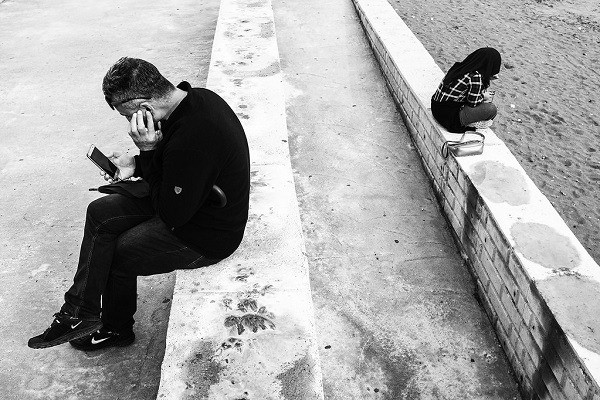
We've never been so connected, across physical borders. Two people separated by an ocean can exchange messages instantly. Social networks enable us to develop links with tens, hundreds or even thousands of individuals. And yet, at a time when digital technology should be bringing us closer together, the feeling of solitude is growing in all age groups, including the generation born with these communication tools. How can this paradox be explained?
Social networks in the dock
Some studies have been quick to point the finger at social networking sites. For these researchers, the young people surveyed seemed to show that, despite an increase in positive interactions, the feeling of isolation remained unchanged or increased. In their view, this can be explained by the longer-lasting effect of negative interactions on the psyche.
However, this conclusion is likely to hold much less water following the publication in May 2019 of a vast study of over 12,000 young people (aged 10-15) over 9 years, which showed that the effect of social networks on young people's mental health is minimal. Other research has also debunked the myth that computers increase isolation and depression. The biggest impact is that of blue light on young people when it's time to go to bed, leading to a drop in sleep that affects mood, concentration, well-being and so on.
Of course, social networking can be a challenge for those with social fears, especially the fear of rejection. Hypersensitive to negative reactions, they avoid conflict and confrontation by not communicating. This accentuates their isolation, creating a vicious circle that can only be broken by exposure to social situations. Because while the media has been plagued by paranoia about young people and digital technology, it often forgets that, at the other end of the spectrum, the digital divide isolates. Indeed, a large number of older people find themselves excluded from the family or general social environment because they haven't mastered digital tools. This gap is all the more important now that everything is going digital, including medical and government communications.
Taming solitude
So why do so many young adults feel so alone? It's a feeling that's shared even by couples and groups of friends. It's based on three pillars:
- the need for recognition and approval,
- fear of standing out from the crowd
- the inability to indulge in comforting thoughts and activities during moments of real isolation or downtime.
So it's a very personal perception that needs to be worked on. Some organizations, such as UQAM, run campaigns to raise awareness of the isolation felt by a significant number of students. This is even changing the approach of student associations, which are seeking to offer activities that will encourage human contact among their members who need it most.
Last but not least, the question of loneliness has to be worked on with oneself. In this connected world, it seems we always have to be doing something. Yet it can be healthy to simply unplug and enjoy a moment of introspection. And if this leads to negative thoughts, the individual should accept this and welcome this darker part of themselves. Then, by accepting to work on ourselves, we open ourselves up to possibilities for developing social bonds. It takes effort and patience, but according to many psychologists, it's well worth the effort.
Illustration: LivBelko Alanya, 2018 via photopin (license)
References
Brosseau, Anaïs. "L'exclusion Numérique Aggrave L'isolement Des Personnes âgées." La Croix. Last updated: September 27, 2018.
https://www.la-croix.com/France/Exclusion/Lexclusion-numerique-aggrave-lisolement-personnes-agees-2018-09-27-1200972015
Draillard, Bénédicte. "Se Sentir Seul, Avec Ou Sans Amis." RCF. Last updated: July 24, 2018.
https://rcf.fr/vie-quotidienne/psychologie/se-sentir-seul-avec-ou-sans-amis
Girard, Marc-André. "DIGITAL AND YOUTH MENTAL HEALTH: WHAT IF IT WAS NOT EXACTLY WHAT WE LIKE TO BELIEVE?" École branchée. Last updated: May 30, 2019.
https://ecolebranchee.com/numerique-et-sante-mentale-des-jeunes-et-si-ce-netait-pas-exactement-ce-quon-aime-croire/
Laty, Dora. "Les Réseaux Sociaux Augmentent-ils Notre Sentiment De Solitude?" Doctissimo. Last updated: January 24, 2019.
http://www.doctissimo.fr/sante/news/les-reseaux-sociaux-renforcent-le-sentiment-de-solitude
McEvoy, Julien. "L'UdeM Lance Une Vaste Campagne De Sensibilisation Pour Briser L'isolement étudiant." Radio-Canada.ca. Last updated: February 4, 2019.
https://ici.radio-canada.ca/nouvelle/1150641/campagne-universite-montreal-sante-mentale-ca-va
Nowland, Rebecca. "Are Social Networks Really Responsible For Young People's Loneliness?" The Conversation. Last updated: October 9, 2018.
https://theconversation.com/les-reseaux-sociaux-sont-ils-vraiment-responsables-de-la-solitude-des-jeunes-104579
Robidas, Pascal. "L'utilisation Des Médias Sociaux Aurait Un Effet Néfaste "minime" Sur Les Jeunes." Radio-Canada.ca. Last updated: May 10, 2019.
https://ici.radio-canada.ca/nouvelle/1168694/medias-sociaux-jeunes-usage-impact-minime-etude-oxford
Rodrigues, Aurélie. "Il Faut Apprendre à être Seul Avec Soi-même." Slate.fr. Last updated: June 29, 2018.
http://www.slate.fr/story/163880/apprendre-etre-seul-avec-soi-meme
Taubes, Isabelle. "Pourquoi Se Sent-on Seul Même Quand on L'est Pas?" Psychologies.com. Last updated: May 7, 2019.
https://www.psychologies.com/Moi/Moi-et-les-autres/Solitude/Articles-et-Dossiers/Pourquoi-se-sent-on-seul-meme-quand-on-ne-l-est-pas
See more articles by this author