National and international competitions mobilize a wide range of skills
The case for competition in a training context was well-founded. Competition in a training context was condemned: it leads to confusion between the goal and the learning situation, it bases motivation on external factors such as rankings, it sometimes leads to a devaluation of self-image, and it provokes disloyal behavior. At the extreme, efforts are made to make others fail rather than succeed. Aside from efficiency, competition is seriously detrimental to the group atmosphere.
Just type "pedagogy" and "competition" into a search engine. The proposals that emerge are manifestos from training centers, schools and universities that claim to favor a pedagogy of collaboration over one of competition.
And yet, the history of thought is punctuated by competitions...
As we celebrate the 500th anniversary of the birth of Leonardo da Vinci, we cannot ignore the highly competitive atmosphere that existed between artists and architects during the Renaissance. The history of art, philosophy and science is often presented as a history of struggle. Would Pasteur have been Pasteur without Koch? Would Einstein have had the same energy without Poincaré or Hilbert? Not for sure. Great minds emerge in environments where competition, emulation, inspiration and collaboration are intertwined, with no one person being able to produce the recipe.
In another field, and despite claims to the contrary, companies that push their teams towards greater collaboration build their founding myths around exceptional personalities. Sometimes it stimulates, but it can also destroy motivation... How do we deal with it in a training project?
Some training centers, universities and schools organize part of their pedagogy around competition. These are, of course, team competitions based on multi-disciplinary projects, which take students over fairly long periods of time. Racing, programming, robot design and the environment are among the most popular themes.
When 600 student teams reinvent the car
Created in 1981 by the Institution of Mechanical Engineers, Formula Student is a comprehensive competition in which technical, project management and commercial skills are tested and evaluated. Student teams must present their project and its business model. One event is dedicated to this aspect of presentation alone.
But other students compete on a second level. In addition to presenting their concept, they drive a working prototype, and take tests designed to demonstrate the superiority of their technical proposal. Their achievements are recorded in videos and posted on the Internet. They testify to skills developed in computer design, design, materials technology, mechanics of course, but also in communication and prototyping. And since teams are made up of a large number of participants, these competitions help develop cooperation and mutual aid!
The criteria for placing in the Formula student are as follows:
Static criteria
Project cost
100
Business model
75
Design
150
On-track criteria
Acceleration
100
Tested skidding on an 8" circuit
75
Auto-cross (succession of straights and curves)
125
Efficiency (through energy consumption)
100
Endurance over 22 kilometers
275
Among the many schools taking part,ESTACA, an engineering school in the Paris region, presents a website dedicated to the competition, illustrating the teamwork, organization, multidisciplinarity and support of the school.
Vehicle performance is highlighted in several dimensions. So there's not one winning team and over 500 losing ones. Numerous opportunities to showcase each other's skills, as well as local competitions, encourage participants. A few years ago, ESTACA was awarded the prize for first-time participation.
But getting all the way to the competition is a challenge in itself, and is backed up by numerous collective victories. Victory depends on a number of factors, among which the training center's facilities, the investment made by teachers and sponsors, and the budget all play an essential role. The schools themselves are involved in many actions of this type. No one's career is at stake in this project, and the simple fact of having taken part is a strong element on a curriculum vitae.
Courses en cours - an educational project geared to equal opportunities
Course en cours is aimed more at secondary school students. The vehicles are not driven by drivers, but are powered by an electric motor supplied by the organizers. The criteria differ little from the previous competition: technique, design and the ability to lead a project, as well as oral expression, are among the main criteria. The rules, which are updated every year, propose 3 "courses", each of which focuses on certain criteria from among the twenty included in the scoring grid.
Course en cours thus offers a stimulating educational activity, bringing together several disciplines and aiming in particular to raise young people's awareness of scientific disciplines and the business world. Teachers are also supported through the sharing of online resources, specially designed and selected for this action.
Groups of six students are selected on the basis of their motivation and commitment, as they will be spending a few evenings and part of their vacation there. They include some students who are full of energy, but are ready to drop out because they feel less at ease in more conventional courses.
The many testimonials relayed by the Course en cours website show that motivation and commitment are not based solely on a desire to win. The participants discovered companies, project logics and engineering techniques. They have prepared presentations and arguments in a real-life context. And of course, there's the intense moment of the race, which lasts just a few seconds!
When robots play soccer
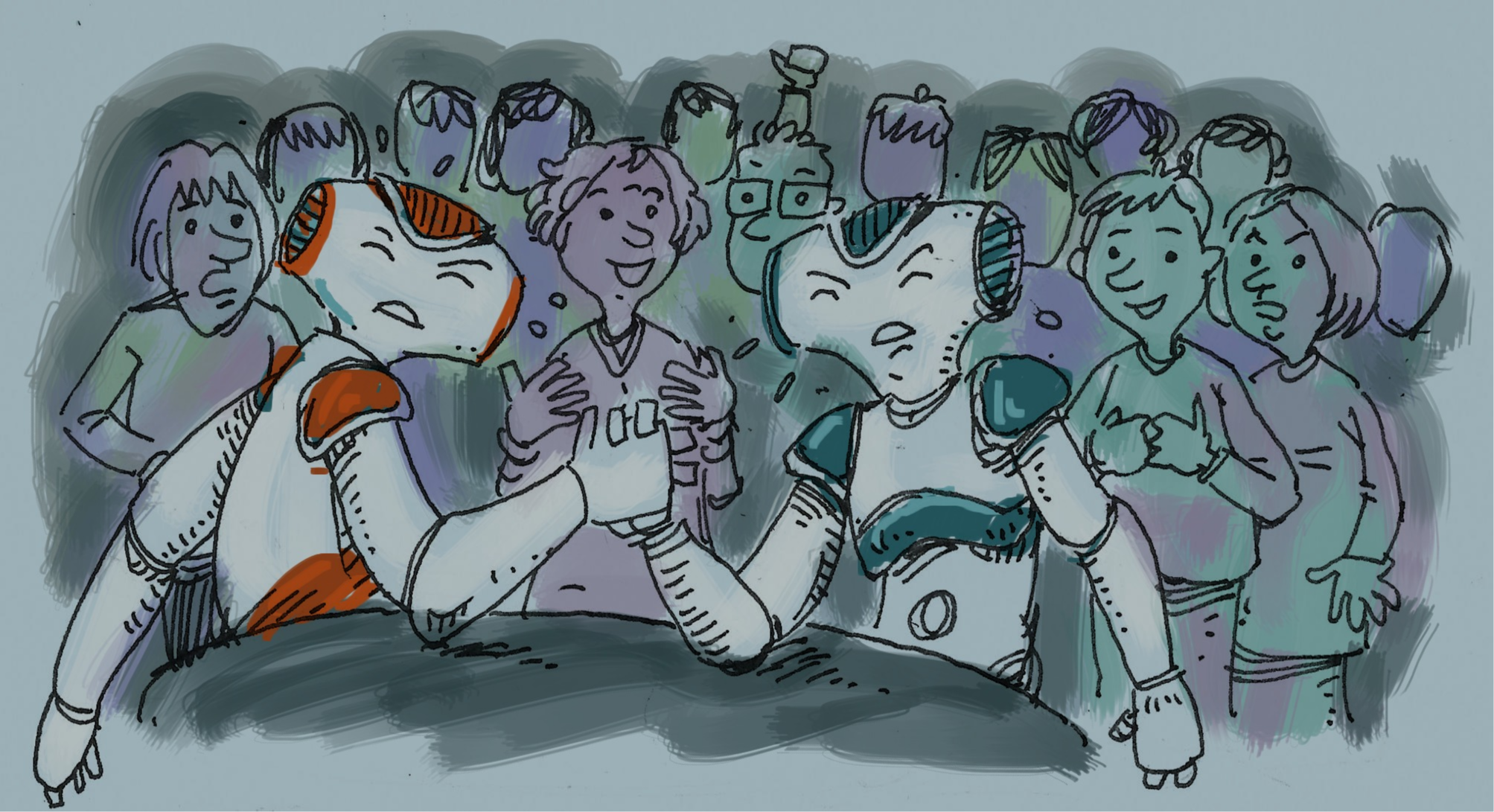
If there's one field where no one doubts that competition drives individuals to improve their performance, it's sport! And that's exactly what the organizers of the Robocup have been doing since 1997. A wide range of events enable participants to measure their skills, from the design of robots for domestic use, to industrial robotics and rescue robots. But the most spectacular event is undoubtedly that of the robot soccer players.
Whether humanoid, like Softbank Robotics' Nao, or wheeled, these robots have to move on a real pitch, interacting with other players and a moving ball. 450 teams and 3,500 participants come together to try and win their category, but also to share and learn.
Many of the technologies deployed are open source. The organizers emphasize the exchanges that take place between participants throughout the event. Training is built up throughout the project, but also during the competitions, between students from schools that are already used to working together.
These competitions are therefore formative for several reasons. They are based on teamwork, sometimes in large groups as in the Formula Students. The "teacher/teacher" relationship is also shaken up.
The tests require different disciplines to be brought together, and a cross-disciplinary project approach to be adopted.
The danger of a competitive approach is to lose sight of what is really at stake, which is learning, and to diminish the self-confidence and sense of efficiency of the less well placed. The competitions presented in this article avoid these pitfalls. Taking part in the competitions is already a victory; competitors exchange a lot with each other and learn from each other.
But the real challenge lies elsewhere, in advancing technology. Organizers of tournaments between robots are already dreaming of human-machine soccer matches, just as there have been chess matches between humans and computers...
Rigorous methods to foster creativity? Should we believe in them? Most techniques prove to be disappointing or at least random in their results. However, the TRIZ method is an exception, undoubtedly because it provides for a more structured and complete progression, at the price of greater rigor and more laborious learning. We suggest you discover its principles and steps.
How can we learn together spontaneously when we don't share the same objectives and our backgrounds are varied? Eric Simon suggests "Recreation". These recreations offer a wide range of fun, technology-free activities every week, around a community of some 80 people.
For over 60 years, Oulipo has been offering a variety of ways of stimulating or challenging the imagination of writers, editors, poets, students and anyone else who can write, as well as those who can read. We're sure you'll find something to inspire you.