A break... to avoid breaking up
Taking the time to do things for yourself or for others... You just have to get your head out of the game before it's too late. You'll be able to take advantage of it, feel useful or develop personally.
Publish at December 03 2020 Updated November 28 2024


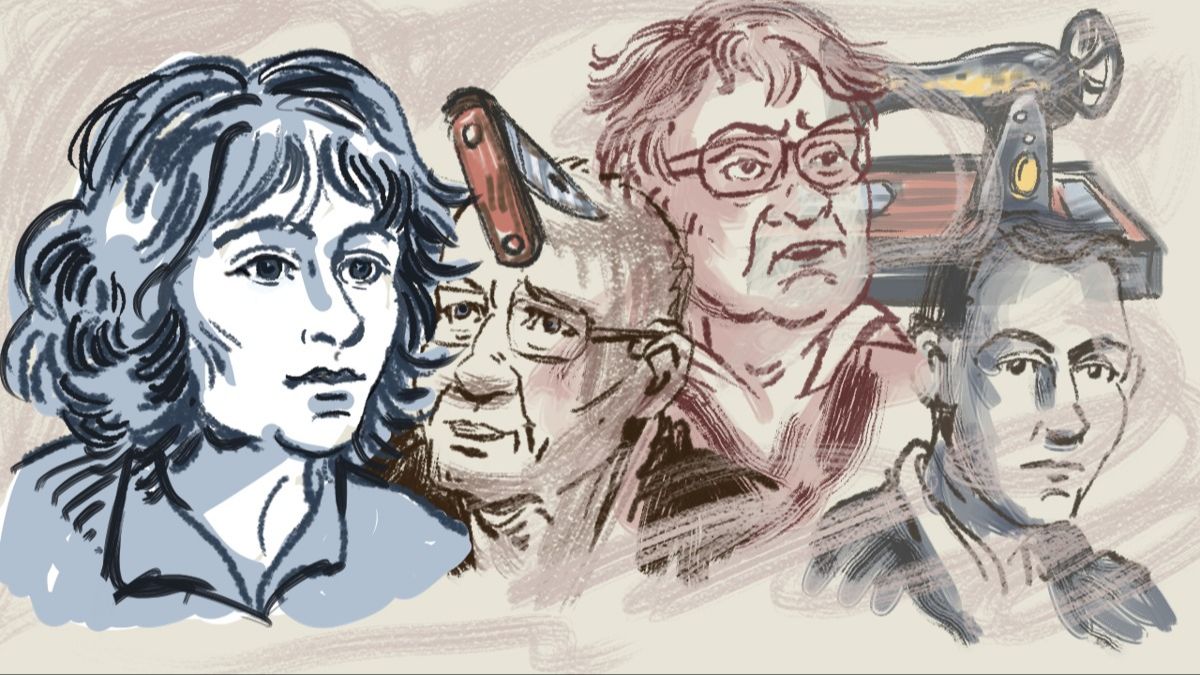
An old building is full of the scars left by its various occupants. Not only does it preserve the memory of its inhabitants, it also reflects local and national history. Ruth Zylberman takes up the challenge of telling the story of a Paris apartment building in a sensitive way, by searching for the many traces left by the generations who have lived there.
Photographs, sound recordings, newspaper cuttings, police and hospital archives, letters, models and small objects help her to bring to life the times, and in particular the roundups of Jewish families during the Second World War.
Ruth Zylberman is a journalist and writer. She sets out to recount the life of a Paris apartment building since 1840, particularly during the German occupation. But 209 de la rue Saint-Maur takes us through the history of an entire country since 1840. The choice of location is not entirely coincidental. The neighborhood was affected by the 1942 round-ups, which led to the deportation of entire families and children, many of whom did not survive. This story resonates with the author's own family history.
Over the next five years, she became familiar with the inhabitants of this building. She got to know those who occupy the premises in 2015, but above all those who have lived at this address since 1840. By tracing the threads of singular lives, she tells us about the history of immigration, working-class life in the capital and the noise of the inner courtyards, the crimes committed during the Second World War and the after-effects still present seventy years later. The return of the "gueules cassées" from the 1914-1918 war, small-scale craft businesses in the early 19th century and the barricades of 1849 intersect with the daily lives of the building's occupants.
These characters, selected by chance, seem to have been chosen with scriptwriter's care, so much so that they leave their mark. Imagine the concierge, Madame Massacré, who sweeps the inner courtyard in a certain way to indicate that the police are in the building. Upstairs, the Dinanceau family hides Jews, while the family's son joins the Nazis. And seventy years later, Henry, who fled at the age of five, would like to forget everything, but also pass on the family memory to his daughter...

What traces do we leave in the digital age? If we lose a hard drive or even a password, our entire memory, often concentrated in a single space, disappears. For the people whose stories Ruth Zylberman recounts, the problem lies elsewhere. Often torn from their homes in a matter of minutes, forced to flee and despoiled, sometimes by their own neighbors, they have lost everything. But the roots of memory are tortuous. The memory of tiny lives, to use Pierre Michon's term, sometimes lodges itself in unexpected places, and Ruth Zylberman is tenacious in finding those secret clues of which Walter Benjamin speaks.
The past is loaded with a secret clue that points the way to redemption. Aren't we ourselves touched by a breath of air that has surrounded those who came before us? Is there not in the voices to which we pay attention an echo of those who have fallen silent? (...) If so, then there is a secret agreement between past generations and our own.
Among these clues, the green eyes of the woman who entrusted René, not yet two, to the janitor of the building will help Ruth Zylberman to piece together part of the puzzle.
Letters and photos have survived successive moves. Police, departmental and hospital archives methodically record facts, with a coldness that contrasts with the horrors they describe. One man finds recordings of his wife's testimony on audio cassettes. These sensitive traces, to which we should add the accents of the protagonists, remind us that these were people, who made choices, who had projects and personalities of their own.
Memory also finds its place in architecture. Made up of poor families, many of whom had fled Eastern Europe, the apartments had no running water or electricity. The toilets were on the landing, and many people lived in a single room: the Diament family, for example, had seven people in 20 m². Testimonials regularly mention the rats that used to swarm in these spaces, which today would be described as insalubrious.
Since then, some walls have been knocked down and the surface areas have been enlarged. But traces of the past are still visible. The walls and basements bear the marks of the residents who have passed through the building. Ruth Zylberman quotes George Perec: "Who's under your wallpaper? To facilitate the emergence of memories that have been buried for decades, the author uses models, plans and diagrams. Survivors handle miniature furniture, recall sewing machine noises and hallway life.
Elderly survivors, children of survivors, former neighbors, landlords or spouses also keep traces of memory. Memories are carried by architecture, photos, recordings and objects, but above all by people. They are fragile, sometimes imprecise, sometimes erroneous, but they give flesh to the journalist's discoveries.
Ruth Zylberman's initiative and, above all, her talent for storytelling have transformed traces into narrative. It was only a matter of time before all was forgotten, or survived only through a few vague anecdotes. It's a single building, and not the largest on the street, far from it. It's dizzying to imagine that each of these buildings also keeps secrets behind its wallpaper, in its cellars and corridors. This makes the testimony of the residents of 209 rue Saint-Maur and Ruth Zylberman's work all the more precious.
Through one building, she tells us about an entire neighborhood, and an entire era!
Ruth Zylberman - the children of 209 rue Saint-Maur - report released in 2017
available online until January 2022
https://boutique.arte.tv/detail/les_enfants_du_209_rue_saint_maur
Ruth Zylberman - 209 rue Saint-Maur, Parix Xe -Arte Seuil Editions - January 2020
https://www.decitre.fr/livres/209-rue-saint-maur-paris-xe-9782021426243.html#ae85
Frédérique Fanchette - Libération - new blood at 209 - January 2020
https://next.liberation.fr/livres/2020/01/15/ruth-zylberman-du-sang-neuf-au-209_1773255
You might also like:
A break... to avoid breaking up
Taking the time to do things for yourself or for others... You just have to get your head out of the game before it's too late. You'll be able to take advantage of it, feel useful or develop personally.
Moving from "Vision to Action" with school leaders
Digital plays a role in educational success; by offering them new ways to learn, communicate, share, create and collaborate, principals are breathing new life into today's school!
Residential tourism: when relocation becomes the trip of a lifetime
Residential tourism is redefining the boundaries of travel. Families and entrepreneurs no longer use tourism as a parenthesis, but as a tool for rebuilding their lives. Driven by the risk society, they are looking for mobility, fiscal agility and quality of life. Half-tourists, half-migrants, these lifestyle nomads don't flee: they choose.
Artificial intelligence and us: a relationship to be defined
Artificial intelligences have moved out of the realm of fiction and into reality. Search engine and social network algorithms are forms of it that we come into contact with every day. Yet, with the progression of artificial intelligence, come many questions about ethics and relationships with human beings. Will A.I. be able to make good choices?
.Benefits of innovation in training
Innovation is on everyone's lips as the ultimate solution, but we need to look at the individual, collective and societal levels to see the benefits but also the limits of this intention to bring something new to an organization.