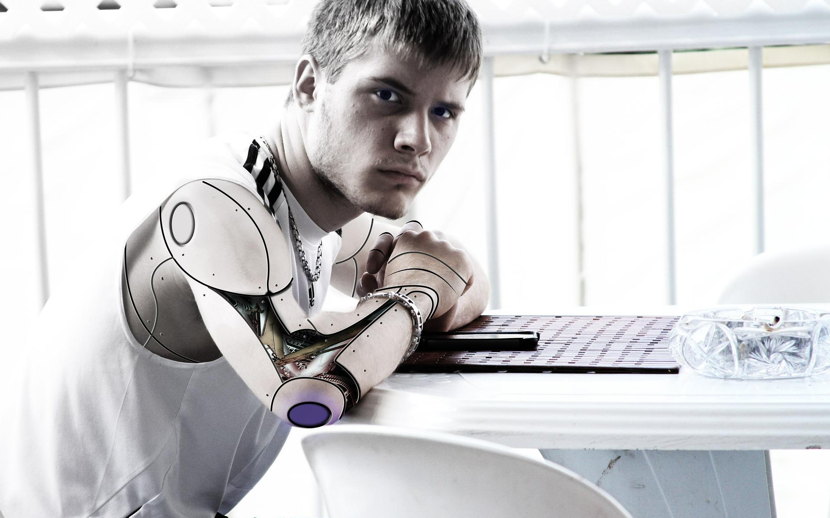
Will artificial intelligence one day be able to completely compensate for our physical and mental deficiencies and handicaps? Are we destined to "cyborgize" ourselves in order to better advance and endure? These questions remain in the dark, but given the state of the art in science and technology, we could indeed ask ourselves.
And what about languages, you ask? Here too, AI is making giant strides. In fact, two technological innovations are showing us remarkable possibilities: on the one hand, a patch that restores speech to those who have lost it, and on the other, an application that lets you communicate with your eyes. Who says artificial intelligence isn't well-intentioned?
The patch that gives you back your voice
The late Stephen Hawking, the famous British astrophysicist who died in 2018, would have been proud to test this first piece of AI. The term "bit" is not a pejorative, as this is indeed a small, unobtrusive patch, just a few centimetres in size. Small, but strong, because it's packed with high technology! All created by a team of researchers from the famous MIT (Massachusetts Institute of Technology), renowned for the quality of its technological innovations. 
How does it work?
Made from silicone, this stretchable patch is fitted with piezoelectric sensors which return an electric current when mechanically deformed, and is glued to the patient's cheek. The electrical signal sent via the patch "forces" the muscles to work, thus mechanically reproducing the physical structuring deployed during the speech act, a little like an exoskeleton, but for the mouth, to help with speaking.
For the record, dysarthria is an articulation disorder also known as Charcot's disease, or amyotrophic lateral sclerosis.
This degenerative disease of the motor neurons involved in movement affects some 150,000 sufferers worldwide, causing difficulty in walking, speaking, writing and breathing. Its most famous representative, as we have just mentioned, was Stephen Hawking. Although survival after such a diagnosis is barely five years, developments in gene therapy are opening the door to decisive improvements.
For example, the creation of such a patch would enable sufferers to catch a glimpse of light in their condition, restoring the speech they have lost as a result of this physical degeneration.
The application that lets you speak with your eyes
 The second innovation lies at the very edge of reality: an accessibility application developed by Google. Called "Look to speak", it enables users, particularly those with disabilities, to communicate using their eyes and gaze.
Can you imagine? You stare at your smartphone and, with a simple movement of your eyes, without even opening your mouth, you can "dictate" a message, which will then appear on your screen, ready to be sent! It's like being in Star Trek!
It has to be said that Google has been working for many years on accessibility features for its entire ecosystem. Indeed, when you think of a web giant, you think of accessibility for the greatest possible number of people, whatever their condition, whether disabled or not. So, one of the big questions at the heart of Google's research is: "How do we communicate with people who can't speak or use their hands?"
In concrete terms, here's how it works, as explained on the Experiments with Google website:
- The user can look at the screen in three directions: left, right or up, to choose ready-made phrases suggested by the system.
- The smartphone's camera analyzes the direction of the gaze.

- The integrated AI of the Look to Speak application detects this gaze, records the selected words and continues its proposal of subsequent words, so as to construct entire sentences.
It should be pointed out that this project was created to meet the needs of people suffering from motor neurone disease, another rare neurodegenerative disorder leading to motor disorders and progressive paralysis.
Could this be a case of reality meeting fiction? In any case, we seem to be getting closer. More and more innovations are coming to the rescue of those who are deprived of their sensory abilities, whether to speak, see, hear or touch.
Artificial intelligence is becoming like a "prosthesis" capable of replacing what has been lost: restoring speech with a patch, communicating with the eyes. This is no longer science fiction, but our contemporary reality. And what if our future was precisely this intimate, bodily integration of AI into ourselves? Shouldn't we ourselves be human-robot hybrids?
Sources and illustrations
- Un patch redonneonne la paroles aux patients atteints de la maladie de Charcot, Sylvie Rioult-Milliot, Sciences et Avenir, December 2020,
https://www.sciencesetavenir.fr/sante/cerveau-et-psy/un-patch-redonne-la-parole-aux-malades-de-la-sla_149462
- Look to Speak, Sarah Ezekiel & Google Creative Lab, December 2020, Experiments with Google, https://experiments.withgoogle.com/looktospeak
- Getting started with Look to Speak, Google promotional video, https://youtu.be/r6WVBSRe_ek
- Stephen Hawking, Pixabay , https://pixabay.com/images/id-3244215/
- Cyborg - D500 - Pixabay
See more articles by this author