Practices and histories of circle pedagogy.
Publish at April 21 2021 Updated May 25 2023


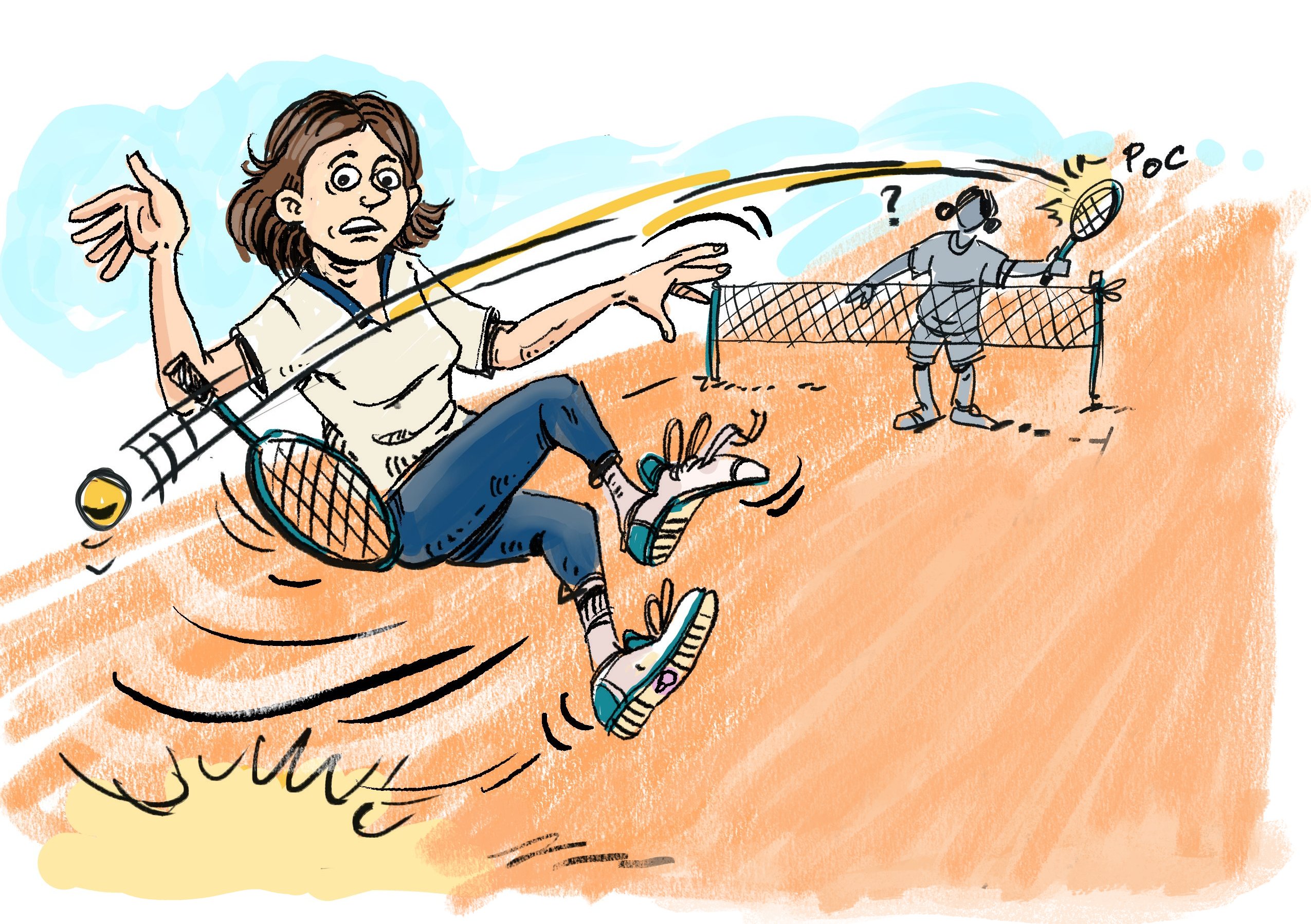
2015, Evan Jager leads a 3000-meter obstacle course. He has just one hurdle to clear to shatter the American record, break the eight-minute barrier, and win gold. But his foot hits the obstacle lightly. He fell. He managed to get back up and finish the event, beating the American record, but a competitor had overtaken him. A bitter silver medal that leaves one perplexed. How is it that during a competition, we fail at actions we perform hundreds of times without difficulty when there's nothing at stake?
The sports press presents numerous examples of this loss of means even as an athlete strives to be perfect. For example, French tennis player Alizé Cornet explained in 2010 after a match: "I wanted to do too well again, and it backfired on me", while her coach confirms: "When she doesn't close the first set at 5-2, she gets tense, frustrated and rehashes the past without looking at the present (...) There's a whole way of thinking to change, and the rethinking must be immediate." "[She] has a brain that's almost too well done. She thinks a lot and sometimes too much," sums up her technical director.
Between fatalism and psychologizing explanations, the teams providing support feel powerless. However, researchers are coming up with some interesting solutions.
Sian Leah Beilock came close to being selected for the U.S. soccer team. But when she was at the top of her game, she lost her nerve when she spotted the national coach watching her. The end of a career, the beginning of a scientific research project. She is now studying situations where we show a deplorable level when we should instead be at the top.
For the neuroscience specialist, the explanation is simple. We focus on the situation, on the movements, on the context, on the people present, on the consequences in the event of failure... And we analyze step by step, step by step, each of our actions. The brain is so busy that it freezes. "Paralysis by analysis" is the expression she gives to this mechanism.
By analyzing the situation from every angle, we put a strain on the cortex, when we should be trusting the autopilot. Athletes who have repeated the same gestures thousands of times
perform less well when asked to concentrate precisely on those gestures. Many athletes have testified to the damage caused by over-concentration. Tim Duncan of the San Antonio Spurs basketball team puts it succinctly: "When you have to think, that's when you screw up".

Sian Leah Beilock and other authors offer us antidotes. The first step is to practice in a situation close to the one you're going to experience. Getting used to the gaze of an audience, to noise, to a limited duration, will avoid being impressed and bewildered in a real situation.
Another technique is to focus on something else. For example, golfer Jack Niklaus used to focus on... a little toe. Others sing songs to themselves in their heads. Noa Kageyama and Pen-pen Chen tell us that golfers perform better when they mentally visualize the trajectory of the ball rather than the mechanics of their gestures.
A third approach is to write down your fears, just as you write down your nightmares to get rid of them when they wake you up in the middle of the night. Finally, many athletes have adopted a ritual, often brief, that helps them regain their footing: warm-up movements, words we repeat to ourselves can be enough.

Unfortunately, sometimes the feeling of losing one's skills extends beyond a competition. Athletes' careers sometimes come to an abrupt halt or halt, when the athlete suddenly feels he or she is no longer capable.
The newspaper Le Monde refers to this as "loss of figure", which translates into the feeling of no longer knowing how to perform an acrobatic feat, and which is prolonged by a fear of injury. In this case, it's best to relax, temporarily forget the ambitious goals, and start learning again from the fundamentals. But the outcome is not guaranteed. Whether we're talking about "loss of feeling" or "loss of confidence", the causes are numerous and personal, and the techniques for getting out of them uncertain.
These negative anchors are all the more important to combat as the digital world, social networks, online sports journals accumulate statistics, historical reminders, speculation about players' state of fitness and mental toughness. All this information, which arrives unannounced, can be a source of destabilization.
Such is the tension before the event or match that players sometimes look for signs of an upcoming victory and anxiously watch for negative signs. When superstition gets involved, athletes can lose their nerve very easily.
The best-known case is undoubtedly linked to a prank played by Ilie Nastase, a tennis champion in the 80s. He had incidentally spotted that his opponents regarded black cats as signs of a curse. Before a doubles match, he locked one up in a bag, and using a change of racket as an excuse, set it free... The black cat ran across the court. The rival team is destabilized... and loses. Ilie Nastase will be punished for this unsportsmanlike tactic:

Inversely, athletes create positive rituals that convince them that the stars are aligned and victory is assured. This approach may make you smile, but in a high-stress situation, all signs are important. Astronaut Thomas Pesquet, points this out himself in a tweet on April 17, 2021:
Human spaceflight, like everything else human (and especially anything risky) has a lot of traditions and rituals. Astronauts aren't superstitious in general, but... it can't hurt to keep doing what worked for the previous ones!!!!
So, on the eve of lift-off, the astronaut team leader plays against the head of Nasa at a card game, until he wins.
The "black cat" is also the expression used when a well-ranked player loses his ways in every encounter against another, who thus becomes his "black cat". On paper, in the rankings and given past performances, this sportsman has every chance. On the pitch, however, he's being pummelled... and each defeat reinforces the feeling that bad luck is getting the better of him. "It's very hard to win against an opponent you've never beaten," French tennis player Gilles Simon summed up in Le Point magazine.

These lessons that athletes gradually learn are of great interest to anyone who is sometimes faced with a situation where he or she has to be at their best for a brief moment. The advice is the same, with a few adaptations.
Thus, we'll refrain from checking our e-mails, text messages or any messaging system before stepping up to the podium, as sometimes all it takes is a sour message at the wrong moment to send us over the edge. Rituals of relaxation, but also avoiding "black cats" just before the event, are good advice. Don't cross your worst enemy before speaking in front of a large group! Limit the opportunities to receive negative judgments from your hierarchy a few minutes before going on stage...
Like the champions, we also take care to let go of the pressure, not to criticize ourselves and to avoid analyzing ourselves during the action and, above all, to train again and again in extreme situations to trust our automatisms more. As the stakes are lower than for a champion, who sometimes stakes his entire career on one match, we'll add "accept to fail or stumble".
Illustrations : Frédéric Duriez
Sources:
Wanda Diamonds League : Evan Jager's dramatic fall in the steeplechase at Paris 2015
https://youtu.be/eb4UY3ey4gc
Sian Leah Beilock - TEDX talk - Why we block under pressure, and how to avoid it - translation Morgane Quilfen - October 2018
https://youtu.be/OrB9JBEk1ds
Noa Kageyama, Pen-pen Chen TEDX - How to stay calm under pressure - May 21, 2018 - translation - Nawej Kasongo
https://youtu.be/CqgmozFr_GM
Thomas Héteau - Le Monde Ces mystérieux maux du sport (3/3) - loss of sensation, translation of a psychological malaise? - published December 20, 2011
https://www.lemonde.fr/sport/article/2011/12/20/ces-mysterieux-maux-du-sport-3-3-la-perte-de-sensation-traduction-d-un-malaise-psychologique_1620586_3242.html
Thanks to Jacques Brouleau for his bibliographical advice.
You might also like:
The Singapore method to France's rescue
At first glance, mathematics may seem a little abstract to a child. They are presented with vague terms and concepts. The Singapore method helps pupils to concretize the precepts at the outset, gradually making them more abstract. But how well does it fit into the French system?
Is the general culture in school in danger?
Schools try as much as possible to transmit knowledge that must be transmitted, according to ministerial guidelines. But what about knowledge that is less crucial but cultivates young people? A decline in general knowledge in the educational system causes disparities between learners. Do we need more general culture?
The great schisms and the scarcity of books
Books are becoming rarer in favor of metavers, that's a fact, but isn't it just a matter of media and a change in the adventure mix that's really at stake?
The book does not spend its best hours. The current enemy is not its digitization, but rather the sensitivity of others. On the left, people who would like to try to erase the offensive words of the past. On the right, censorship against all books that speak of alternative sexualities, feminism or racial inequalities.