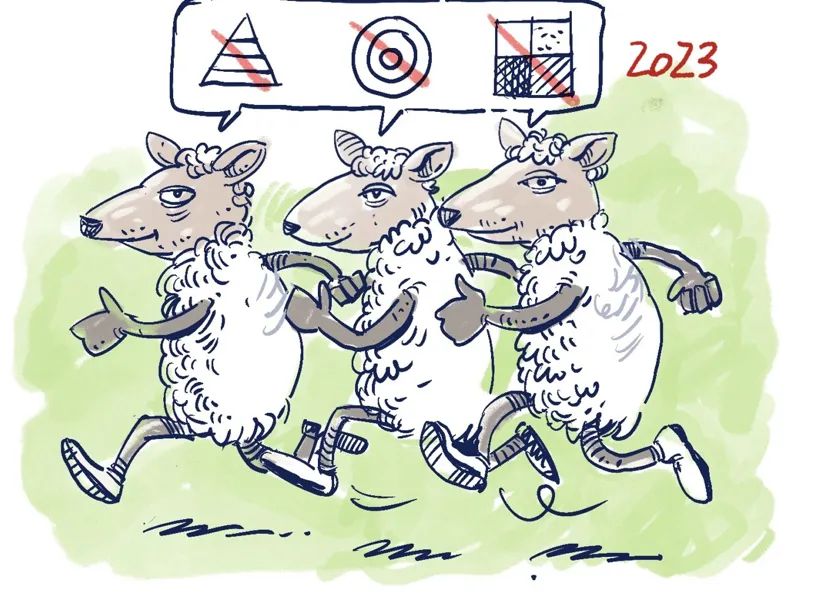
"Who does not know that one must unlearn before learning, and that the first task is the more difficult of the two? " Erasmus, 1529
Deconstruction
What if the idea of unlearning was part of the continuation of the philosophical movement of "deconstruction" initiated by Jacques Derrida? This movement comes to question all concepts and consider them in a new light.
Remember that this idea of deconstruction aims at destabilizing well-established categories that are at the service of the dominant classes that benefit from them. Therefore, why can't the concepts of learning and of learning be examined?
Yes, we can unlearn
We are steeped in certainties, in beliefs, in a hodgepodge of knowledge accumulated throughout our lives that we hold onto. When times change it becomes essential to re-evaluate our thoughts to make room for others. This is what the management science theories that rely either on the vision of a post-modern management or on the continuation of the cycle of creative destruction theorized by Schumpeter are forcefully showing.
Whether one takes a contemporary or a classical approach to management, what is important is to change in order to find new ways of economic development. Is this learning or unlearning? Maximilien Brabec suggests ways to reprogram ourselves and see the world differently. He invites us to a set of personal and organizational practices to reset our beliefs. For example engaging a "wonder machine."
It is also possible to observe that a language, even a native one, is forgotten if it is no longer used. Unlearning here is a more or less voluntary forgetting that takes place over years, until even reminiscences no longer carry meaning.
Another mechanism known as learned impotence plays as a learning inhibitor. Some claim that it is possible to unlearn for example gestures as simple as riding a bike. This is shown in this video with a modified bike making us lose our bearings. So whenever we lose confidence in a way of learning, misplace our bearings that we show curiosity we might unlearn.
No, we cannot unlearn
It is interesting to identify which learning theories an author refers to in order to identify how he or she views unlearning. Indeed, if unlearning consists of removing superfluous or obsolete information from one's brain, considering memory as a stock of knowledge with a level that rises or falls, then we are caught in the cognitive paradigm that oversimplifies the complex processes of incorporating experience and cuts into the space of desire.
If unlearning consists of changing one's emotional, affective, cultural, and social learning then we must expect re-education camps. Historical examples, for example in China, show the price to be paid for such extremities.
If unlearning consists of returning to the human relationships that have woven our relationships to knowledge then it is a matter of returning to all the relationships of a lifetime, ranging from an ephemeral contact to an in-depth interaction that can be estimated in the millions to interrogate each thread woven or opportunity missed. Is this even possible?
Some unlearning, for example, of a language would require going back to the fetus to make other sound frequencies, other rhythms, other vibrations heard. Unless we have powerful means of conditioning, how can we go back?
Knowledge is an interweaving of the self with the living and of the living with the self, resulting in such a symbiotic mesh that unlearning is much more than an unraveling in the manner of Penelope who every night, according to legend, undid her work. If learning and living are mutually consubstantial, because one cannot learn without living nor live without learning, then what would unlearning mean? To go against the living? To refuse to deal with what is there and poses a problem for us?
It is hardly possible to unlearn at most we can reread an experience, or re-envision a piece of knowledge, re-evaluate the fine contribution of the context, appreciate the relevance of a belief, refine the information that an emotion brings to us, or learn something else that replaces what has been learned.
Unlearning as a process of involution that would cause knowledge to regress and leave in its place a shapeless web of elements, untethered from meaning, is difficult for a mass of sensitive and meshed human knowledge. To unlearn would rather be to learn again, but differently or something else, to show more critical sense, curiosity or nuance.
On the debris of obsolete knowledge it would be a matter of building new knowledge. In the same way that toothpaste once out of the tube will not go back in, it is quite difficult to return to a previous situation. Our mind being modified by an experience, it is part of us.
Sources
RMS Magazine. Learning to Unlearn https://www.revue-rms.fr/Apprendre-a-desapprendre_a166.html
Maximilien Brabec https://youtu.be/MqK6zrQXScg
Odysseum. Penelope the faithful wife of Odysseus https://eduscol.education.fr/odysseum/penelope-la-fidele-epouse-dulysse
Wikipedia - involution https://fr.wikipedia.org/wiki/Involution_(medicine)
The Human Relations Blog. Learning to Unlearn https://www.leblogdesrapportshumains.fr/apprendre-a-desapprendre/
Integrating Educational Technology: Changing Automationshttps://cursus.edu/en/13073/integrating-educational-technologies-changing-automation-and-teaching-methods
How to unlearn https://www.bing.com/videos/search?q=how+unlearn&qpvt=how+unlearn
See more articles by this author