![]()
Which ways of teaching should be favoured in languages?
The journey from learning the first words of a foreign language to mastering it is different for each person, which leads us to ask ourselves what were the ways of teaching and learning it in the training courses we followed and beyond.
![]()
Learning kanji from two ignorant masters
Established systems are not always the most effective. By experimenting and observing, it is possible to find more suitable forms of intelligence to serve the most varied wills.
![]()
Moving furniture in my classroom? I dream about it...
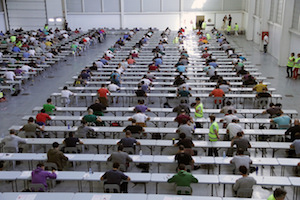
Except in experimental settings, the classroom hasn't changed much in over a century. It's made up of rows of chairs and tables (or bench-tables) arranged in onion rows facing a blackboard, and this is what distinguishes it from any other room dedicated to work.
![]()
Priorities in ecological education
The very principle of environmental education is to integrate oneself into the environment, to take action and not to consider oneself outside the subject.
![]()
Assessment in Health Care and Education
Assessment guides much of what we do, particularly in school. However, while it may be inconsequential in some cases, it can become counterproductive in others if not properly managed. In the context of student support services, assessment may seem absent when viewed through the lens of standard criteria; yet it remains, focusing on elements beyond the purely academic realm.