Publish at November 01 2022Updated November 03 2022
Eliminate food waste
The example of Spain on this issue
While millions of people are barely able to feed themselves, rich countries waste 40% of their food purchases. To put this in perspective, it is as if we burned the equivalent of Russia's agricultural production in fields and slaughtered 12 million animals without eating them. Frightening data that reminds us that the problem of nutrition in the world is not that there is not enough food but rather that it is poorly distributed.
Madrid-based activist and scientist Diego Garcia-Vega made a capsule for Brut in his native language (with French subtitles and narration) to talk about the Spanish case.
In fact, the country is one of the first in the West to regulate on the issue. It has passed a law allowing fines of up to 60,000 euros for restaurants and hotels that do not comply with the new rules. For example, they will have to publicly state how much food is thrown away each year, offer discounts on soon-to-be-expired products, and offer customers the opportunity to take away their leftovers. If they don't want to, then they will have to turn them into juice or jam or be composted.
However, as the young man points out, supermarkets are not yet affected by this law even though they participate greatly in waste. They force consumers to buy more fruit or vegetables than they need. Much of it ends up in the household garbage. They do this because right now they buy in bulk and it's cheaper to offer more at once.
So the next logical step would be to regulate the big box industry so that these images of trash containers full of often still-consumable food disappear.
Video games designed for people with disabilities are already a rare resource. An experience that allows multiple players is even rarer. Yet this latest creation from "Ludociels for All" challenges players to light up an entire maze by walking balls of light.
The Englishes MOOC course was developed by an artist and is designed for anyone interested in the (English) language. It explores the history of English, its pronunciation, and its relationship to the art world.
All our lives have an online component. As a result, a large proportion of Internet users are at risk of being tricked by hackers. A short game invites Internet users to remember certain elements of cybersecurity using a space theme.
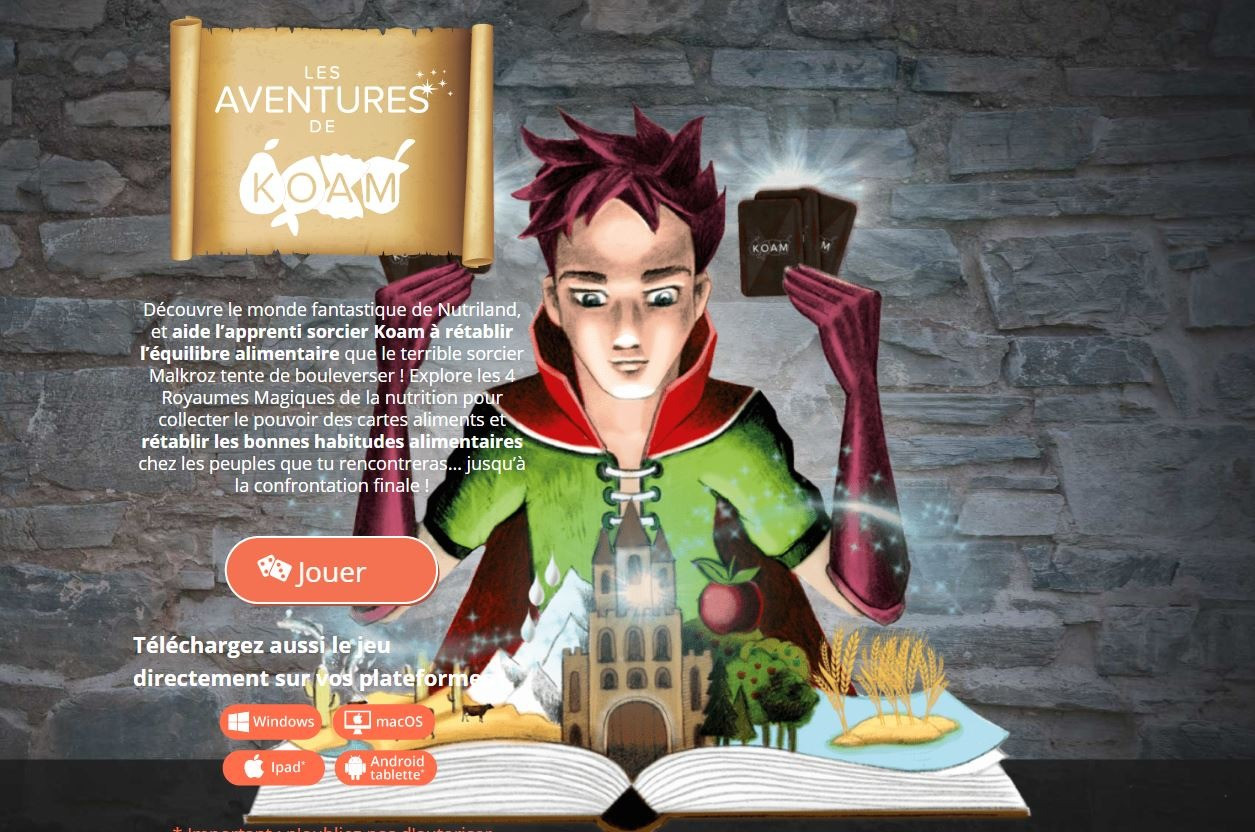
A veritable showcase for public health, Koam was developed by Nutrikeo, a consulting firm specializing in nutritional strategies. Supported by BPI France, the Nouvelle Aquitaine region and Europe, Koam is the result of two years' work by a team of leading specialists in nutrition, childhood, pedagogy, sociology, digital and behavioral theory.