"Phalenes! understanding natural selection through play
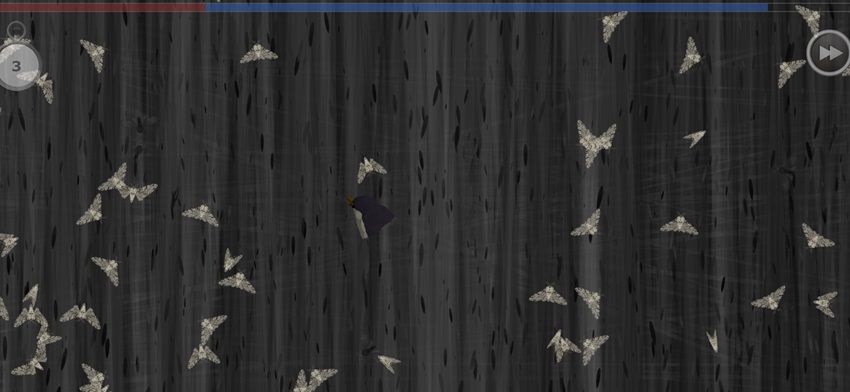
A serious game designed to demonstrate natural selection and its effects on a moth population.
Publish at December 07 2022 Updated December 07 2022


Dutch artist Nicoline van Harskamp makes videos in which she explores spoken language.
In
a work called «My Name is Language», everyone
are in a waiting room (which gives the impression of being in an airport), and actors tell stories about their names -
where they come from, who gave them to them, and what they mean. The artist sees names
as language, and questions what happens when they are translated; how does this affect their holders.
An
other work, a video entitled PDGN (from pidgin:
A simplified mixture of two languages, with a rudimentary grammar,
which serves as a medium of contact), shows people in a
society, recycling the artifacts of the previous era and communicating in an English that barely resembles the current language.
In the
Englishes series, the artist surveys the history and future of the language
English, as well as the varieties of spoken English. For her, the "mistakes"
and accents represent a liberation of the English language from its center
(where English is the native language): "Because [the spoken word] is the
last area of recreation that we can still have left."
She developed the «MOOC Englishes», in which you can learn about the history of English, its phonology, linguistic varieties such as pidgins, jargon and creoles, the use of jargon by the artistic community, and the invention of languages.
The goal of the course, according to the artist, is to encourage people to stop measuring their English against a native standard, and adapt the language to the needs of its users.
In an interview, Nicolina van Harskamp says,
"...if you think of the worst thing that could happen to English is that it will remain standardized and everyone will have to speak in a certain way; it will be a status mark and people will have to invest a lot of time and money to acquire a certain accent, for example. a certain accent, for example. But the best thing would be a language that people can use and develop freely using other languages at their disposal. »
To learn more:
Nicoline van Harskamp - interview: 'Once you start thinking of names as language, people get very upset or very excited' - https://www.studiointernational.com/index.php/nicoline-van-harskamp-interview-thinking-about-names-as-languages
Nicoline van Harskamp interview - Englishes at Project Arts Centre, Dublin
https://www.youtube.com/watch?v=h-EV6cTkY5s
You might also like:
"Phalenes! understanding natural selection through play
A serious game designed to demonstrate natural selection and its effects on a moth population.
A fun game about heredity and genetics - Welcome to Thingdom
How do you talk to children about genetics and heredity? A British museum has come up with the method: design a game in which you create a line of adorable creatures with precise objectives. The game is fun, colorful and easy to learn. Even adults will succumb to the charms of the bugs and their large families.
Develop your musical ear through play with Meludia
To a layman, music is just a tune performed by a musician. Yet, if he were to play Meludia, he would learn all the rudiments and terms associated with musical practice.
A series of games that require an ear.
Elude: a serious game for understanding depression
An original approach to depression. The game's metaphor is well conceived, a little dark and informative about a problem that affects millions of people.