Do you think the next generation will live in better conditions than ours?
Pauperization and uberization of society; unemployment, precariousness and difficulty in starting a family; global warming, mass extinction, pollution and depletion of the soil; increased feelings of insecurity... Our era is characterized by the fact that for the first time in living memory, the new generation will have less than the previous one.
This new generation is confronted with a multitude of global crises as much ecological, climatic and sanitary as economic, social and political. The whole of these crises disrupt and constrain the trajectories of individual lives, but also collective by altering our societies and the living together.
This institution responsible for the intellectual, civic and social development and empowerment of the future citizens of the Republic has been insidiously transformed into a factory for the reproduction of inequalities and a capitalist consumerist civism with innovation.
Schools today are in trouble and no longer make people dream. This is due to the inequalities between establishments, to the strong increase in the rate of illiteracy and school dropouts as well as to the lack of means generating competition, ghettoization and school violence.
Closing in on itself because of these multiple internal and external crises, the school institution is sinking. By isolating itself within four walls or by interposing screens in remote classes, interrupted by videogame recreations, the school fails by protecting individuals in an idyllic virtual and toxic individualism.
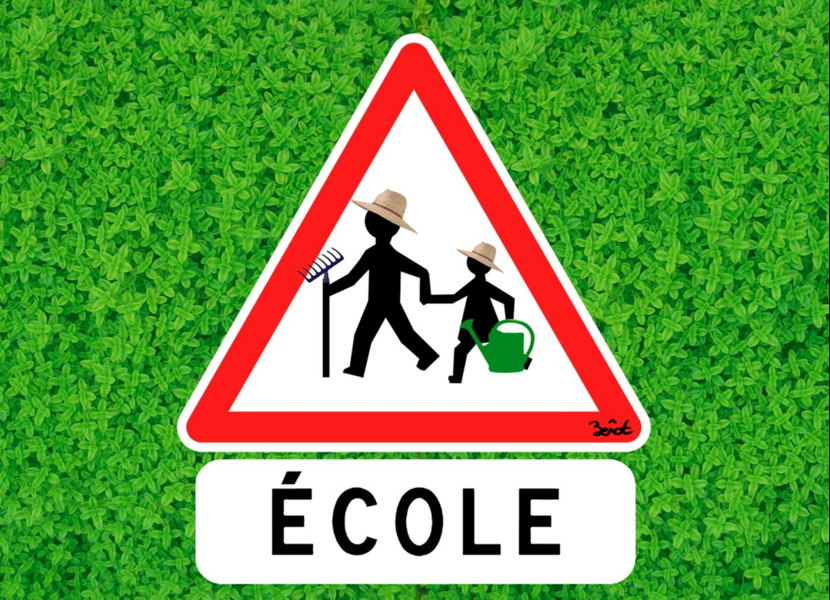
What if the solution to these crises was to open the school instead of closing it? To make it closer to nature than to screens? What if the school became a garden?
The garden school could prepare future citizens for the respect of nature and for the general and urgent change of behavior that the various crises impose by teaching ecology and eco-citizenship. This is what Gilles Delesque proposes to discover in his thesis "The Garden School: anthropology, history and pedagogy of collective and family gardens".
Why Read This Thesis
This research work places the school at the crossroads of the crises shaking the world. We discover the meaning of what school is and what a garden is through a finely crafted theoretical and practical exploration. We understand the interest of a garden school and how this innovation of the past could be the panacea of the future.
Gilles Delesque, with a remarkable philosophical, historical, anthropological and practical overview, plunges us into the different models of garden school that exist and have existed. By seeding his reasoning and argumentation with the ideas and concepts of different currents, eras and disciplines, the author proposes, by force of proposal, an innovative and constructive form of garden school.
The budding researcher invites us to discover the anthropological and pedagogical functions of the garden school, which allows the reader to grasp the interest in changing the school paradigm. The arguments of a dorological nature linked to the gift, xenological linked to the social and pharmakological linked to health, are arranged throughout the pages and enrich the pedagogical function of this place where knowledge about the world, the others and oneself is cultivated.
Excerpt - Dialogue with my gardener?
The idea of a refoundation of the law with respect to nature, the commons of water, land, air, fauna and flora, with a legal personality, is topical, it is justified by the speed and violence that the consumerist economy causes as damage to these commons.
The school would thus be invited to reflect on the three notions of the social contract given by Jean-Pierre Cléro: "The free gift (donatio libera), the contract (contractus), and the convention (covenant/pactum)" terms that appear in recent history with the conventions on climate, the citizen conventions, the natural contract of Michel Serres. We may also find the notion of gift studied by Marcel Mauss and its absence of monetary speculation, of financial interests, of the monetization of nature, in this school re-foundation envisaged, which we will also have to study. It will also be necessary to ask the question of this contract made in the school of the Garden of Epicurus, a contract which is called sunthêkê in Greek, this fundamental notion which will inspire Rousseau and which appears in the capital maxims of Epicurus:
Justice is not something in itself, but, in the gatherings of some and others, in whatever place it is, each time, a certain contract (sunthêkê) with a view to not doing harm to oneself and to not suffering from it.
We will consider the hypothesis that this contract may be based on respect for nature in gardening communities or in the practice of gardening at school.
In the seventeenth century, for example, the Covenant was an example of a social contract in Scotland, but based on the Protestant religion and not on "nature." Can schools, like other institutions, ignore these crises? This research interrogates education in light of these crises.
Is this change of educational paradigm, the passage from the state of "citizen" of a society without a major ecological crisis to the state of "eco-citizen" of a society with an "urgent" ecological crisis, the corollary of critical situations in our societies? The urgent deadline of ten years given to our societies to react in depth by the ecological experts is now acquired: "We have only ten years left to save the planet" is thus scientifically founded (but what it does not say is that it is a question of saving the human adventure even more than the planet)."
Rapidly turning a citizen into an eco-citizen may seem like a tall order, but that is the hypothetical challenge of a garden school.
Garden School
Gilles Delesque's work as a whole results in a philosophical, historical, anthropological, and pedagogical research, both theoretical and empirical, around the concept of the garden school. All in all, the author's path seems to show that the garden school constitutes a global remedy for the ecological, social, economic and educational crises of our societies.
The Garden School also responds to health issues with a pharmakological function by allowing the body and mind to be healed. Indeed, the direct link with food and its production is associated with a healthy diet, an awareness of the crucial role of the environment for our food survival as well as the limits of sustainable development as it is thought today.
There is also a xenological function that responds to the economic crisis by promoting secular values. These humanist values include mutual aid, solidarity and collaboration as much in the area of food as in the area of welcoming foreigners, the inclusion of people with disabilities or respect for others in their differences. The whole is articulated around this common place that is the garden encouraging inter-community and inter-generational exchanges in a school and extracurricular context.
And finally, the garden school is a pedagogical remedy to the current school crisis by articulating the dorological, xenological and pharmakological functions of this place to heal the school and society as a whole.
How to stop being caroted
Alienated by the instantaneousness of the digital, of information, of everything, right away and now, Man seems to be detached from his own time scale.
Living the crises as a spectacle, our eyes chained to television, telephone, tablet or computer screens, we forget that reality is not pixelated and that we are actors in it.
What about you? Would you like to participate in a garden school?
Good reading
This work was defended on July 1, 2021 in Rouen at the doctoral school Homme, Sociétés, Risques, Territoire (HSRT) : ED 556 - of Normandie Université within the Centre Interdisciplinaire de Recherche Normand en Éducation et Formation (CIRNEF) (EA 7454) (Rouen - France)
Sources
Gilles Delesque. The Garden School: anthropology, history and pedagogy of collective and family gardens. Education. Normandy, University, 2021. French. NNT: 2021NORMR034. tel-03506286
Thesis: https://theses.hal.science/tel-03506286
PDF: https://theses.hal.science/tel-03506286/document
See more articles by this author