A multilingual continent
Africa is the second-largest continent in the world and the most multilingual. According to the African Language Program at Harvard, there are between 1000 and 2000 languages spoken on the continent, with possibly as many as 8000 dialects. These indigenous languages have been negatively affected as a result of colonization, which almost led to their extinction because of the impact of official languages (English, French, and Portuguese primarily) and their ascribed privileges.
Today, African languages continue to be marginalized and remain under-used by most of the native speakers, who see them as being inferior to other colonial languages.
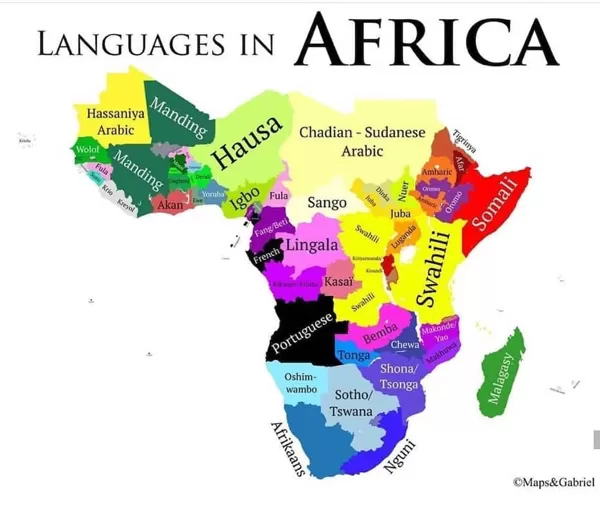 Even when African indigenous languages like Arabic (in Somalia) or Swahili (in Kenya) are in a co-official role, the ex-colonial language still enjoys greater prestige than the local official language[1].
In countries where the ex-colonial language is not official by law, de facto it often plays an important official role and enjoys significant prestige. Cameroon is unique as the only African country that has more than one ex-colonial language, English and French, as official languages.
As a result, almost all of the existing stories and books for children are in English and European languages (98%). South Africa is one of the few African nations where more than 10% of books’ sales are directly in one of the nine indigenous languages: English-language publications accounted for 72% of sales across all sectors, while those in Afrikaans accounts for 16% and those in isiZulu, IsiXhosa, Sepedi and Setswana account for 12%. Thus, the interest for books published directly in African languages is extremely small.
This under-utilization of African languages affects the quality of education delivery, especially the foundational literacy programs for children: 130 million of children globally still did not achieve the minimum benchmarks in literacy and numeracy. The Global Book Fund Feasibility Study 2016 revealed that a significant contributing factor to this crisis is the lack of reading material available in languages familiar to children. This is further reinforcing the growing interest in bilingual education in sub-Saharan Africa, where there is an increased need to produce more children's books, textbooks and early readers in African languages.
Conscious of this, the Global Book Alliance together with the Association for the Development of Education in Africa (ADEA), advocated to increase production of high-quality textbooks and reading books, in children’s own languages, at the 2022 Transforming Education Summit (TES). At the TES, all education stakeholders agreed on the need for more children's books written in the children’s own languages, and with vocabulary and syntax that are within their competence. For these books to be culturally and linguistically relevant, and supportive of children’s sense of belonging, the content should be created and published by people who are grounded in the children’s own cultures.
Academics Grassi and Barker recommend the use of students’ native language for content instruction as it increases students’ academic achievement. Researchers Doiron and Asselin confirmed that learning to read is most successful with mother tongue texts. Therefore, children’s sense of belonging is nurtured by books that are relevant to their environments, cultures, genders, and ability status. And ‘it is especially valuable to make the best books for young people written in any language available to them while they are the right age for them commented Anthea Bell, a famous translator of children’s books who was three times awarded the prestigious Marsh Award for Children’s Books in Translation[2].
How many books about other countries or translated books did you read as a child?
This question, though apparently simple, would generate different answers depending on the continent where it is asked. In Africa, the majority of response will refer to foreign books for children while in other continent, the answers will most likely refer to an indigenously produced children book. In my case, my favorite book as a child was Zembla and many in my generations also read Astérix, Babar, Pinocchio, Iliad and the Odyssey, which are all from Europe. So the question is, where were the stories from the rest of the world — Asia, Australia, Africa or the Americas?
The need for diversity in global children literature is increasing. Translation and bilingual publishing are two key ways of growing the existing body of children and young adult books from diverse continent, especially in African languages. But currently, they are few expert translators of children’s books from international languages (English, French, Portuguese, Spanish etc.) to African indigenous languages. Authors and publishers of children’s books in Africa have difficulty finding competent and trained translators of the books and stories. Moreover, the level of development and use of African indigenous languages is affecting the level of development of literary translation in Africa.
References
[1] There are countries like Algeria, Egypt, and Libya where Arabic, the official language is also a local medium; in Morocco and South Africa, more than one local language is constitutionally recognized as official in co-equal status with English.
[2] The Marsh Award for Children’s Literature in Translation is a biennial award, given from 1996 to 2017, that celebrated the best translation of a children’s book from a foreign language into English, published in the United Kingdom. Through these translations, children who are primarily English-speakers are able to be exposed to stories that are written and take place in another country. It important to note that no African language book has been awarded through this prize.
See more articles by this author