Elude: a serious game for understanding depression
An original approach to depression. The game's metaphor is well conceived, a little dark and informative about a problem that affects millions of people.
Publish at May 02 2023 Updated May 02 2023


The words "Terra incognitae" on old maps stimulated explorers. We have always desired to go and discover the unknown lands. Since the 19th century, in addition to terrestrial environments, many have had their noses to the grindstone on our neighboring planet: Mars. Scientists and authors have been interested since that time in the possibility of civilizations there or that the human one goes there.
Multi-billionaire Elon Musk dreams of sending the first humans there around 2029. Except that for the moment, there is no solution to transport people to the red planet. Already because 50% of the robots sent there have failed to get there, due to an atmosphere much thinner than that of the Earth. Moreover, it would be necessary either to find a way to plunge the earthlings into a type of hibernation where the basic needs would be less during the trip or to manage to bring enough food, oxygen, water, etc.
However, landing on Mars would not be so difficult. We know more about our neighbor's surface than we do about our own because it has no significant water mass. On the other hand, the absence of a magnetic field will complicate the existence of humans who are very vulnerable to ultraviolet and cosmic rays. Already we don't know how to protect the astronauts during the trip against these radiations...
Once there, one would have to settle in one of the many lava tunnels unearthed by scientists. To live on the red planet, it will be necessary to find a way to create water and nutrients to make the soil fertile. Cyanobacteria could help to achieve this, but this is still a matter of debate. The idea of terraforming itself is not unanimously supported by specialists, with many believing that, apart from in enclosed areas, it would be impossible.
In short, Mars rightly interests researchers. However, to see in it the possibility of a star to start all over again is more science fiction than science.
Time: 20 minutes
Picture credit: en.depositphotos.com
You might also like:
Elude: a serious game for understanding depression
An original approach to depression. The game's metaphor is well conceived, a little dark and informative about a problem that affects millions of people.
A serious game on social engagement
Many serious games address the topic of sustainable development. Yet before such solutions were proposed, innovative people had to go against the social grain and fight to improve their environment. A humorous adventure game, hosted by the National Film Board, teaches children the attitudes they need to adopt to make a difference.
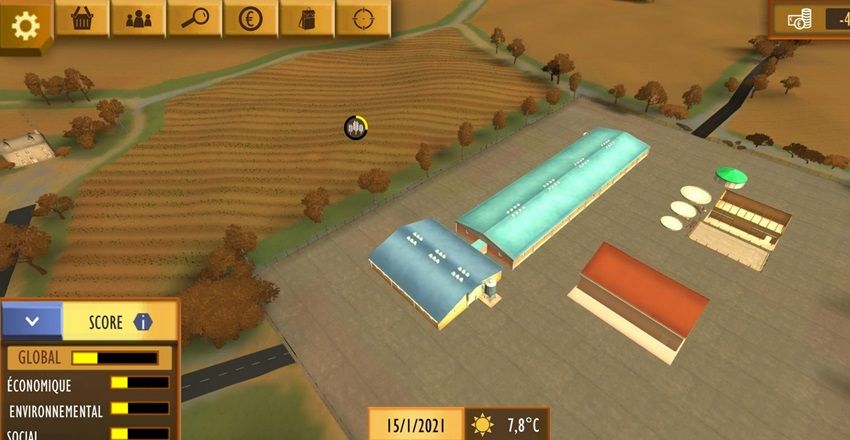
Reflecting on agroecology through play
There's nothing simple about being a farmer. You have to plan your activities throughout the year, make sure you have the right machinery, maintain it and so on. All with a view to ecology. A serious French game seeks to teach agroecology.
The sharing economy has led to small changes in various economic sectors such as transportation, housing, etc. This approach has changed the relationship of citizens for different services, now cheaper and offered by their fellow citizens. However, who actually benefits from this new economy? The people or the companies in question? A U.S. newsgame shows how the life of Uber drivers isn't as lucrative as one might think.
A multiplayer game designed for people with disabilities
Video games designed for people with disabilities are already a rare resource. An experience that allows multiple players is even rarer. Yet this latest creation from "Ludociels for All" challenges players to light up an entire maze by walking balls of light.