Virtual tours, learning and the desire to learn [Thesis]
Can virtual tours help art history teachers?
Publish at September 06 2023 Updated September 06 2023


"Hear me
I do not speak to you with my voice
(nor my lips nor my tongue)
(nor my trembling vocal cords)
I'm not talking to you with my words
(nor my ideas nor my ideals)"
Michaël Lambert, La vengeance du Pangolin.
How can we reconnect with our nurturing gardens and reformulate a living agricultural practice? This is the message we take from Margaux Alarcon's thesis.
Her research in environmental geography involved investigating concrete practices and relationships between humans and non-humans (plants, animals, soil) in three wine-growing and agricultural areas of France and Belgium: Occitanie, the Paris Basin and Wallonia.
Against the backdrop of intensive agriculture on a massive scale, the author has sought to link current agricultural practices (conventional, sustainable, organic, biodynamic) to the notion of care. This can be translated as solicitude in French, but here we'll stick to the author's own formulation, which explains the concept as follows:
"The ethics of care is a moral philosophy stemming from feminist theoretical thought developed in psychology and then in philosophy as part of a non-theoretical movement of applied ethics, concerning the usefulness of moral principles in solving real-life problems."
It is a disposition and a practice, which "mobilizes the concepts of vulnerability, interdependence and care".
"It emphasizes that human beings are above all relational, and aims to refocus moral thinking on the relationships between human entities rather than on moral action itself."
It is with this view of care that the researcher has chosen to approach "relational agricultural practices" and the way this solicitude has of renewing the peasant perspective. This perspective reverses that of rationalist philosophy:
"Thus the key concepts of care, vulnerability and interdependence, are opposed to the abstraction of isolated, independent human beings, whose reasoned confrontation would be at the origin of the social bond [...].
In this sense, the ethic of care reverses the perspective of rationalist philosophy and highlights the fact that some people care for others, and that interdependence is real and necessary for social functioning."
In terms of farming practices, it's a question of deciphering the environment, of being attentive by mobilizing one's perceptual and technical skills. This may seem simple and obvious, but conventional agriculture (in Europe at any rate) was strongly structured after the Second World War around a "fixist" approach to the living world, in which nature was reduced to the status of an object to be exploited (the farm model).
The peasant model was devalued in favor of a top-down model of knowledge production and dissemination: "science has a monopoly on defining good practices and production processes". Prescriptions are top-down and standardized, and in France, landscapes are being reshaped, with a significant impact on the environment (destruction of hedges, embankments, ditches and watering places).
The Chambers of Agriculture supported this model of "reduced, controlled, standardized nature". And, in the 1960s-1970s, the pathologization of crops emerged: the aim was to administer preventive treatments for diseases and pests to standardized crops.
In the decades that followed, the voices of protest against this way of relating to the living world were heard (supported by the existence of health scandals), notably with the "creation of farmer collectives autonomous from the classic development groups stemming from the dominant agricultural model of intensive farming".
Here, too, the researcher is in line with the care approach, for in agriculture, the interpersonal dimension of knowledge and knowledge production is fundamental:
"Farmers have a diversity of different types of knowledge, including experiential knowledge, i.e. knowledge that is not said, but comes from directing attention to processes that are being done, i.e. concrete actions."
She quotes anthropologist Tim Ingold:
Direct knowledge is based on "a way of feeling that is constituted by the capacities, sensitivities and orientations that have developed through long experience of living in a particular environment".
"Farmers work with nature" in a relationship where the economic dimension is strong. Investments (financial, temporal, emotional) are significant, and choices are made between laissez-faire and control (particularly with regard to the presence of grasses).
For example, we read in the thesis that "thetransition to integrated viticulture modifies the relationship with vine diseases": some winegrowers are moving away from the systematic use of treatments, and disease symptoms can persist without treatment as long as there are no consequences for production. One winegrower reports higher yields by letting a large part of the vines wither away, rather than treating all of them (pesticides weaken all living organisms).
We also discover some surprising methods for novices:
"To make vines stronger and grow better, we use silica. It's a rock we pick up with an ice axe in the Alps. It's silicon dioxide, silica. It's finely ground and look, it's here in the kitchen, always stored in the morning light, here it's due east. We use 100 grams per hectare, it's very powerful, it's something that calls for light, heat."
In all the farming practices she observed, the researcher noted adjustments in the direction of a greening of practices and relationships with nature, with a growing complexity of these relationships. Here are just a few of them:
"Mysoils were no longer responding, there was no life left in the soil.
And also: "Several farmers we met noted that they had gradually stopped relying on people providing advice and selling phytosanitary products to monitor their crops."
What's interesting in this thesis is to understand the movement towards the greening of practices, whatever the starting point.
These practices have made it possible to switch to organic farming in a maturing process that can last several years, with tests on plots that are then extended. The switch is a "combined consideration of environmental and health issues (impact of products on health)".
Generally speaking, "eco-knowledge" is "built in a way that is adapted to specific interactions with natural environments", in a living modality.
"In the silence of machines
The forest will be returned to me
The song of the birds
The reason for storms
The trickle of water
La mousson des sages"
Michaël Lambert, La vengeance du Pangolin.
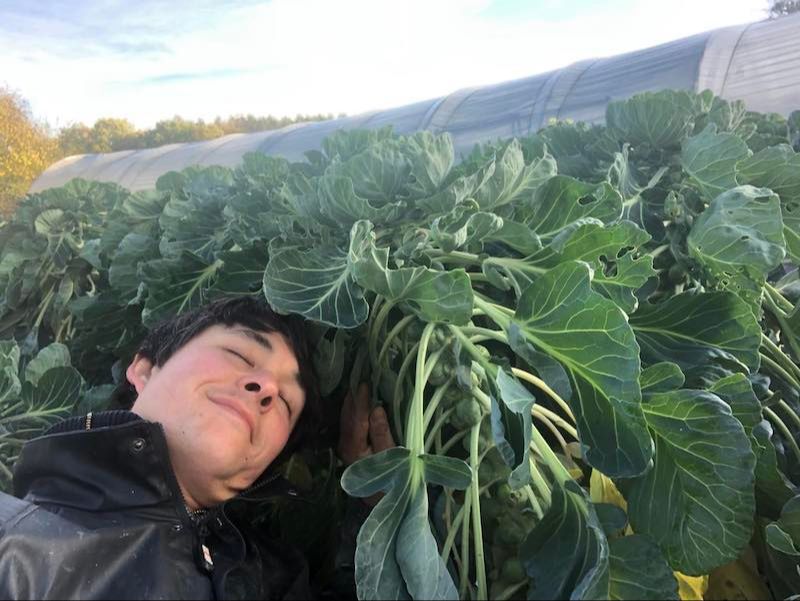
Image source: Laurent Van Ngoc, Jardin du Voisin, with his kind permission.
Margaux Alarcon. Caring for plants and soils: characteristics and transformation of agriculturalcarepractices . Geography. Museum national d'histoire naturelle MNHN Paris, 2020.
Thesis available at: https: //theses.hal.science/tel-03385689
A partnership between automation courses at a high school in Liège (Belgium ) and a permaculture market gardener, Laurent Van Ngoc :
https://www.helmo.be/Actualites/Articles/On-jardine-en-automation-!.aspx
A first draft of a - perhaps - future slam by Chance, written with the instruction of care in agricultural practices:
"Un jour j'irai prendre soin - De c'qui est dans l'jardin - J'irai étendre du foin - Pour cacher les misères - Des terres vidées - Par notre manque de care - Un jour j'irai prendre soin - De c'qui passe dans mon ventre - Dans mon ventre morbide - Qui à force se wrinkle - J'repousserai ce qui vient de loin - Quand je mange les 4 saisons ! - One day I'll take care - Of what's vital to me - I won't swallow any more" so? - "When are we going to start?" - When are we going to "but"- When is care - Made compulsory? - For what makes the living grow - And passes through our hands? - Someday I'll stop saying someday - Someday I'll live in the garden."
You might also like:
Virtual tours, learning and the desire to learn [Thesis]
Can virtual tours help art history teachers?
Ethnography of an apprenticeship of ignorance [Thesis].
"Experiencing daily, often painfully, the complexity of clay transformations, constantly questioning the rightness of what is felt and whether it can be shared with others, students do not learn to know so much as to acknowledge their ignorance, as to experiment from what they cannot control."
Making Schools the Beating Heart of Europe
Knowing that the budget for the Erasmus program has been almost doubled for the period 2021-2027 and that the project for a European Education Area is one of the European Union's priorities, it is not surprising that this report is a call to enhance the value of the teaching profession.
Success for all" in elementary school - A real-life experience.
"Professional Learning Communities", we talk about them, we read about the benefits of such communities, but when it comes time to act, the comfort of the status quo often wins out except that, in this school, they didn't want the status quo anymore: they wanted kids who would get off to a better start in life, despite adverse starting conditions. Here's how they did it.
The life of models of peace. Educational tools - Thesis
Can we use the journeys of people who are considered models of peace to promote a spirit of peace? A researcher offers pedagogical tools, inspired by the lives of five emblematic figures, so that everyone can identify their potential as peacemakers.