The poker player's hidden strategy and A.I.
What is the optimal algorithm when playing with partial information?
Publish at October 04 2023 Updated October 04 2023


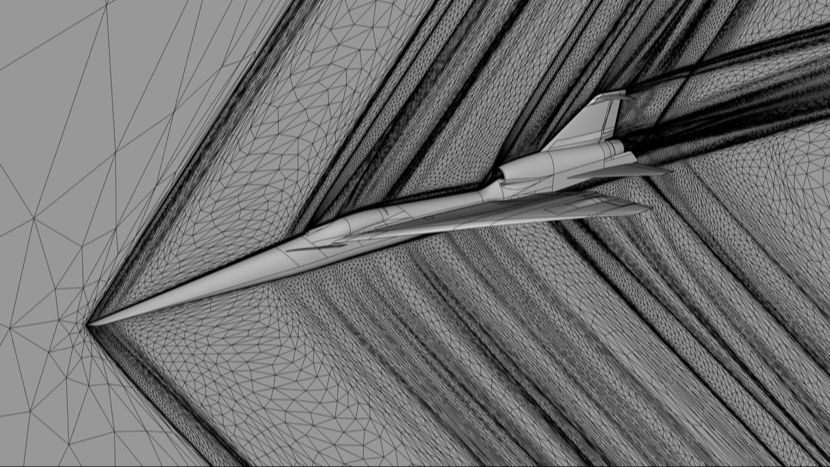
In the world of simulation, things quickly become complex as soon as you move away from simple geometries and isolated movements. Interactions between billions of elements, as in a fluid, become almost incalculable, especially when the properties of the medium change according to orientation, temperature, pressure, distance or frequency. How can we calculate what happens when a plane breaks the sound barrier, or when the plasma of a lightning bolt strikes an aircraft made of composite materials?
The answer is that models are represented using small tetrahedrons (4 faces) or hexahedrons (6 faces). The higher the resolution required, the smaller they are. So, even with supercomputers, complex simulations become technically impossible to calculate, as there are so many of these small tetrahedrons to mesh (establish what kind of relationships they have with each other).
To get around this problem, GammaO is a joint project-team with ONERA (Office national d'études et de recherches aérospatiales) which has developed a calculation method called "anisotropic adaptive meshing". Anisotropic refers to physical properties that depend on orientation.
This method of calculation makes it possible to increase the precision of the mesh where it is important for studying phenomena, adding resolution where it counts and removing it where it doesn't. This in turn reduces the cost of the mesh. This in turn reduces calculation costs and time, and makes it possible to carry out simulations that were previously impossible.
For the full article: Precision digital simulation takes off with GammaO
Onera
GammaO

Domaine de Voluceau
Rocquencourt - B.P. 105
78153 Le Chesnay
France
Tél.: 33 (0)1 39 63 55 11
You might also like:
The poker player's hidden strategy and A.I.
What is the optimal algorithm when playing with partial information?
Present security compromised by the future: at the dawn of quantum computers
A race is on between the developers of quantum computers and cryptographers who seek to ensure data confidentiality because the most advanced current protocols in cryptography are challenged by the capabilities of quantum computers.
Identifying biodiversity on a large scale
How can you identify a 10 km2 profusion of leaves and tangled plants?
Discovering the hidden functions of our phones' applications
It's hard for applications' graphical interfaces to reveal their full functionality, even less so on phones where menus are reduced to their simplest expression. INRIA is working to improve the situation.
Regulation of algorithms: transparency, fairness, moderation
The paradoxes between possibilities and desires, between intentions and actual practices, lead researchers to define ways to supervise algorithms.