Online behavioral influence: studies in the pressure-free submission paradigm - Thesis
The role of avatars in pressure-free submission: the anthropomorphism of the avatar has a very real importance in inter-individual interactions.
Publish at October 25 2023 Updated November 06 2023


Finding the right balance between work and family life is a concern that haunts the minds of many. With more and more women entering the workforce, the proliferation of single-parent families, global competition and tertiarization, it's difficult to reconcile work and family life, affecting employee performance in the workplace.
In order to guarantee the productivity of employees, especially top performers, it's up to the company to create a suitable environment that favors reconciliation of family and professional life. It was with all these considerations in mind that Pierre Garner wrote his thesis on the effects of work/family balance on job satisfaction and the intention of managers to leave: an investigation of the moderating role of the feeling of personal effectiveness.
The research question is how and by what mechanism can an organization retain an employee judged to be a high performer when he or she is subject to an imbalance between work and family life?
To answer this question, Garner draws on Bandura's socio-cognitive theory, role theory and turnover theory. In terms of approach and data collection techniques, the researcher uses the deductive quantitative method and the questionnaire. The sample corresponds to 1,192 employees belonging to SMEs in the private sector in the Lorraine region.
Reporting on this study means highlighting the theoretical underpinnings of work-life balance, analyzing the moderating role of the sense of personal efficacy (SEP) on the relationship between work-life balance and job satisfaction, and formulating the research findings.
Work-life balance is a major global issue. That's why measures are being taken at national and international level to guarantee work-life balance. In France, for example, a legal framework for this purpose, including maternity leave and parental leave, is in place. Internationally, the OECD favors flexible working hours and part-time work, even if these measures imply a break in career opportunities and the assumption of future high incomes, especially when children are young.
From this point onwards, a conflictual relationship (Barnet and Gareis 2006) emerges between family and professional life, as "inter-role" tension is simply the result of role overload, according to the proponents of role tension theory, leading to malaise characterized by stress, role conflicts and more. And yet, according to Almqvist (2006), "multiple roles and dual professional and family involvement are beneficial to the individual".
The difficulty in balancing the two spheres lies in the individual's preference for individual strategies and issues based on Cartesian calculations and choices (Philippe Bernoux, 1980), personal projects (Thévenet, 1992: 33) and the professional sphere (Barel and Frémeaux 2008: 50). Whereas finding the right balance relies on good time management, limiting stress and adapting behavior.
Pierre Garner highlights the behaviours adopted by individuals in the workplace that can influence performance. He shows that employee behavior in the workplace is strongly motivated by needs and the benefits this can bring. Motivation being a production process aimed at achieving an objective, satisfying a need.
While some consider job satisfaction to be a person's evaluation of his or her work (Cranny et al 1992), Bernstein and Nash see it as a combination of emotional, cognitive and behavioural components. Thus, a person who judges his or her work environment negatively generates job dissatisfaction, according to Mackensie et al. And conversely, a positive feeling leads to satisfaction, giving rise to organizational involvement.
While it is true that organizational commitment marks a long period of collaboration between the organization and the employee, its affective dimension produces ambivalent reactions: resignation (Mathieu & Zajac, 1990), absenteeism (Meyer et al., 1993), job satisfaction (Mowday et al., 1982) and the intention to leave the organization (Clegg, 1983).
The intention to leave an organization can have several causes (Tunrover). For Burke (1988) & Good (1996), they are based on work-family balance. These voluntary departures entail huge losses for the organization, which proves unable to retain the best profiles in order to optimize performance indicators. In order to mitigate these losses, strengthening the sense of personal effectiveness seems to be the solution.
SEP, or self-efficacy, is the belief in an individual's ability to achieve the results he or she desires (Carré 2004/5: 19). In addition to being a stress-modifying factor, this conviction is a determinant of reflection and action. Endowed with behavioral predictive power, self-efficacy would encourage an individual to take up a challenge, rather than avoid the obstacle and achieve organizational performance. Even if a past experience resulting in failure or success affects self-efficacy according to the high or low degree of conviction, the point of self-efficacy is to make the individual the master of his or her future actions.
This regulating tool is used by managers to create a work environment conducive to employee productivity. This is made possible by feedback from management on an employee's performance, the function of which is to satisfy needs for emotional support, affiliation, esteem and approval (Rhoades & Eisenberger, 2002: 711), producing a pygmalion effect -obtaining what one expects from others- on employees. SEP thus highlights the relationship between the environment, the individual and his or her behavior.
Having reviewed the theoretical foundations of work-life balance, as well as the moderating effects of SEP, we move on to the confirmatory phase, which presents the hypotheses followed by the research results.
Illustration : Mohamed_hassan - Pixabay
Reference
Pierre Garner, 2015, Les effets de l'équilibre travail/famille sur la satisfaction au travail et l'intention de départ des cadres : une investigation du rôle modérateur du sentiment d'efficacité personnelle, PhD thesis, Université de Lorraine, online https://hal.univ-lorraine.fr/tel-01751820
You might also like:
Online behavioral influence: studies in the pressure-free submission paradigm - Thesis
The role of avatars in pressure-free submission: the anthropomorphism of the avatar has a very real importance in inter-individual interactions.
Prison and vocational training [Thesis].
History, conditions and constraints of vocational training in prisons. An invitation to rethink the institutional relationships and didactic organization of prison training, "so that it can be more effective in terms of the reintegration mission [...] to which it contributes".
Visualizing Students' Skills Graphically. Feedback
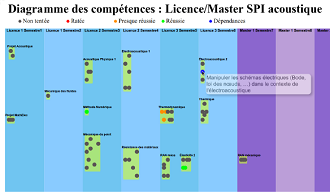
How is a learning tracking tool actually implemented? A case study presented at the most recent French Acoustics Conference details the rollout of an online visualization tool—a “skills graph”—within a bachelor’s-to-master’s degree program ... and the reactions of faculty, students, and administrators.
The Garden School against everyday crises and disasters [Thesis].
For the first time in living memory, the new generation will have less than the previous one. Ecological, economic, social and health crises are disrupting our societies, our way of living together and the school. In difficulty, the institution no longer inspires dreams and seems inadequate to respond to the crises we are going through. What if it was enough to change the paradigm and to think of the school-garden? Let's find out with Gilles Delesque and his thesis.
Global warming, class warfare and tree mortality in French forests
Forests provide ecosystem services essential to life. Human activity on Earth has resulted in the loss of 60% of forests, 60% of wild animals and 60% of insects. Ongoing climate change is one of many causes impacting forests. An increase in tree mortality is associated with climate change becoming more frequent and intense. But in what proportions?