Protective intelligence: learning to care
How the association "Pôle en pomme" initiates the protective intelligence we need to connect in a fragmented society
Publish at November 08 2023 Updated November 08 2023



Faced with major collective challenges, such as climate change, many do what is commonly known as ostriching. They bury their heads in the sand to avoid seeing anything.
And the more glaring the reports, the more they remain deaf and blind in a passivity that seems mind-boggling to activists. So what is this phenomenon?
A mother or father, if they see their child crossing the road in front of a large truck coming at high speed, will take the risk of going to save their little one, beyond their own life, without even doubting. They are already responsible for this life, and they know that if they do nothing, there will be a tragedy that will affect them for the rest of their lives.
Why are they doing the opposite with this famous climate? In fact, all the ingredients are in this little story...
"Awareness is, above all, a wake-up call. It means opening our eyes from within to make the unconscious conscious, so that we can take the first step and begin the personal revolution that was needed. Only then will we be able to heal ourselves, let go of what ails us and, quite simply, move towards what we deserve.
Many philosophers and sociologists define today's society as a sleeping entity...
...Perhaps we're a "Matrix"-type society, still in a state of indefinable apathy. An inner atmosphere in which we fill emotional voids through food, relieve our loneliness with ephemeral relationships and limit ourselves to escaping boredom through the momentary catharsis of our mobile or computer games."
Source : Awareness is the first step to healing or change - Our thoughts - 2017
https://nospensees.fr/prise-de-conscience-premier-guerir-changer/
If we don't see a problem, or don't want to see it, the result will be the same and there will be no action.
"Once the risks have been identified and classified by criticality level (quantified risk assessment), it's up to Management to define the strategy it wishes to adopt with regard to a risk, which confronts it with the notions of responsibility and commitment in the face of a danger of which it is no longer unaware. Unfortunately, the response is all too often the same: risks must be addressed at all costs, and improvements must be made.
However, management also has the option of accepting a risk, which does not mean doing nothing - quite the contrary. Rather, it's a question of maintaining the criticality of the risk at its current level. This means that management is committed to maintaining the control systems in place, as well as the related investments. It is therefore essential to have clearly identified these measures beforehand, and to have measured their effectiveness".
Source : Why is accepting risk a particularly attractive option? - 2022 - Amanda Wanderley
https://pyx4.com/blog/quoi-accepter-risque-revient-a-commencer-a-gerer/
Seeing a problem, a danger, means accepting its existence and therefore taking responsibility for doing something or not. It's more complicated than ignoring it or not seeing it.
Accepting a risk also means facing up to it. And that's not always easy, especially when we're talking about unacceptable things like the disappearance of animal species.
"Accepting the unacceptable is the greatest source of grace in this world".
Eckhart Tolle quote
Grace is not in the unacceptable itself, but, the virtue of acceptance is in the fact of accepting, it's the taking on board of a problem and agreeing to regain sight and hearing. It's a way out of Matrix-style apathy and ostrich apathy. It's about changing the scope of what's possible, and perhaps writing a different story from the one predicted.
In today's society, when we say that we accept a risk, it actually implies the notion of statistics. I accept the risk not to fight against it, because my insurance allows me 10% losses or accidents or...
Here we find the problem of managing the delegation of risk. To accept a problem, you have to feel responsible. Here, insurance becomes responsible, whereas in our civic life, we are responsible for our actions, but everything that goes beyond work and the domestic sphere is mostly delegated to policies set up to manage these responsibilities according to their levels of intervention.
Our political structure, generally speaking, puts us in a position of being hierarchically children who let themselves be guided, and does not allow us to be in a position of being parents of our civic life, and therefore does not allow us to be in a position of action.
To act, we need to feel legitimate in the situation, but also understand or visualize the power we can have over things. Take the example of melting ice causing the oceans to rise. Can an individual do anything about it?
"Has the individual become the driving force of society, or is his or her emancipation a source of danger for the community? How can we reconcile individual and general interests? Overcoming egoism in the name of enlightened self-interest - social justice, collective identity, the principle of solidarity - is a major challenge for democratic societies.
The question of the individual and individualism is the big issue of our time. Against a backdrop of ever more pressing questions about the conditions for "living together" and the vectors of social cohesion, we are faced with the problem of the relationship between individuals.
In concrete terms, this raises questions of insecurity, incivility, solidarity and even political abstentionism. It's as if the "invention of the social" phase, whose dynamics and challenges Jacques Donzelot has illuminated, were to be replaced today by a period of social decomposition, punctuated by the banging of a single individual "turned in on himself", as Alexis de Tocqueville wrote in the middle of the 19th century. How much longer, then, will we be "society"? In a world where various forms of uncertainty are emerging, we sense that the question is not merely a rhetorical one.
Source : Individu et société : les enjeux d'une controverse - The vectors of social cohesion
Patrick Savidan - In Informations sociales 2008/1 (n° 145), pages 6 to 15
https://www.cairn.info/revue-informations-sociales-2008-1-page-6.htm
In fact, no, this individual alone cannot save the world, but he must remain hopeful. There remains a climatic phenomenon that affects the entire planet.
"Do you remember a weekend when the weather forecast called for rain, but it turned out to be glorious? Or the other way around? Even though technology is making meteoric progress every day, and your cell phone is more powerful than the computer that sent the first men to the Moon, we're still unable to predict the weather more than two or three days in advance.
Why is that? American scientist Edward Lorenz put the problem on the table at a conference in 1972. The title of his presentation is still remembered: "Can the flapping of a butterfly's wings in Brazil cause a tornado in Texas?" What does this have to do with the weather?
What does this have to do with the weather? According to his analogy, no matter how many parameters measured today and which could influence the weather in a few days' time (wind strength and direction, sunshine, humidity...) are entered into a gigantic equation, there will always be a tiny, and above all unpredictable, detail (like the flapping of a butterfly's wings, which creates a local disturbance, which creates another, which amplifies...) that we don't think about and which could radically change the final result. We call this the butterfly effect: small causes can sometimes have big long-term consequences. It applies to many other phenomena, such as the formation of traffic jams".
Source : The butterfly effect: when a detail changes everything - 2021 - Québec Science
https://www.quebecscience.qc.ca/14-17-ans/encyclo/leffet-papillon-quand-un-detail-fait-tout-basculer/
So, we can't save the world, but, following the example of Pierre Rabhi's Colibris, if each of us does our part and coordinates it with others, then there's hope.
The final ingredient for taking action, which is in fact the first, is motivation, and therefore the emotional connection we may have with a risk, a problem...
There are two types of motivation: extrinsic motivations, which are reinforced by demands coming from outside our mind: hunger thirst, sex, body integrity...
And there are intrinsic motivations, of a psychological nature, such as novelty, error of prediction, exploration, curiosity...
...It's tempting to confuse motivation and emotions, although they are fundamentally different. Emotions give value to things, but remain passive. Motivations, on the other hand, drive us to action: they make us say "I want... I don't want", not "I like" or "I don't like"...
Source : Learning, motivation, emotion: how do we learn?
Le Monde - Rémi Sussan
https://www.lemonde.fr/blog/internetactu/2014/06/20/apprentissage-motivation-emotion-comment-apprenons-nous/
With all the above ingredients, when everything is aligned, we can, you can, take action, but first we need to have the hope, to reflect and weigh up the things that are going to make us take action.
Being able to assess the effects of doing something or doing nothing is a prerequisite. Some people take the plunge without going through this stage at their peril, while others are so risk-averse that they do nothing. This is the field of risk management, which is studied in business, but which could be a fundamental in school too.
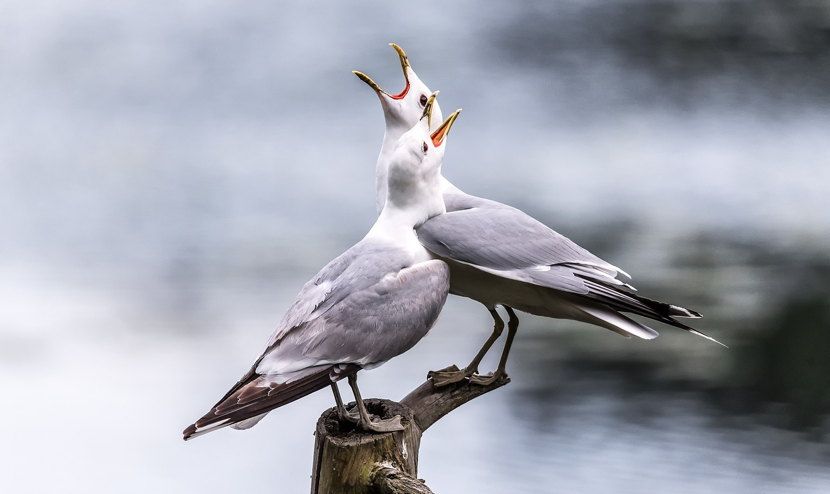
Image: Pixabay - Gert Haltman
You might also like:
Protective intelligence: learning to care
How the association "Pôle en pomme" initiates the protective intelligence we need to connect in a fragmented society
Although some animals are capable of associating symbols with meanings, there are no known examples of animals leaving written traces. Their language is essentially direct, in sound, gesture or olfactory mode. So, if we look at the instant messages we exchange, we get some idea of the kind of messages exchanged by the birds and animals that make up the soundscapes of each region.
A school without grades, various approaches
For the learners, the discussions revolve around one thing: the grade. Everyone is looking for the best result in order to get into the most prestigious courses. However, this system has turned school into an anxiety-provoking environment that makes those who do not succeed feel guilty. What if evaluation eliminated percentages and letters? An idea that is being debated, but that is of interest to more and more teachers.
What if the self-proclaimed experts were just beginners?
If you want to become an expert, pay attention to the stage you are in according to the Dreyfus model, it is a good way to assess yourself. If you are around someone you think is an expert in a field, also think about the different stages of the model and the ways to recognize an expert person described above. As for the title question, the answer is in the article.
Fractal organization as a response to complexity
Applied theories always end up corresponding to the changes they induce. The world of education teaches and develops both theories and, subsequently, their applications. When these applications affect the organization, it is also called upon to review its functioning.