Publish at November 29 2023Updated November 29 2023
Developing your personal brand: content, form and manner
Personal branding is important for professional identity, standing out, establishing authority and connecting with an audience.
Personal branding is not a new phenomenon. As early as 2006, Time Magazine declared "You" as its Personality of the Year. At the time, we were witnessing the emergence of social networks and Youtube. The article concluded: "You control the information age. Welcome to your world".
In almost two decades, how has personal branding evolved?
Is it worth developing a personal brand or not?
Developing a brand or an image takes time and effort. Can these efforts be justified by a quid pro quo? What can people expect when they develop their brand on the Internet?
Students and employees
Even before they finish their studies, students have an interest in positively distinguishing themselves on the networks. At a time when many people are wasting their time scrolling endlessly, the person who constructs interesting content will give a positive image of himself or herself, which will have a positive effect on employability among other things, but not only.
Here's a list of other reasons:
By developing a personal brand, students will develop connections with other Internet users. Indeed, their participation in exchanges on various topics on the Internet will be the starting point for conversations with professionals in their sector.
The process of creating a personal brand often involves developing skills. Producing content requires research, understanding, curiosity and a spirit of synthesis, among other qualities.
Opportunities: A personal brand can attract opportunities such as internships, collaborations or even mentoring proposals.
Thanks to the recognition that comes with their online presence, students gain confidence and belief in their own abilities.
Developing a personal brand is particularly crucial for freelancers and contractors for several key reasons:
Differentiation: In often saturated fields, a strong personal brand helps freelancers and contractors stand out from their competitors.
It highlights their uniqueness, whether in terms of style, approach, skills or experience.
Overcoming impostor syndrome: A well-established personal brand builds trust with potential customers. It demonstrates their expertise and professionalism, which is essential to attracting and retaining customers.
Attract good customers: By clearly communicating their personal brand, freelancers and entrepreneurs can attract customers who share their values and visions. This often leads to smoother, more satisfying collaborations.
Partnership opportunities: A strong personal brand opens doors to networking opportunities, partnerships and collaborations. It enables professionals to connect with others in their industry, creating mutually beneficial business opportunities.
Customer-perceived quality and price match: A strong personal brand often enables freelancers and contractors to charge more for their services. By being perceived as experts or leaders in their field, they can justify higher rates.
Personal satisfaction: As developing your personal brand is synonymous with content creation, by developing it you'll be helping others, which can be gratifying.
But how do you develop your personal brand?
In many fields, the most important thing is to take the plunge. All too often, people stay in their thoughts, or even their dreams, and don't take action. Of course, this doesn't mean you have to act any old way, because there's a risk of giving a bad impression of yourself. So be structured and organized to develop your personal brand.
Define your objectives
For many people, social networks are a pastime, used to consume content. When you want to become a content producer, you need to know why. That's why defining your objectives is so important. More often than not, the main objectives will be to find customers or develop your employability. More disinterested objectives are also a good source of motivation, and can be found in various sectors such as free software.
Creating support for your online presence
Although social networks are becoming increasingly popular, a website or blog remains an interesting tool for centralizing your online presence.
A blog or website
Social networks haven't replaced the blog, which still has unrivalled appeal:
Control over content: Having a website or blog gives you total control over the content you create and share.
Centralized online presence: A blog acts as a central hub for your online presence. You can direct your audience to it from a variety of channels (social media, business cards, email signatures) to offer a more complete and integrated experience of your personal brand.
SEO or Search Engine Optimization: A website or blog helps optimize your content for search engines, increasing your online visibility. Good SEO can help you reach a wider audience and be discovered by people seeking information in your area of expertise.
Social networking
Given the number of possibilities, you need to be selective!
Focus on the platforms where your target audience is.
Each platform has its strengths and should be used strategically (LinkedIn for professional networking, Instagram for a strong visual presence, etc.).
Also, choose platforms according to your preferences. If you're not comfortable with video, Youtube may not be ideal or for Faceless videos, i.e. without showing your face.
Define your publication schedule
Too often, people who want to develop their brand are full of good intentions, but for various reasons are not consistent in publishing: either they get discouraged because the results are not as quick as hoped, or they are not organized enough and postpone because they consider they have other priorities. That's why it's essential to stick to a schedule and not deviate from it.
This planning will enable you to achieve these objectives:
Reliability: A regular publication schedule establishes a consistency that reinforces reliability in the eyes of your audience. Readers or subscribers know when to expect new content from you, which can increase their engagement and loyalty. Regular, consistent publishing helps build and maintain a solid audience base, which is essential for the long-term growth of your online presence.
Pleasing the algorithms: Many online platforms favor accounts that publish regularly. By sticking to a schedule, you improve your chances of being ranked higher by these algorithms, thus increasing the visibility of your content.
Better organization: Having a fixed schedule helps you better manage your time and resources. You can plan ahead, avoid last-minute rushes and maintain consistent quality in your publications.
Self-discipline: Sticking to a publication schedule demonstrates strong discipline and a professional commitment to your personal brand. It sends a message of seriousness and dedication to your audience.
Measuring results: By following a regular schedule, it's easier to measure the effect of your content on different days and times, which can provide valuable statistics for optimizing your future publications.
Create and publish high-value content
Ever heard the phrase, content is king? More than ever, it's true. Creating and publishing high value-added content isn't just about sharing information, it's a key strategy for establishing your expertise, strengthening your personal brand and engaging your audience.
Here's how to do it:
Identify your target audience's needs: Start by understanding their needs, challenges and interests. What problems might they face? What information are they looking for? This understanding will enable you to create content that really resonates with them.
Bring your expertise to the table: Showcase your expertise and unique experiences. Share your knowledge, tips and perspectives to offer content that can't be found elsewhere.
Be creative: Use a variety of formats such as blog posts, videos, podcasts, or infographics to maintain engagement and reach different segments of your audience.
Ensure quality and relevance: Make sure every piece of content is well researched, well written (or produced) and relevant to your audience. Quality content builds trust and authority for your brand.
Two examples of successful personal branding
Personal branding allows you to stand out from the crowd, whatever your age or sector.
Personal branding for a junior freelancer
A recent example worth analyzing is that of a young webmaster. His name is Paul Vengeons. Thanks to his Internet presence via his website, his Youtube channel and his social networks (LinkedIn and X, formerly Twitter), Paul has managed to capture the attention of customers to the point of being able to live like a digital nomad.
Paul was invited by a well-known Youtube channel for SEOs, Wizards Podcat. In it, he explains his personal branding strategies and how they have benefited him.
A LinkedIn expert
Another very interesting example is what Xavier Degraux does to develop his personal brand.
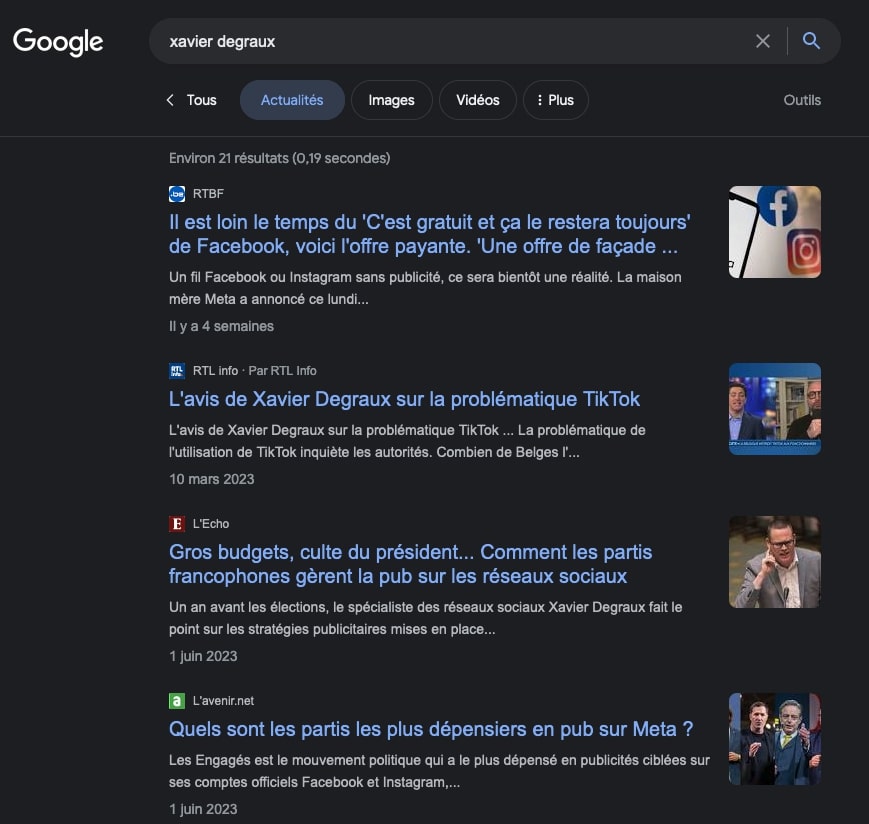
Thanks to his online presence and the qualitative content he regularly shares, Xavier is perceived as the LinkedIn and social networking expert in Belgium. So it's only logical that he's very active on LinkedIn and implements all the best practices.
Thanks to this expertise, when the traditional media need an opinion, the first person they think of for an interview is Xavier. It's easy to see from Google News just how regularly he's in demand:
If you were a company looking for a social networking consultant, who would you contact - someone who's been on TV for their expertise, or someone more anonymous?
Developing a personal brand is not self-promotion
Navigating between developing an authentic personal brand and avoiding excessive self-promotion can be a challenge. Authentic personal branding focuses on sharing values, experiences and expertise to create a real connection with the audience. It involves sincere communication, engaging storytelling and a willingness to provide value to others.
In contrast, excessive self-promotion can appear as a one-sided effort to attract attention, often focused on self-glorification rather than creating value for others. Balance lies in the ability to share one's successes and skills in a way that benefits and inspires others too.
Existing, contributing
Personal branding is important to professional identity, offering many opportunities to stand out, establish authority, and connect with an audience.
As the digital world continues to evolve, the ability to build and maintain an authentic and respectful personal brand will become increasingly valuable.
The key to success lies in balancing authentic presentation with measured promotion, always remaining true to oneself and bringing value to one's audience.
NB: In this article, we've tackled the issue of little-known people. Politicians, sports stars, music stars and movie stars need a different approach, as they are already well known.
Banana leaves, which have long been used for gastronomic and clothing purposes, need to come back into the spotlight in view of the ecological issues at stake. In fact, given their importance, we need to raise awareness of their importance and reforest banana trees.
The position of principal is unique. He or she is a middle manager who directs the staff of a school while responding to the demands of other public bodies. Although they do not have as direct a relationship with the students as the teachers, their attitude is crucial to the success of the children. By establishing a healthy work environment, he or she enables a rewarding pedagogy.
If web radios are considered to be part of the mass media used within organizations, they can also contribute to innovation and accompany transformations.
The conditions are right to encourage the emergence of sudden creativity as a team, and it's often specific preparation and work on common ground that matter most.
Our biases reassure us in times of peace, but disarm us in times of upheaval. By adopting an intellectual vigilance, we transform the illusion of unpredictability into an opportunity for adaptation. The future is not to be foreseen in its entirety, but faced with an open mind, to navigate a world of Black Swans with greater wisdom.