The Tao Way is a fluid path. It moves like water. What is the movement of water? Or a river? Movement knows a few nice things about itself. One, it always moves towards depth, it always seeks the lowest ground. It is non-ambitious; it never aspires to be first, it wants to be last.
Lao Tzu
The power of internal energy arts
The word Qi Gong is composed of two Chinese characters: the "Qi" character (氣), which translates as "air, vapor, energy", and the "Gong" character (功), which means "discipline, will, exercise, work, labor". The first written traces of Qi Gong come from silks found in a Huan dynasty tomb called Mawangdui. These silks depict a series of figures, of all ages and sexes, performing stretching movements. This was the first form of Qi Gong to include physical exercises and body gymnastics. It's called Daoyin (leading and stretching).
Qi Gong is a bodily practice, an "internal energy art" that promotes understanding of human energy mechanisms. Modern Qi Gong began to take shape in the 50's, with the encouragement of the Chinese Communist Party and Mao, who saw it as a counterpoint to Western medicine, while ridding it of its Taoist religious connotations. Qi Gong was then organized into Curative Qi Gong in health centres and Garden Qi Gong in the 70's. By strengthening its economic ties with China, the West began to take an interest in these practices in the 60s.
From then on, its pedagogical applications, particularly in collective intelligence facilitation, were introduced into personal development practices, before sliding into professional training and facilitation. Qi Gong practice opens us up to our own inner spaces, allowing us to experience the inner spaces of other practitioners in physical presence.
Several benefits can be identified. Qi Gong harmonizes energy. According to Qi Gong expert Ken Cohen (1999), the practice promotes energetic balance, creating an environment conducive to collaboration. For Jon Kabat-Zinn (2009), meditation combined with Qi Gong improves concentration and mental clarity, essential for collective thinking. But the benefits of Qi Gong don't stop there: the tranquility produced by Qi Gong practice reduces stress and, according to Herbert Benson (1975), even promotes a relaxing climate more conducive to creativity. It is probably in strengthening presence that facilitators will make the most progress. Joan Halifax (1975) points out in "Being with Dying" how mindfulness, encouraged by Qi Gong, can reinforce presence in collective interactions.
Many Qi Gong practices put us in collective rhythm and help us to perceive a vibration. In this way, the specific rhythm of Qi Gong, the gentle sequence of steps, warm-ups and the realization of forms is an experience of cardiac coherence that will make communication more harmonious within the group. (Braden, 2015). Psychologist Daniel Goleman (2008) talks about how the regular practice of Qi Gong promotes the development of empathy, a key element of collective intelligence. The fact that Qi Gong is practiced in silence enhances non-verbal communication. According to Paul Ekman (2004), mastery of breathing and body movement in Qi Gong improves our ability to read each other's bodies and express nuances, as well as keeping us supple and fresh.
"By making your body breath (or shen qi) and your primordial breath (or jing qi) embrace Oneness, can you become a child again?" Dàodéjīng 10
Synchronized exercises and forms performed by all practitioners together reinforce the social cohesion essential to group dynamics. Experiencing the same movements on a regular basis brings people closer together. The choreographic forms of Qi gong unite inner and outer ballet; minds and bodies dance together, swaying in the same gesture and breath (Janssen, 2006). As for Peter Senge (1990), author of "The Fifth Discipline", he stresses the importance of active listening in collective intelligence and how Qi Gong helps cultivate this skill. William Isaacs (1999), in "Dialogue and the Art of Thinking Together", suggests that the presence practices of Qi Gong facilitate collective decision-making processes.
Beyond the virtues of Qi Gong identified by the Scientific Research Society on Qi Gong of China (SRSQC), the health and well-being benefits of Qi Gong are corroborated by concepts and research from psychology, neurology and communication. What is an age-old Chinese intuition has been demonstrated by the latest scientific research, and its contribution to the development of collective intelligence is well established.
Qi Gong in practice
Here's a description of 3 practices for developing collective intelligence by mobilizing the body.
1. Harmonious breathing (breathing Qi Gong):
- Root yourself in a stable posture.
- Initiate deep, regular breathing, synchronizing your movements with inhalation and exhalation.
- Visualize energy flowing through your body, promoting mental clarity and concentration.
- Gradually increase the duration of your practice to reinforce your ability to maintain a centered posture during collective intelligence exchanges.
2. Raising energy (Heavenly arms Qi Gong):
- Start in a stable basic position, with feet shoulder-width apart.
- Slowly raise your arms to your sides as you inhale deeply, visualizing rising energy.
- As you exhale, gently bring your arms back down, releasing tension and promoting a calm presence.
- This practice strengthens your ability to maintain an open, receptive posture, essential for facilitating collective intelligence collaboration.
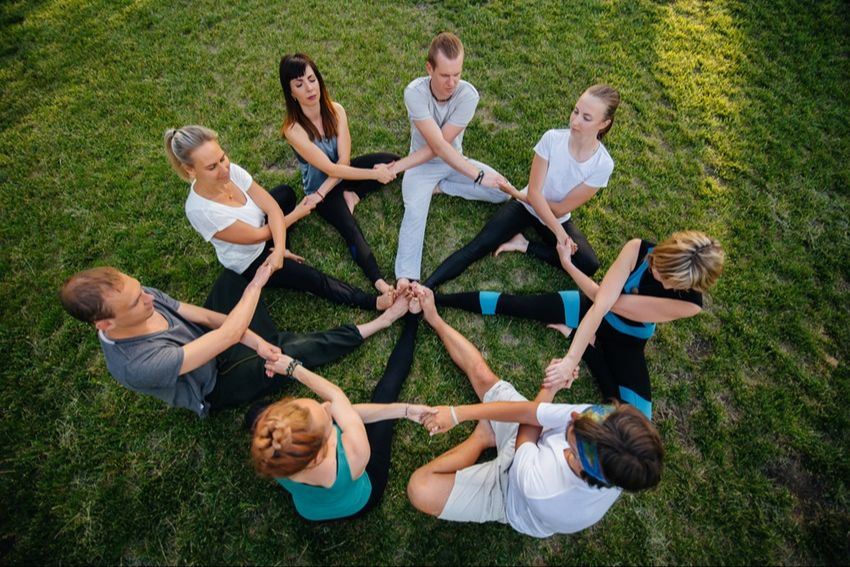
3. Energy circle (Qi Gong of harmonious unity):
- Form a circle with other practitioners, each representing a unique energy.
- Follow slow, coordinated movements, strengthening the energetic connection within the group.
- Incorporate moments of stillness to cultivate collective awareness and group synergy.
- This practice promotes collective intelligence facilitation by developing the ability to harmonize individual energies within a coherent whole.
Photo : ASMedvednikov.mail.ru / DepositPhotos
Sources
Origin and history of Qi Gong from ancient times to the present https://qigong-paris.fr/origine-et-histoire-du-qi-gong-de-lantiquite-a-aujourdhui/
La main de chine http://www.lamaindechine.com/modules/qigong/qigong-histoire.php
Wikipedia Qi Gong https://fr.m.wikipedia.org/wiki/Qi_gong
FFAEMS The pedagogical relationship in Qi Gong practices Taichi meditation and Chinese martial arts https://www.ffaemc.fr/yimag/la-relation-pedagogique-dans-les-pratiques-du-qigong-taichi-meditation-et-arts-martiaux-chinois/
Cohen, K. S. (1999). The way of qigong: The art and science of Chinese energy healing. Wellspring/Ballantine.
Kabat-Zinn, J., & Hanh, T. N. (2009). Full catastrophe living: Using the wisdom of your body and mind to face stress, pain, and illness. Delta.
Benson, H., & Klipper, M. Z. (1975). The relaxation response (p. 240). New York: Morrow.
Halifax, J. (1997). Being with dying. Sounds True.
Braden, G. (2008). The divine matrix: Bridging time, space, miracles, and belief. Hay House, Inc.
Isaacs, W. (1999). Dialogue: The art of thinking together. Currency.
Goleman, D., & Boyatzis, R. (2008). Social intelligence and the biology of leadership. Harvard business review, 86(9), 74-81.
Peter, S. (1990). The fifth discipline. The Art & Practice of Learning Organization. Doupleday Currence, New York.
Ekman, P. (2004). Emotions revealed. Bmj, 328(Suppl S5).
Braden, G. (2015). Resilience from the Heart: The Power to thrive in Life's Extremes. Hay House, Inc.
See more articles by this author