SEGAE: agricultural challenges turned into a playful experience
A solution for European agricultural training
The question of balancing sustainable development and the economy lies at the heart of all professional activities, including agriculture. Farmers need to be able to make a living from their operations, provide sufficient food and also reduce the sources of pollution and other practices that weaken the soil, air and water. Agroecology is therefore an approach that needs to be taught, particularly in Europe.
A game adapted to the training of tomorrow's farmers
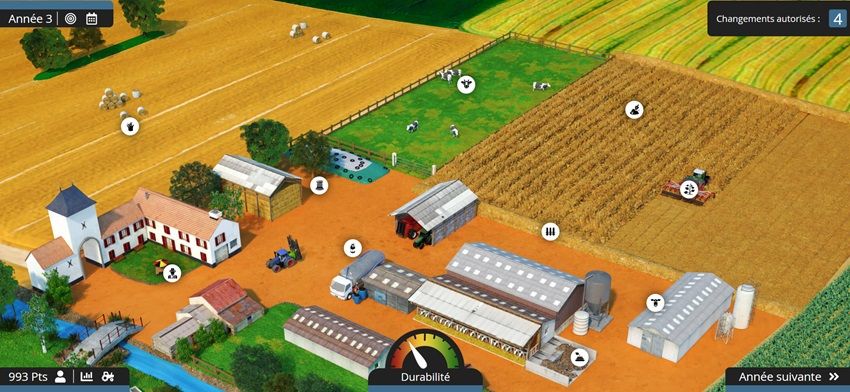
So, 6 universities offering agricultural training in different EU countries got together and, thanks to ERASMUS + funding, created the serious game SEGAE (Serious Game AgroEcology).
The idea was to offer trainers across Europe a fun approach to teaching about agricultural development from an ecological perspective. Teachers who register will be able to create their own experience and submit it to their students. The game is available in 6 languages: French, English, Dutch, Italian, Polish and Spanish.
Otherwise, there are already 4 scenarios plus a sandbox for experimentation. The idea is to take a farm in a given country and, each year, make up to 5 changes in different sectors.
The aim is to improve productivity and environmental performance while remaining profitable. It's a tricky business, and one that requires systematic reflection every year. All the more so as certain choices cannot be changed once they have been made. An experiment with simple mechanics, but complex to tackle, which will therefore be an interesting tool for students aiming to work in the agrarian field.
Theater remains an opportunity to recreate the world, for better or for worse, identically or differently, but always from a different point of view. It can educate, relax, entertain, move; it can also precede change and open us up to other ideas. Here are some excellent contemporary theater resources.
Motivation is a key factor in a child's success in learning to read, and readers are more likely to be interested in texts that reflect their personal experiences. But this is not enough. For imitation to become deep motivation, the child must be given the freedom to construct his or her own reading project. In this article, I present you with some tried and tested tips for naturally stimulating your child or young person to read for pleasure.
Crawford invites us all to reflect on the meaning of our work. No doubt we won't all make decisions as radical as his. But in these times of crisis, it can be salutary to remember that repair jobs provide satisfaction and a decent income, whereas many so-called intellectual tasks are in fact nothing more than mechanical operations paid by the slingshot.
Teaching the basics of economics seems essential. Children need to understand how the principles of saving, withdrawal, credit, etc. work. Some believe children should be taught the stock market and speculative investing. The United States has proven that there are all sorts of educational tools to do this. However, what about teaching the risks of such devices?
A significant portion of new Quebec teacher candidates drop out in their first year, sometimes even during teacher training. What is it that makes young teachers feel that they will no longer make a career of it? Is it the gap between theory and classroom reality? Or a lack of support from experienced staff?