The cost of training
On average, a year of university study costs between €10,000 and €15,000 per year, depending on the discipline and study conditions. Distance learning obviously costs less than in-class training, and technical training with laboratories is usually more expensive than essentially theoretical training.
Even if the cost of education is only partially passed on to students as a matter of accessibility, the real cost must still be borne by the state, and this calculation evolves with society. When it comes to setting investment and spending priorities, the overall education funding equation is taken into account. Whether for a student or for the state, the same parameters are considered, but weighted differently.
For the student, the question is: is it better to continue his or her post-secondary studies, or is it better to start working and possibly studying part-time, even if it means completing the degree later?
For the state, the advantage of developing a skilled, versatile and specialized workforce ensures the economic resilience essential to prosperity... and to its tax revenues. The higher the productivity, the better. To achieve this, we need both to guarantee basic training for the entire population, which enables versatility, and to ensure the supply of specialized training according to the needs of society and the orientations chosen by the State.
Study or work
If education is heavily subsidized, it is logically advantageous for a student to take advantage of the "study grant", i.e. the part of education paid for by the State. The income gap between a university graduate and someone without a post-secondary diploma is on the order of 40-60%, in all countries.
Even if this gap tends to narrow as the supply of graduates increases and the scarcity of knowledge diminishes, it remains large enough to justify the extra 3 to 5 years of study for a student.
To subsidize studies or not
For the state, the calculation is more sophisticated, taking into account the needs of workers and society in general. It's accepted and proven that, up to secondary school level, universal and free education, including for most vocational courses, is the most advantageous formula. As for specializations, it's also clear that we need to invest in them, even if the return on investment takes longer to achieve and is riskier in a context of rapid change.
Here's an overview of the benefits of studying or working. These are averages based on average salaries and taxes. As living costs are the same whether you're studying or not, they are not included, nor are the costs of any loans required to pay for your studies, or the income from a part-time job for a student.
Wage differentials between a post-secondary graduate and someone without a diploma are also based on current averages. A portion of the cost of education, corresponding to the average fees charged by institutions, is assumed by the student. The portion assumed by the State corresponds to the average cost of a post-secondary student in the State budget.
Opportunities for salary progression are generally higher for graduates, as they continue to train more frequently after graduation, but these opportunities also exist for non-graduates, so this factor has not been considered in the table.
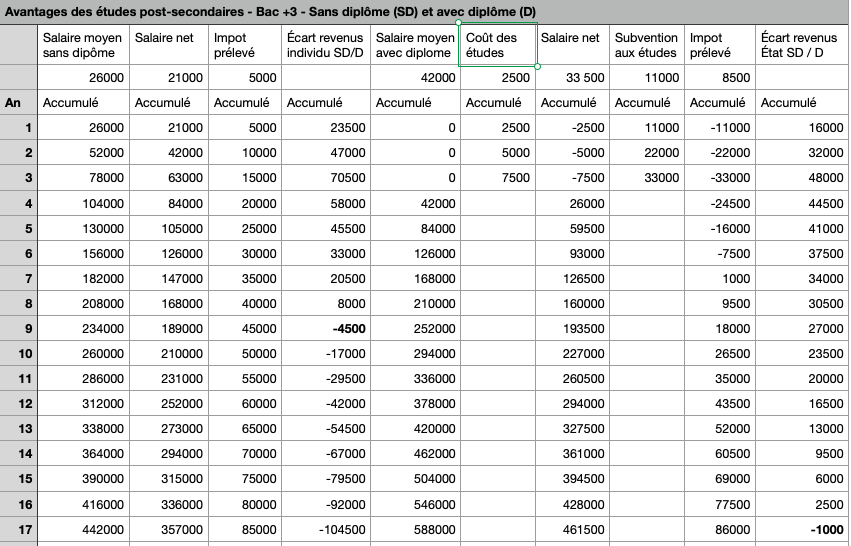
What we can deduce from this is that a student in a country where education is heavily subsidized makes a profit around the 10th year after starting university studies, and after 17 years the financial advantage is around €100,000; it pays to study, no doubt about it.
For the State, it's around the 18th year that it finds its profit in terms of direct tax revenues. If we add to this the increase in productivity and the resulting value-added tax revenues, the economic advantage is much earlier.
Continuing education, an optimal strategy for institutions in 2024
As both the obsolescence of knowledge and the evolution of technology accelerate, the principle of continuing education becomes more and more attractive, as does the idea ofentering an in-demand job market earlier, with good salary conditions .
With a working week of 30 hours or less, completing post-secondary studies on a part-time basis is becoming a viable option, especially through hybrid or distance learning. And if the training is subsidized by the government, as is the case in many states and companies, you've got the best of all worlds.
In a context of shortage of specialized manpower and accelerated job specialization in many sectors, the idea of 3 or 5 years' training before becoming operational is not really attractive. We need skilled workers now, in A.I., robotics, the environment, renewable energies, construction, social animation, health and many other rapidly evolving fields. Considering the time it takes to create programs, conventional university training will be constantly out of step.
Continuing education can respond more reactively to needs, and more rapidly integrate new practices, tools and technologies adopted in practice environments. The transformation of universities towards online and continuing education is becoming more widespread, out of necessity.
Almost all universities are expanding their continuing education offerings, whether in the form of one-off courses, mini-programs or complete programs. France's FIED presents the programs available by distance learning. Most universities now offer online courses, and some, like Université Laval, offer an online version of all their courses, in addition to fully distance universities like Téluq.
State orientation
For the State, the choice to favor flexibility in education seems an obvious orientation, especially with the pressure that artificial intelligence is putting on the methods of the education system.
At higher levels, the form of education is called upon to evolve in response to the rapid pace of change and the multiplication of needs.
But institutions will rise to the challenge of adaptability if they are given the opportunity to do so, outside a rigid framework.
Illustration: [email protected] - DepositPhotos
References
In 2019, the average cost per student is 11,530 euros - French Ministry of Education
https://www.education.gouv.fr/en-2019-le-cout-moyen-par-etudiant-est-de-11-530-euros-322990
It pays to learn - Bank of Canada
https://www.banqueducanada.ca/2020/10/apprendre-cest-payant/
Yes, you have time and money to study - Téluq
https://jereussis.teluq.ca/oui-vous-avez-du-temps-et-de-largent-pour-etudier/
Institut de la statistique du Québec - Educational attainment and employment income - Stéphane Crespo
https://statistique.quebec.ca/fr/fichier/niveau-de-scolarite-et-revenu-emploi.pdf
Average salary for a person with no diploma in 2024 - France - Talent
https://fr.talent.com/salary?job=sans+dipl%C3%B4me
What are the salaries of young graduates in France?
https://www.studyrama.com/emploi/premier-emploi/salaires-jeunes-diplomes
Distance learning and online courses in France - FIED
https://www.fied.fr/rechercher
Université Laval - Online courses - https://www.distance.ulaval.ca/
Télé-Université - https://www.teluq.ca/
See more articles by this author