How do you get a robot through a crowd? Public cobotics arrives at INRIA
Crowdbot, a consortium coordinated by Inria, is looking at how robots move in public places and crowds. They are expected to behave in a civilized manner.
Publish at May 02 2024 Updated May 02 2024


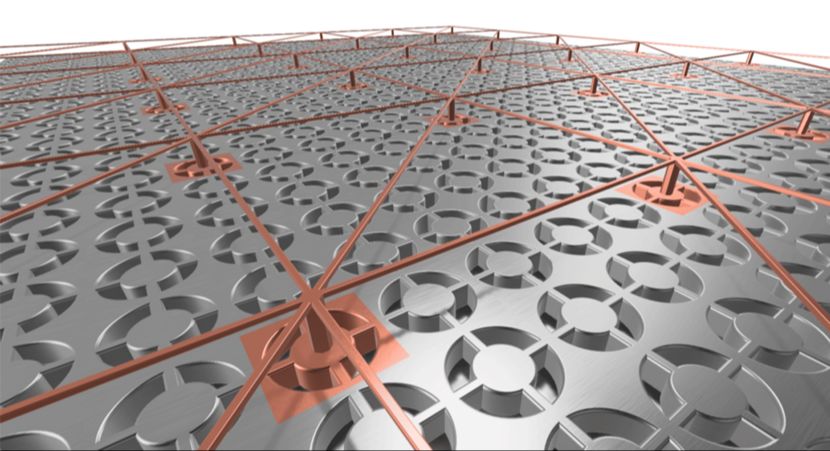
To soundproof a plane or a truck, we use materials that must have five characteristics:
To achieve this, we use a set of materials with a periodic structure that can block most frequencies. The problem is that they become less and less effective at low frequencies, below 300 Hz, which are the most damaging.
Christophe Droz, a member of theI4S (Inference for Structures) team at the Inria Centre at the University of Rennes, is exploring the possibility of moving away from the concept of periodic materials via meta-materials designed to interact at a distance and better absorb these vibrations. Such phenomena are observed at the quantum and magnetic levels, and the challenge is to reproduce them at the macroscopic level.
To achieve this, simulators are used to test thousands of hypotheses and configurations, leading to prototypes derived from theory.
"We don't know how far we'll be able to go. But the important thing is to develop original, usable vibro-acoustic phenomena, based on these new concepts. If this works, we'll have a corpus of methods, results and metrics to take things further. We can then try to scale up, and move on to experimentation with industrial partners."
For the full article: A new concept in acoustic insulation for transport
Illustration: © Inria / Christophe Droz - I4S team

Domaine de Voluceau
Rocquencourt - B.P. 105
78153 Le Chesnay
France
Tél.: 33 (0)1 39 63 55 11
You might also like:
How do you get a robot through a crowd? Public cobotics arrives at INRIA
Crowdbot, a consortium coordinated by Inria, is looking at how robots move in public places and crowds. They are expected to behave in a civilized manner.
Agriculture and Digital - White Paper
Understand, control, prepare, equip and support the deployment of digital technology in agriculture and the food chain. Today's agricultural sectors must adapt to environmental issues (global warming, collapse of biodiversity, reduction of resources, etc.), ethical issues (respect for animal welfare) and also ensure the maintenance of a living rural fabric, based on attractive "family" agriculture.
Ensuring the transparency of automated administrative decisions
How can we ensure that administrative algorithms apply the law as interpreted by administrative legal departments, without distortion or approximation?
Tattoos against misinformation
When it comes to exceptional, extraordinary events, it becomes vital for professional photographers or researchers to be able to certify that an event or phenomenon really happened. Discreet technology makes it possible.
No matter how the Parcoursup criteria are weighted, we need to be able to justify the result and ensure that the rules are known and fair.