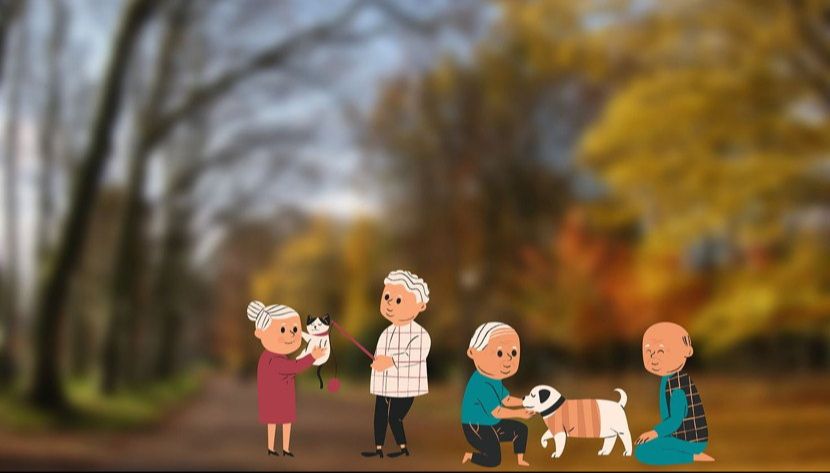
Animal doctors? Unthinkable, but true. If animals are known as human companions, it seems that sharing daily life with these beings improves the health of people suffering from mental deficiencies. In the 1950s, psychiatrist Levinson and many others experimented with pet therapy. Despite the positive results, in the absence of written documentation to back up certain experiments, it is difficult to attest with certainty that these therapies were animal-assisted.
With this in mind, Julia Boude, using the "Single case experimental design" method, proposes to analyze the effect of the dog's presence on the non-verbal communication of patients with Alzheimer's-type dementia, within the framework of a directed conversational workshop, with a view to obtaining a certificate of competence as a speech therapist.
1. Defining the problem and prior responses
In her work, Julia Boude poses the following problem: is the mere presence of a dog during a therapeutic activity sufficient to induce an effect on the non-verbal communication of elderly patients with Alzheimer's-type dementia?
To this main question, she assigns the following hypotheses: in the presence of the dog as part of a directed conversational workshop,
- The frequency of non-verbal acts during the turn increases;
- The frequency of non-verbal acts outside the speaking turn increases;
- Time spent speaking during the turn increases.
2. From determining the field of investigation to the choice of analysis tools
The author opted for a fairly small sample, comprising four (04) participants A, B, C and D, sharing certain parameters: being over seventy-five (75) years of age, homogeneity in terms of cognitive disorders, attraction to dogs, among others.
In the library room of the Centre Long Séjour, over a period of four months, the researcher, assisted by a speech therapist, gathered information relating to her research objective. Using a variety of equipment, the main ones being two cameras, open and semi-open questions, and a Grid for the Evaluation of Communication Capacities (GECCO) - which provides information on acquired and preserved capacities, facilitating patient management - Julia Boude evaluates the effect of introducing or removing the dog on communication, using non-verbal acts and speaking time as the unit of measurement.
3. General information on animal-assisted therapy for patients with Alzheimer's-type dementia
The need for animals in human life began with their domestication in ancient Egypt. They were used solely for utilitarian purposes. It wasn't until the 9th century that they were integrated into the hospital environment in Gheel, Belgium, given the multiple psychological benefits that contact with animals brings to human beings. In the West, for example, these beings seem to be gifted with the ability to fill an unmet emotional need, given their non-judgmental and retroactive nature towards human action.
Although humans are the only beings endowed with speech, this does not rule out the fact that animals also communicate. From this point of view, an exchange between the two categories of living beings is possible. It takes two forms: verbal and non-verbal, with the effect of soothing and establishing a climate of trust. This relationship of security that develops between humans and animals is the vein that zootherapists will exploit.
Treating patients with the help of an animal is all well and good, but only domestic animals are suited to this type of practice, such as dogs, as in the present work. The animal therapist, it must be said, receives special education and care to better assist Alzheimer's patients. Its intervention in therapy consists of giving it a task within the discussion group that encourages inter-species interaction, designed to trigger an increase in non-verbal gestures and speech time in patients with language disorders. In this study, Noisette, the dog, was in charge of distributing the basket containing the questions the patients were supposed to answer.
Alzheimer's is a disease caused by the excessive presence of tau proteins and amyloid state pesticides in the body, resulting in lesions in the brain and neuronal dysfunction. These lead to problems with memory, spatio-temporal orientation, language and even severe loss of autonomy, depending on the stage of progression of the disease.
There is an abundance of literature on the subject of human-animal interactions to limit the disorders caused by Alzheimer's, but most of it concerns children. However, work on adults also requires attention. One example is the study by Wesenberg et al. who found a marked improvement in patients' speaking time in the presence of a dog. What about this study?
Research results and conclusions
At the end of her analysis, the researcher found that :
- In the presence of the dog, there was an increase in the frequency of non-verbal gestures during the speaking turn in patients A and D, which was not the case in the other two. The above hypothesis is therefore partially validated;
- The presence of the dog did not modify verbal exchanges outside the turn and during speech;
- The dog's presence has no effect on turn occupancy.
These results do not call into question the benefits that pets can have on human health, otherwise cat bars would be worthless. This concept, which originated in Japan, offers customers the chance to interact with felines over a cup of tea, for example. According to Souter and Miller (2007), this interaction significantly reduces depressive symptoms. So it's a good tip to try out in midsummer. How about some purrson therapy?
References
Boude Julia, 2018, Impact de la présence du chien sur la communication non verbale des patients atteints de démence de type Alzheimer dans le cadre d'un atelier conversationnel dirigé : une étude en single case experimental design, Université de Strasbourg, online
https://psychaanalyse.com/pdf/IMPACT%20DE%20LA%20PRESENCE%20DU%20CHIEN%20SUR%20LA%20COMMUNICATION%20NON%20VERBALE%20DE%20PATIENTS%20AGES%20MEMOiRE%20(85%20Pages%20-%201,6%20Mo).pdf
Hediger Karin, Beetz Andrea, "Le rôle des interactions entre humains et animaux dans l'éducation", in "Une seule santé" édition Quae, pp 113-128, online https://books.openedition.org/quae/35995?lang=fr
https://www.decitre.fr/livres/one-health-une-seule-sante-9782759230969.html (free).
L'instant chat : le bar à chats unique du Var, online - https://www.youtube.com/watch?v=R5xYmvxY8d4
See more articles by this author