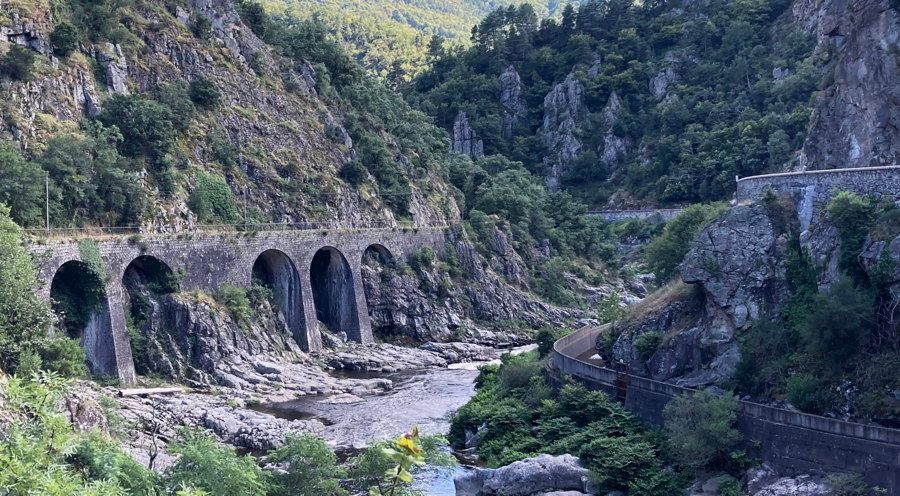
Among the most durable common materials, stone is almost without rival. Because of its abundance and availability, it has been used in construction for millennia; stone is naturally chosen for everything that is built to last: cisterns, pavements, harbour facilities, fortifications, mausoleums... the first stone temples have been dated at almost 12,000 years old (Göbekli Tepe)!
Bridges, aqueducts, quays, arenas, roads and Roman temples are still standing after 2000 years. Few human constructions stand up as well as those made of stone. But there's a difference between building a pile of stones like a pyramid or a dolmen and a work of engineering like an arched bridge or a cathedral. Many public infrastructures, roads, bridges, dams and embankments are still in use and diligently maintained.
A world of constraints
Stone does have a few appreciable shortcomings: it's heavy, it's irregular in both composition and properties, and it's generally tricky to cut. All these characteristics mean that humans have had to develop a range of techniques to create architectural constructions capable of standing the test of time and use.
The genius accumulated over the centuries is prodigious, and incorporates a level of observation that stretches over several lifetimes. For example, even if a building is built according to the rules, the ground on which it rests will not stop moving; so the best builders have developed techniques over the centuries, such as placing an interface of sand and gravel under the foundations to minimize the effects of deformation over centuries, or using flexible mortar to absorb vibrations during earthquakes, as mortar that is too rigid will fracture.
Engineering is all about directing stresses to achieve the desired effect. The slight inclination of the walls, the angle at which they are cut to allow water to run off, the shape chosen for the joints, the places to put ties, the choice of mortar, etc., none of the old techniques are obsolete, the weight of stone gives weight to traditions. The technical guides "La maçonnerie de pierre" (stone masonry) published by Quebec City and "Réparation et renforcement des maçonneries" (masonry repair and reinforcement) published by the Syndicat STRRES provide a good overview of modern maintenance and restoration practices for stone constructions.
Ongoing evolution
Stone-cutting is an art that has never ceased to evolve. To carve a stone stronger than all the tools at our disposal has required tremendous inventiveness on the part of human beings, such as using abrasives from the material to be carved, materials that swell with humidity, rotary hand tools, fire and, above all, lots and lots of perseverance.
Today, although traditional techniques are still applied in certain specific cases, stone is cut with diamond saws, pressurized water jets mixed with abrasives, ultrasonic vibration tools, lasers and even electric pulse fragmentation (EFT) tools. It's a far cry from the chisel and hammer of the traditional cutter, but his knowledge of angles of attack, crystallization properties and cutting methods is still relevant today.
Today's craftsmen
Stone buildings and infrastructures continue to be maintained, and new ones are still being built in stone, generally for aesthetic or heritage reasons. Municipalities are often in the front line, both in terms of authorizations and maintenance of stone constructions.
Professional associations such as STRRES (Syndicat NationaL des Entrepreneurs Spécialistes de Travaux de Réparation et de Renforcement des Structures) provide good advice and ensure that professional standards are maintained, while numerous professional training centers ensure that they are passed on.
References
The world's oldest temples - Cicitatis
https://www.civitatis.com/blog/fr/temples-anciens-monde/
Techniques
Construction prevention - Safe maintenance of masonry bridges
https://www.preventionbtp.fr/ressources/solutions/entretenir-les-ponts-en-maconnerie-en-toute-securite_BfDuHNLKSV94b5N8hwjsD8
Management and maintenance of bridges in France
https://fr.wikipedia.org/wiki/Gestion_et_entretien_des_ponts_en_France
Bridge inspection and maintenance
https://www.ginger-cebtp.com/inspection-des-ponts-et-maintenance-des-ouvrages-dart
STRRES (Syndicat NationaL des Entrepreneurs Spécialistes de Travaux de Réparation et de Renforcement des Structures) - http://www.strres.org/
STRRES Guides - http://www.strres.org/presentation_des_guides_strres-224fr.php
Masonry repair and reinforcement
http://www.strres.org/fichier-utilisateur/fichiers/FABEM/FABEM_6_3_V2.pdf
Ville de Québec - Heritage properties and buildings
https://www.ville.quebec.qc.ca/citoyens/propriete/maison_patrimoniale.aspx
Stone masonry (PDF)
https://www.ville.quebec.qc.ca/citoyens/propriete/docs/patrimoine/guide_tech06.pdf
Home care with Claude Lefrançois
https://soigner-l-habitat.com/murs-en-pierre-leurs-atouts-et-contraintes/
Stone construction - Abdel Basset - SlideShare
https://fr.slideshare.net/AbdelbassetBouteldja/la-construction-en-pierre
Training
CAP stone cutter - Onisep
https://www.onisep.fr/ressources/univers-formation/formations/lycees/cap-tailleur-de-pierre
Old buildings and eco-construction training center
https://www.formation-ecoconstruction.com/formation-maconnerie-pierre-seche-et-pierre-hourdee
Professions of the future - Bricklaying and masonry
https://www.quebecmetiersdavenir.com/formation/briquetage-maconnerie/
See more articles by this author